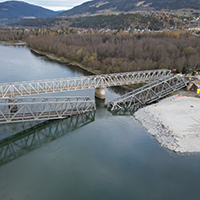
Pioneering international fire protection guidance being compiled by the International Association of Bridge & Structural Engineers is aimed at reducing the number of fire-related bridge collapses such as the most recent and devastating event in the USA in March.
“About as serious a transportation crisis as we can imagine,” was Atlanta mayor Kasim Reed’s comment on the incident on the elevated section of Interstate 85, which prompted the declaration of a state of emergency. The hour-long fire and subsequent bridge collapse closed off the north-south highway to the 250,000 vehicles that used it every day. As Bd&e went to press, the Georgia Department of Transportation contract to replace the damaged bridge, currently being carried out by by CW Matthews Contracting, had a completion deadline of 15 June with incentives of up to US$3.1 million on offer for earlier re-opening.
Given the huge potential for disruptive consequences from these types of incidents, however, it is surprising that so little fire-related guidance exists for bridge engineers or bridge owners wanting to prevent these types of incidents or, indeed, evaluate the damage once they have occurred. “We find that bridge standards don’t say anything about fire protection and that fire standards don’t say anything about bridges,” summarises Ignacio Paya-Zaforteza, chair of the recently-formed IABSE working group 12 on design of bridges against fire hazards.
The codes dealing with bridge design such as the Eurocode 1 part 2 and the AASHTO standards ignore bridge fires altogether. Fire design standards on the other hand, such as the Eurocode 1 part 1-2 (CEN 2002), focus on buildings and do not cover bridges. In fact the only standard containing some information on bridge fires is the US National Fire Protection Association’s 502 standard, which groups bridges and other ‘limited access highways’ with road tunnels. Here, the standard recommends some engineering analysis but does not provide any further detail.
The result of this situation is that because engineers don’t have the guidance to design against fires, when a fire does occur – and the conditions are right – the consequences can be significant, explains Paya-Zaforteza.
To believe that this type of incident is rare and that there is no need to consider it as a risk is to ignore the statistics. Collapses as a result of fires do occur and they do so with greater frequency than as a result of earthquakes.
The New York Department of Transportation conducted a bridge failure survey in 2008, gathering responses from 18 state departments of transportation. Data from 1,746 bridge failures revealed that although the vast majority of bridges – 1,001 - collapsed for hydraulic reasons and 520 collapsed due to collision, overload, or deterioration, 52 bridge collapses were due to fire, with only 19 collapses due to earthquake – and this included the seismic state of California. “What is interesting is that we design against earthquakes but not against fires. So the idea of the working group is to evolve this area and make international recommendations so that those who want to design bridges against the risk of fire at least have something to go on,” says Paya-Zaforteza.
Although little exists in the way of guidance and norms, the new working group will not have to start with a blank page. Paya-Zaforteza and colleagues around the world have carried out enough of the legwork in the form of literary reviews, statistical analysis and numerical models to identify the typical causes of fires and their associated damage levels. Open fire tests are also under way.
A summary of the current knowledge on fires in bridges was made in Paya-Zaforteza’s paper Fire hazard in bridges: review, assessment and repair strategies which he wrote in 2011 with co-authors Maria Garlock, Venkatesh Kodur and Li Gu. Based on a literature review, current knowledge related to post-fire assessment and bridge repair measures was collected to provide guidance on evaluating damage and establishing procedures for repair. One of the aims of the paper was to present engineers and researchers with sufficient practical knowledge to enable them to make fast, informed decisions following a bridge fire event.
Three ‘classic’ fire scenarios were then identified last year in a subsequent paper Detailed analysis of the causes of bridge fires and their associated damage levels, which analysed 154 cases of bridge fires between 1997 and 2015.
The most common collapse usually follows an accident under a bridge involving a large vehicle transporting flammable fuel. If the bridge is made of steel and concrete and the fuel catches fire underneath it, the likelihood is that it will collapse. This was the case with the MacArthur Maze Bridge fire that occurred on 29 April 2007, in the heart of San Francisco, California’s busiest freeway interchange. Direct costs for this incident were around US$12 million but the fire had an estimated economic impact of US$6 million per day, or US$90 million in total.
The second scenario again involves a tanker truck transporting flammable liquid, this time overturning on the bridge and spilling fuel onto vehicles underneath, which then catch fire. This scenario occurred on the Mathilde Bridge in the city of Rouen, France in October 2012 and led to the costly replacement of 40m of the 105m-long steel span.
The third scenario involves materials stored under a bridge catching fire, as was the case in the fire on the elevated section of Interstate 85 in Atlanta. The fire at I-85 was thought to be the result of arson in a secure area used by the state to store equipment and construction materials such as PVC piping. A homeless man has been charged with first-degree arson and first-degree criminal damage to property.
Due to the lack of readily-available bridges for live burns, most of the research on bridge fires is based on theoretical finite element models whose validity has not been checked experimentally. The exception is some back-analysis of previous incidents, such as a fire on the I-65 overpass in Birmingham, Alabama, USA in 2002. In this case, a numerical analysis showed that the model was able to simulate the response of the composite bridge and could be used as a basis for a performance-based approach for the design of bridges under fire.
Guidelines for numerical modelling of simply-supported steel girder bridges are now in the public domain, as are some of the revealing findings. These include the fact that the heating of the bridge causes very high horizontal reaction forces in the bridge deck hinges, very likely to cause hinge failure and reduce their capacity to restrain horizontal deck movement.
Fire scenarios where a burning tanker is close to an abutment have greater impact than under the mid-span because they result in higher temperatures due to the Coanda effect (the tendency of a fluid jet to stay attached to a convex surface) and shorter times to failure. Other results show that multi-span bridges have a better fire response than single-span bridges supported by full-retaining abutments, due to the better ventilation of the fire affected area and the lesser importance of the Coanda effect in the case of multi-span bridges.
In order to calibrate the numerical models; analyse the response of composite bridges to fire; and test specially-designed fibre-optic sensors, Paya-Zaforteza has initiated some open fire tests.
The first of two sets of tests have already been completed on the type of bridge most susceptible to a collapse, using the most damaging type of fire scenario – flammable liquid fire on the underside of a bridge. Paya-Zaforteza expects the paper which covers the work and its outcomes to be published in the next year.
Eight open fire tests took place last summer at the Universitat Politècnica de València, Spain, involving a 6m-long composite bridge with a number of sensors capable of taking measurements in temperatures of up to 1,230ºC.
“Monitoring the tests will enable us to evaluate with more certainty the damage suffered by the bridge during the fire. In addition, the tests will confirm our model’s assumptions are correct, and if not, it will enable us to calibrate them. Once calibrated we can use them to virtually ‘burn’ many bridges in a cost-effective way to better understand the phenomenon,” explains Paya-Zaforteza.
Although the full results are still under wraps for academic reasons, Paya-Zaforteza can reveal one surprise: “When we increased the fire load at the point where it was closest to the deck, the deck first deformed by a number of centimetres but then returned to its shape.”
The second set of fire tests is planned for later this year, when the fire temperatures will be increased to the point that the girder is unable to recover.
Also involved with the new working group is Panos Kotsovino, a fire engineer at consultant Arup who has been involved in a number of bridge fire-protection projects. These mostly relate to large projects where the fire protection aspect has been identified and linked to operational continuity, and where damage could lead to a significant period – six months or even a year – to reinstate the bridge. “Typically with this type of project the government is the client and they set the level of resilience, not just for fire but in general. Fire is starting to get into the picture but it is normally parcelled together with a number of risks,” he says.
“There is also the life-safety component, as some bridges may have staff working on them and it is important to reduce the risk to them and to the users – particularly in long-span bridges which would take a long time to evacuate.”
Fire protection for bridges comes in three forms, explains Kotsovino. First is the introduction of bridge drainage systems that are properly designed and maintained to prevent fuel spills accumulating under the structure. Second is a management mitigation system where the storage of flammable materials under bridges is forbidden, especially when the vertical clearance of the bridge is small. Thirdly, for strategically important bridges with significant tanker-truck traffic, further specific studies are recommended to ensure the adequate response of the bridge to a fire.
Such studies may conclude that a cable-stayed bridge should have fire protection wrapping around the sheaths of its cables to protect them from fire; on a steel girder, it may be a special fire protective paint or intumescent coating that insulates the girder from high temperatures for a specified time. “Other methods would be to introduce certain risk-management procedures, such as escorting tanker trucks, or only storing materials a certain distance away,” says Kotsovino.
The cost of adding fire protection to a bridge is relatively low compared to the overall cost of a construction project, points out Kotsovino, but at the same time there is no point in wrapping materials around all of the steel if the risk is low. “You need to do it knowingly, appoint someone that understands the potential fire hazards and can develop a solution.”
Depending on the level of resilience required, fire protection should start with a risk analysis and a cost-benefit study carried out by a specialist. Bridge engineers should also play a part, says Kotsovino, by raising the subject of fire protection at an early stage: “The client may not be aware of the technical details so it is up to the designer to ask the question: what type of operational resilience are you looking for in this bridge? Have you thought about fire? It should be discussed at the beginning, before design, because if it isn’t then it won’t be decided on.”
The issues around resilience and risk analysis also form an important part of the working group’s scope, explains Paya-Zaforteza, because although protecting bridges against fire may not be too expensive, the question remains: which bridges should be protected? “In the US, with all its highways and many steel and composite bridges, it would be too much to protect them all. That is why the risk analysis is so important.”
The working group’s goal is to publish a guide that not only identifies the most vulnerable types of bridges, but also outlines the measures that can be taken to protect them. It will also include simplified theoretical models that an engineer can use to identify whether a bridge is protected or not, “The current situation is problematic. Design codes do not deal with bridge fires, and the methods that can be used to analyse many of the problematic bridges are very complicated and require a very skilled engineer.
Therefore, we have to develop, propose and explain simplified design methods that can be used by the average engineer. This is not an easy task, but it is one of our goals. I must emphasise, some simplified methods have been proposed, but they do not work for all bridge types and a work of dissemination of these methods needs to be done,” comments Paya-Zaforteza.
The group also intends to produce a protocol that will help establish whether a bridge that has suffered a fire is repairable, a situation recently faced by engineers following the February 2015 fire on the 424m-long Lazienkowski Bridge across the Vistula River in Warsaw, Poland.
The fire on the 1970s-constructed full steel structure started on one of the three wooden service decks between girders and spread across three spans. Extensive investigations had to be carried out over a six week period to decide whether to repair or remove the bridge, which was used by up to 140,000 vehicles per day.
The final decision, based on many factors, was to replace it, and a new structure was completed seven months later. “I personally think that some concrete bridges could have been saved from demolition, but we still need more research to provide a more founded and scientific opinion,” says Paya-Zaforteza.
Publication of the guidance for designing bridges against fire hazards is expected in two to three years’ time.