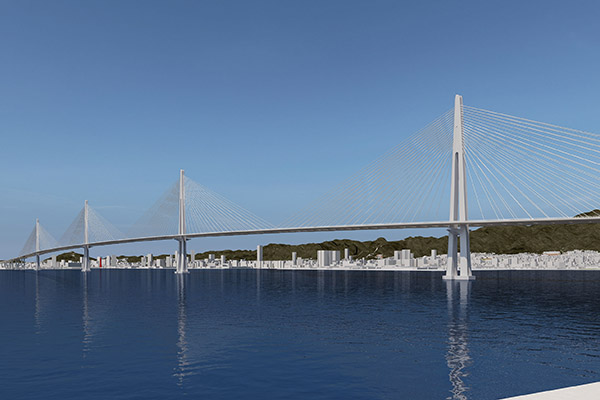
 Rendering of the Shinko-Nadahamakoro Bridge (Kobe Construction Department, Hanshin Expressway Company)
The Early Contractor Involvement method is to be used for the construction of the east and west sides of the 2.8km-long, six-lane sea bridge linking Port Island and Rokko Island across the Port of Kobe. The planned structure features three suspended spans 653m in length and will be the longest of its type in the world.
The record-breaking structure is part of the Osaka Wangan Expressway Western Extension (OWEWE) project that is being built by Kobe Construction Department of Hanshin Expressway Company jointly with the Kinki Regional Development Bureau of the Ministry of Land, Infrastructure, Transport & Tourism. Hanshin Expressway currently manages and operates 258.1km of (mostly elevated) highways in the Kobe and Osaka area.
The OWEWE project is a 14.5km-long bypass to the south of No.3 Kobe Route of Hanshin Expressway, Hyogo Prefecture, around 25km east of the 3,911m-long Akashi Kaikyo Bridge. Kobe Route is the busiest highway section in Japan and the new bypass will not only alleviate the traffic congestion on the Kobe Route but also reduce travel times between western Kobe and Kobe Port from 45 to 31 minutes, as well as between Kobe and Osaka from 96 minutes to 64. The route will also provide an alternative to traffic displaced as a result of control measures.
In addition to the four-tower cable-stayed bridge, the OWEWE project also includes a tunnel and a cable-stayed bridge to the west. The latter, which has been provisionally named Kobe-Nishikoro Bridge, will have a main span of 480m and is expected to become the world’s longest cable-stayed bridge with a single tower.
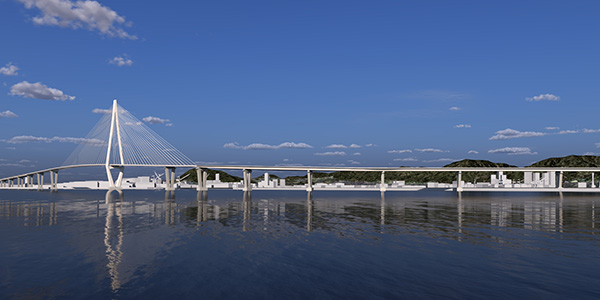
Render of the Kobe-Nishikoro cable-stayed crossing also being planned (Kobe Construction Department, Hanshin Expressway Company)
Regarding the four-tower cable-stayed bridge, the preliminary design for the proposed 2,739m crossing has been carried out by Dia Nippon Engineering Consultants under the supervision of Kobe Construction Department of Hanshin Expressway Company. It has been provisionally named the Shinko-Nadahamakoro Bridge because it is planned to span the Shinko and the Nadahama international shipping routes, which are 400m and 300m wide, respectively. Its navigational channels will be accommodated by the two outer spans of the three 653m-long main spans, which will provide a clearance for shipping of 65.7m and 54.6m.
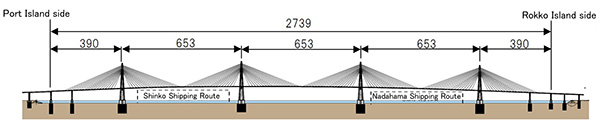
Side view of the Shinko-Nadahamakoro Bridge (Kobe Construction Department, Hanshin Expressway Company)
The four steel cable towers are A-shaped, and the highest tower is 213m. The cable-stayed system that is envisaged comprises 18 pairs of cables in a multi-fan shape on either side of the tower. They support a deck composed of two parallel steel boxes connected by transversal girders across a 12m gap.
The option of constructing a suspension bridge rather than a cable-stayed bridge was excluded from the middle of the project due to the conditions of the ground, explains Manabu Ito, director of the Kobe Construction Department of Hanshin Expressway: “If we had chosen a suspension bridge we would have had to construct anchorages at the ends of the suspension bridge which, at the nearby Akashi Kaikyo Bridge, are huge and located on rock. But the ground here on Rokko Island and Port Island is very different because it is manmade land, which is very weak.”
The bridge will require a large volume of steel: it is estimated that it will be 100,000t in total. “It is a huge amount for a single contractor to procure, and that is why we have divided it into two construction sections, the west side and the east side, and we will have two contractor teams,” comments Ito. The works will be divided at the midpoint of the central cable-stayed span, which neatly apportions around 50,000t of steel volumes to each contractor.
The Shinko-Nadahamakoro Bridge’s basic structure is the result of four main areas of study: bearing capacity of the main towers’ foundations; seismic considerations; wind resistance; and aesthetics in relation to the surrounding landscape.
The selected form features an A-shaped tower with a solid form at the upper section of the ‘A’, at cable anchor height; this then branches out into two legs that dissect the centre of the main bridge girder longitudinally; then, below bridge deck height, the two legs branch out yet again, resulting in a four-legged cable tower. “This A-shape was adopted to improve the main tower stiffness by shape in order to reduce the deformation characteristics of continuous cable-stayed bridges,” says Ito.
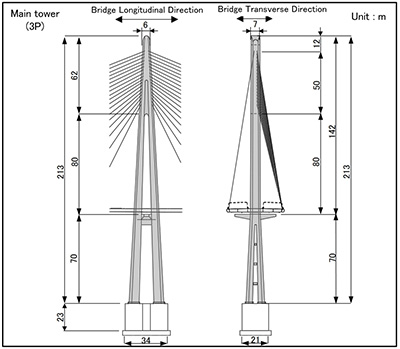
The main tower of a typical girder of the four-tower crossing (Kobe Construction Department, Hanshin Expressway Company)
The results of a preliminary study into ground conditions set out estimated ground bearing depths of a maximum of 52m for the four towers. However, subsequent ground loading tests and soil investigations showed that the ground was softer than expected and consisted of multiple layers of different types of sand and clay. To reach firm layers of Diluvium (older Alluvium) sand instead of clay, depths of up to 68m will be needed at the tip of the piles of the cable tower foundations.
To ascertain the seismic resistance required for the bridge’s main elements, the Active Fault Database of the National Institute of Advanced Industrial Science and Technology was consulted. This revealed that, in the vicinity of the bridge, the Osaka Bay Fault splits into the Wadamisaki Fault and the Maya Fault. “It is really unfortunate that we will construct the Shinko-Nadahamakoro Bridge where the Maya Fault is located,” says Ito, adding: “We could not adjust the location of the piers however because of the very large size of the international sea route.”
The seismic response of the main towers and bridge girders’ designs were tested using a 3D analytic model and the structural design was confirmed as being highly resistant. “The difficulty of the continuous bridge is that if the large earthquake happened, not only would one tower vibrate, but all the tower and all the girders would vibrate together,” says Ito: “So it’s very important to install isolation-type bearings to reduce the effects of the earthquake.”
Further 3D analytic modelling of the foundation was carried for the highest cable tower, Pier 3, due to its location directly above a section of the fault which has been displaced at a depth of between 1,550m and 1,750m, resulting in deformed sedimentary layers. “It is shaped like a curve and it adds a risk of deformation of the upper strata during an earthquake, which is why we had to focus on this for the seismic design,” explains Ito.
Resistance against local wind conditions as well as large-scale typhoons have also been verified through extensive testing. To design the cable towers, the designers first carried out preliminary wind tunnel tests using rigid models to compare the performance of various shapes, from which the dominant forms were extracted and further tested using cross-section profiles.
The design of the cross-section of the tower shows 35° chamfered corners at all outer-facing sides of the legs. “We adjusted the angle of the chamfers many times in the wind tunnel to excel the wind resistance required and ensure the shapes would not cause vibrations in excess of the limit values,” says Ito.
A similar level of detail went into the shape of the main bridge girder, which (as mentioned) is composed by two steel box sections connected by transverse girders. The preliminary design shows that the box girders have different cross-section profiles along their inward (towards the gap at the centre of the deck) and outward-facing sides. “The main feature of the cross section of this girder is that one side is square [and chamfered], and the other is triangular. We selected these shapes as a result of the wind resistance tests, which showed that this cross-section had superior wind resistance,” explains Ito.
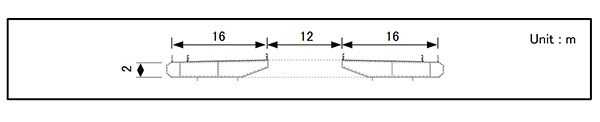
The cross-section of a typical girder of the four-tower crossing (Kobe Construction Department, Hanshin Expressway Company)
Thus far, wind tunnel tests have been conducted separately for the cable tower and main girder, but the intention is to test the two elements combined at the end of the design phase. “It is not easy to find a place large enough to conduct a wind tunnel test for the whole model,” remarks Ito.
While the bridge’s structure has been selected for its performance, a main driver for the overall design has also been aesthetics, which needed to respond to the design scope’s requirement for ‘harmony with the urban landscape of Kobe’ as well as bridge appearance as viewed by drivers.
Consequently, there are a number of architectural design touches that aim to create a bright and modern impression. These include the use of concave lines along the wider sides of the tower legs and an indented section at the upper solid section of the cable tower.
In addition, a colour palette has been outlined that determines a precise hue of beige for each structural element of the cable-stayed section, and one that is planned to be replicated at the Kobe-Nishikoro Bridge plus the viaduct sections on Port Island and Rokko Island.
As regards construction of the bridge, Ito says whatever method is used will have to ensure that the shipping lanes remain open throughout. The contracts for the Shinko-Nadahamakoro Bridge were put to tender in November and follow the Early Contractor Involvement delivery method, which is unusual in Japan, explains Ito: “Normally detailed design is conducted by the design company and then the contractor will come. But in this method, contractor will come very early in the process. At the detailed design phase we will invite the contractor to become involved and assist in reaching the optimal proposal.”
The contractors with the best technical solution will be identified in autumn this year, after which a detailed design phase of around 30 months will take place, followed by the fabrication of the steel elements.
Another unusual aspect of the Shinko-Nadahamakoro Bridge is that a separate tender is to be issued for the construction of the foundations for the cable-stayed structure. “As a critical point of the terms of the construction work, the foundations will be the responsibility of the Kinki Regional Development Bureau of the Ministry of Land, Infrastructure, Transport & Tourism,” explains Ito, “and they will carry out a separate tender process.” The expectation is that by the time the superstructure has been fully designed and its elements fabricated, the foundations will be complete.
According to rankings of its type (as of November 2023), when finished the Shinko-Nadahamakoro Bridge will become the longest continuous cable-stayed bridge in the world. It’s maximum spans of 653m would be greater than the 650m-spans of the triple-towered Queensferry Crossing in Scotland, the 616m of the three-tower Erqi Yangtze River Bridge, and the 560m-spans of the four-tower Rio-Antirio Bridge in Greece. Its 65.7m of clearance for navigation would also make it the highest in the country, a full 0.7m above its nearest competitors, which include the nearby Akashi Kaikyo Bridge and the 3.2km-long Minami Bisan-Seto Suspension Bridge.
An estimated date of construction has yet to be decided.
The Shinko-Nadahamakoro Bridge (provisional name)
Client: Regional Development Bureau of the Ministry of Land, Infrastructure, Transport & Tourism and Hanshin Expressway Company Limited