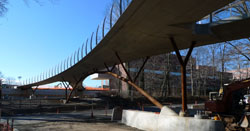
Two bridge deck overlay replacement projects that have been under way in the Netherlands this summer represent the culmination of a major research effort into solving problems with fatigue damage to steel deck bridges.
Projects to rehabilitate the Hagenstein bridges on the A27 near Vianen and the Moerdijk Bridge on the A16 near Breda, which started this summer, are the first large-scale application of a new concrete overlay system that is intended to solve problems with fatigue on such structures.
Serious damage to the bascule of the Van Brienenoord Bridge on one of the main highways in the Netherlands several years ago resulted in a special task force being formed within the civil engineering division of the Dutch Ministry of Transport, Public Works & Water Management. The aim was to investigate the cause, to understand and control the fatigue mechanism for the 80 steel fixed and movable bridges in the Netherlands and to develop practical solutions for their cost-effective rehabilitation and renovation.
A major research project has been carried out over the last six years, including a pilot project in 2003, to try and develop a new high strength concrete wearing course for orthotropic steel bridges which can also extend the service life of the total construction by solving fatigue problems in specific deck details. The resulting solution is very promising since it turns the deck plate into a much more rigid construction with a higher 'plate factor' due the monolithic composite interaction between the reinforced high performance concrete overlay and the steel deck plate. The overlay, with a minimum thickness of 50mm, has been found to reduce stress by a factor of four to five in the deck plate and three to four in the trough wall, extending the service life of the orthotropic bridge deck by a matter of decades without additional maintenance.
Developments in concrete over the last few decades have resulted in high performance concrete of 100-155MPa and even ultra high performance concrete, which can be higher than 400MPa. Much higher strengths can be achieved by a further densification of the cement matrix combined with an additional pressure and heat treatment during setting and hardening.
But HPC and UHPC are also very brittle, so it is necessary to use a large amount of aggregate in the matrix and, if possible, reinforcement with fibres and rebar. This composite or hybrid material is known under the acronym 'compact reinforced composite' and the CRC principle makes it possible to very accurately predict the behaviour of buildings of all sizes under different loadings, especially when scaling up from small models. Heavily-reinforced ultra high performance concrete seems to have extremely good fatigue resistance even under continuous high loads.
One of the first large applications of reinforced high performance concrete overlay was as a white topping on damaged pavements and industrial floors and in cargo ships. The properties of the overlay make it possible to place the overlay as an 'independent' topping or wearing course on a cracked and/or polluted sub-base or even on an under-dimensioned sub-base made from different materials like asphalt concrete, concrete, wood, ceramics or steel. One or more layers of welded mesh reinforcement are included, and the concrete mixture contains both steel fibres and acrylic fibres based on a special composite of pre-blended materials.
The standard setting time of the mixture is more or less equal of that of a traditional concrete mixture and likewise depends on temperature and relative humidity, although accelerators can shorten the setting time. After curing for approximately 24 hours at 20oC, the overlay is ready for use. Due to the large amount of welded mesh reinforcement and steel fibres, the hardened overlay is able to withstand a certain amount of restrained deformations from the base without the occurrence of surface cracks.
RHPC overlay is a combination of an HPC strength class C110 (based on special pre-blended materials and reinforced with both steel fibres and acrylic fibres) and welded mesh reinforcement. The mesh reinforcement is placed on an 8mm diameter rebar used as a spacer. Thus, the total amount of reinforcement is approximately 24kg/m2 of traditional reinforcement and 5kg/m2 of steel fibres. The total thickness of the RHPC overlay is in this specific case 50mm and the concrete cover on the reinforcement is thus only 18mm. If the thickness of the layer were to be increased, the reinforcement could be adjusted if necessary. To replace the existing wearing course with a RHPC overlay, the bonding between the steel deck plate (thickness 10 to 12mm) and the overlay is of crucial importance to secure total deck rigidity and a uniform monolithic behaviour under all circumstances. For that reason, initial research focused on creating a bonding zone that met all requirements - one that could easily be created by connecting the mesh reinforcement and the steel deck plate by welds, but this might result in undesirable local peak stresses. The best bonding method turned out to be the use of a two-component epoxy-based adhesive with broadcast bauxite aggregate. After hardening of the epoxy, the overlay is cast and the surface shot blasted. No additional wearing course is applied.
As well as research on relatively small samples it was also necessary to perform tests on full-scale structural elements under different loading conditions. Several associated projects at different institutes such as the civil engineering division of Contec, Delft University of Technology and TNO Building & Construction Research, were carried out to investigate and document the material's properties and behaviour, and this research is still going on. The behaviour of an orthotropic bridge deck with bonded RHPC overlay is completely different from an orthotropic bridge deck with a traditional surfacing, due to the much higher stiffness, so more investigation is still required, including detailed finite element calculations.
Tests proved that the intended application of RHPC overlay was a very promising solution for rehabilitation of orthotropic steel bridge decks - both durability and strength were found to be adequate. In 2003 a pilot project was carried out on the Caland Bridge to test the logistics of the process. The pilot project was on two traffic lanes with a width of 6.7m and a length of 80m. The whole project had to be carried out in just six days including rerouting of the traffic, removal of the asphalt wearing course, inspection and repair of the deck plate and the application, hardening, curing and shot blasting of the RHPC overlay. After the removal of the wearing course, a tent was placed to protect the whole area from the weather. 'Time of flight diffraction' inspections were carried out to investigate if there were critical cracks in the deck plate that had to be repaired. This is a very reliable but time-consuming technique and must be done on a bare steel deck. When the inspection was finished at the edges, prefabricated steel L-profiles with dowels welded on were placed in a two-component epoxy paste adhesive with fillers. These L-profiles were necessary to avoid 'curling' of the RHPC due to traffic loads, shrinkage, temperature loading or local debonding. Once all the inspection was finished, the whole deck plate had to be shot-blasted again to remove the corrosion film. The two-component epoxy paste adhesive was placed on the deck plate and calcinated bauxite 3-6mm was sprinkled on. Due to the very low temperature