
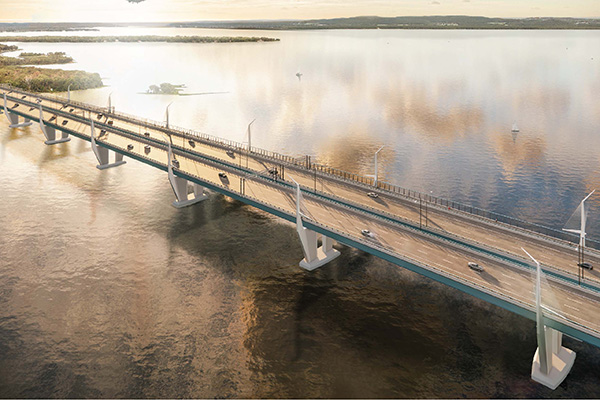
The new bridge features twin carriageways flanked by six piers topped with sail-like masts that evoke wings in flight
When the ageing Île-aux-Tourtes Bridge – a vital link to Montréal for nearly 60 years – reached the end of its service life, planners embraced innovation over replication, opting for an elegant, resilient crossing designed to serve for the next century. Since opening to traffic in 1965, the bridge has carried the Trans-Canada Highway across Lac des Deux Montagnes (Lake of Two Mountains) in Québec, accommodating approximately 81,000 vehicles per day and functioning as an indispensable artery for commuters and commercial transport. While successive rehabilitation efforts extended its lifespan, progressive deterioration ultimately made full replacement unavoidable. Following an extensive evaluation of alternatives, the Ministère des Transports et de la Mobilité Durable du Québec elected to pursue a complete rebuild – a decision that would redefine the corridor with a modern, resilient and visually striking design.
Ambitious in both scale and intent, the project involves building two parallel bridges just north of the existing crossing, followed by the full dismantling of the original structure, and the integration of a new multiuse pathway that includes a new footbridge along the westbound bridge. Each new bridge stretches roughly two kilometres along a gentle, sweeping horizontal curve and comprises 24 spans ranging from 61 to 90m. Together, the twin structures mark a decisive shift away from the purely utilitarian character of their predecessor, blending advanced engineering with a strong architectural expression. This integrated approach has enabled the project team to uphold a high standard of quality while meeting an aggressive schedule.
The contract was awarded to the Construction Nouveau Pont Île-aux-Tourtes consortium – Flatiron Dragados Canada, Roxboro Excavation and Construction Demathieu & Bard. TYLin, bridge structural design lead, is delivering the detailed design and construction support services with Hatch.
Construction for the design-build-finance project began in spring 2023. The westbound bridge is scheduled to open by the end of 2026, followed by the eastbound structure in 2027. Demolition of the existing bridge is planned for 2029, with the overall project concluding in 2030. The construction budget stands at approximately US$1.6 billion (CAD$2.3 billion). As of late December 2025, the project remained on schedule.
The new design bears no resemblance to its predecessor. The original structure – a straightforward concrete girder bridge supported by standard piers and a conventional foundation system – was conceived solely for vehicular traffic and reflected the utilitarian approach of its era. By contrast, the replacement bridges embody contemporary engineering practice, prioritising multi-modal mobility, public accessibility and a refined architectural character that resonates with the region’s identity.
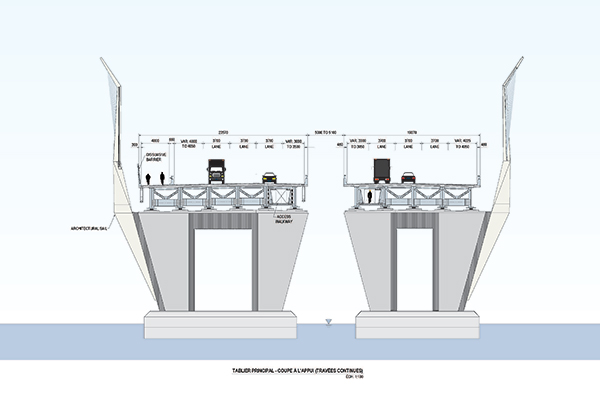 Cross-section view of the bridge highlighting piers, superstructure, and architectural sail elements
The two new structures are independent composite deck-on-steel-girder bridges, one serving eastbound traffic and the other westbound. Each will carry three traffic lanes along with a dedicated shoulder designed to accommodate public-transit buses. The westbound bridge includes a key additional element: a 4m-wide multiuse path extending along most of its length, offering cyclists and pedestrians a safe and scenic crossing over Lac des Deux-Montagnes. The multiuse path departs from the main deck via a gently descending ramp leading into the suburban village of Senneville, where it connects with the local cycling network. Along the route, two belvederes with architecturally framed canopies provide rest points and unobstructed views across the northern expanse of the lake.
On each bridge, the six piers flanking the navigation channel are topped with sail-like masts rising 18m above the roadway – slender vertical elements that evoke wings in flight and create a striking figure against the horizon. Paired with six additional sails positioned at each approach, these features lend the bridges a distinctive silhouette visible from afar.
The piers have sculptural forms: flared twin columns connected by a crossbeam and supported on pile caps set above the waterline. Their foundations comprise drilled shafts socketed into bedrock, a solution carefully adapted to the site’s complex geological conditions. Textured finishes on the pier surfaces further enrich their appearance, ensuring the structures convey both technical sophistication and architectural intent.
Material selection was driven by durability, performance and constructability considerations. The steel girders combine high-performance and conventional grades to optimise structural efficiency and reduce overall tonnage. Deck construction uses a blend of cast-in-place and precast high-performance concrete, tailored to achieve the stringent requirements of a 100-year design life – a leap from the typical 75-year design life specified in Canada. Precast elements also support the accelerated construction schedule through controlled fabrication and rapid installation on site.
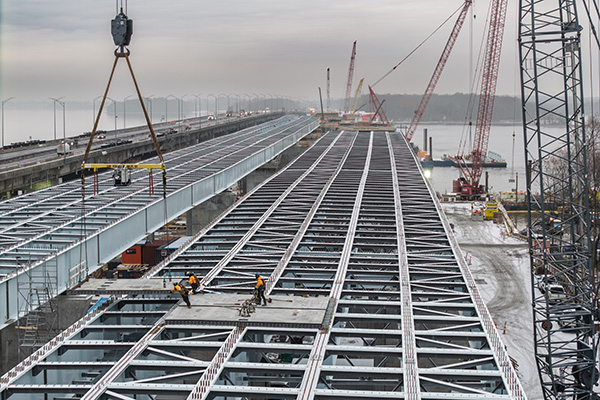
The deck panels will be joined using ultra-high-performance concrete (GNPIAT)
Precast deck-panel connections use ultra-high-performance concrete with steel fibres, a relatively new application in Québec for a bridge of this scale. Most reinforcement is 400MPa steel, with 500MPa bars used strategically to reduce congestion and improve constructability. Depending on exposure, black or galvanised steel reinforcement is specified to ensure long-term corrosion resistance. While a range of alternative materials was evaluated during early design, the selected combination offered the best balance of cost, longevity and proven performance in Québec’s harsh climate.
Several substructure elements required advanced solutions to address the site’s complex conditions. Cast-in-place piers sit on pile caps supported by 1.5m-diameter drilled shafts socketed into bedrock, ensuring capacity across variable geological layers. The pile caps sit above normal water level, while skirt walls anchored with post-tensioned bars resist significant ice forces and conceal the piles, creating a clean, continuous waterline.
Seismic performance was evaluated using non-linear time-history analyses to meet modern performance-based criteria and site-specific demands. To reduce seismic loading on the foundations, the design incorporates targeted structural discontinuities within the piers: a concealed compressible foam joint that partially separates the pier cap and the column, effectively reducing transverse stiffness and lowering overall seismic demand on the substructure.
Geotechnical conditions along the alignment proved highly variable, with bedrock exhibiting marked differences in type, strength and degree of weathering. To refine the foundation approach, Osterberg cell load tests were carried out to confirm design assumptions and calibrate drilled-shaft dimensions, ensuring reliable performance across changing subsurface profiles. The pile caps were cast in two stages, with the initial pour serving as formwork for the remainder of the pier – a strategy that streamlined construction and reduced the need for complex temporary works.
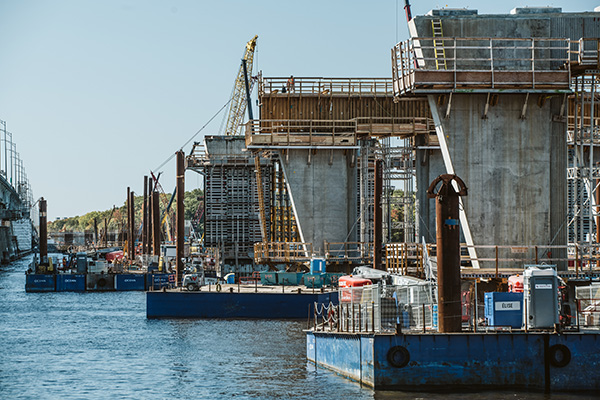 Initial pile-cap pours provided the formwork for the remainder of the piers (GNPIAT)
Several architectural elements, including the sails and belvedere canopies, required specialised aerodynamic analysis to address concerns related to wind stability, ice accretion and snow accumulation. Ice loading on the piers presented an additional design challenge, prompting the development of site-specific parameters to ensure the substructure and foundations remain protected under extreme winter conditions typical of the region.
The bridge follows a gentle 21km-radius horizontal curve that is almost imperceptible at close range, yet calibrated to allow travellers to sense the crossing’s scale. This large-radius geometry, however, creates fabrication challenges, as the curvature approaches or even falls below standard tolerance thresholds. To address this, the horizontal curve was divided into straight chords approximately equal to the span length, with both girders and deck aligned along these linear segments. Over each chord, the deviation from the true curve is roughly 50mm, and to preserve consistent lane geometry, shoulder width varies accordingly by the same amount.
Constructability drove the structural strategy, leading to extensive use of prefabrication – precast deck panels, steel girders and standartised components – to reduce work over water, enhance safety and maintain the project’s aggressive schedule. Although the substructure is cast in place, pier shapes – and therefore formwork designs – were standardised across the alignment to streamline detailing and accelerate production. Similar effort went into reducing the number of precast deck panel types, improving fabrication efficiency and ensuring design consistency across both structures.
Achieving a 100-year service life required measures that extend beyond conventional Canadian standards. Instead, a probabilistic design approach was needed to account for uncertainties in exposure conditions, material behaviour and long-term deterioration, ensuring an acceptably low risk of failure over the extended design life.
On the piers flanking the navigation channel, the sail-resembling masts are accentuated by a lighting system integrated directly into the sail structures, enhancing their presence after dark.
Although all piers share a unified design language, the water piers use flared walls with a textured central zone for depth, while land piers adopt a slimmer profile blending textured and smooth finishes. Abutments carry the same textures to maintain visual continuity across the crossing.
The requirement to keep five lanes open prompted a phased approach: traffic will first shift to the westbound bridge when it opens, with its multiuse path temporarily used as a traffic lane. Because the path is absent over the first 300m, a temporary steel-braced widening provides the extra lane. Once the eastbound bridge is complete, traffic will shift to its permanent layout and temporary works will be removed.
Showcasing engineering ambition and architectural intent, the new Île-aux-Tourtes Bridge was designed with advanced materials, rigorous analysis and thoughtful constructability strategies to set a new benchmark for bridge design in Québec and to serve and inspire for generations.
Andrew Griezic is design director, Maxime Forget and Lucie Tabor are bridge engineering managers, all at TYLin. Antonio Caracena is technical director at Flatiron Dragados
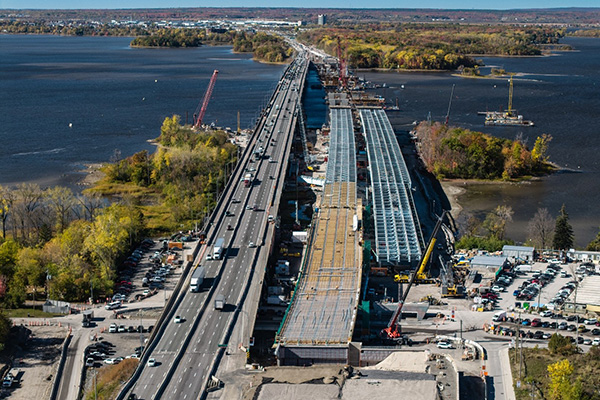 The new bridge will be commissioned in phases (GNPIAT)