What is a constant-stress arch and how does it differ from any other arch?
It is a shortcut term to describe an arch that, under statistically prevalent load – like self-weight – develops constant stress at every cross section. And you, as a designer, specify what that stress should be. Of course, in reality, structures are loaded not just with their own weight, but additional loads such as cars, people, wind and so on, and, under such conditions, they are no longer constant stress arches.
How does this approach differ from normal bridge design?
It goes completely against current design practice, because, in constant-stress arches, the shape is found according to the stress you want, and according to statistically prevalent loading you put on it. By statistically prevalent load I mean load that is significant in magnitude and duration. In current design practice you don’t ‘find’ the shape; you assume the shape and check the structure for the ultimate load.
Should constant-stress arches be a starting point for the design of a bridge?
Yes, because it is essentially a part of the conceptual design. It allows you to design the arch shape according to the limitations of the surrounding environment, such as the required clearance above road and span, and you can fit the shape into abutments at different heights, if need be, so the resulting arch can be asymmetric.
How does ultimate load design fit with constant-stress arches?
When you move on to ultimate load design, you have to up your load, so it is not just your statistically prevalent load, like the self-weight. If, at this point, you find that ultimate stresses in the arch exceed the design strength of the material, you can go back and reduce the value of constant stress and repeat the calculation for the shape. So, there may be some iterations involved, but all design is iterative. This is different to the normal approach of starting with the geometry of the structure, going to the ultimate load analysis to check if the structure is strong enough and, if it is not, simply increasing the cross section. I’m saying: I’m going to find the arch shape; its geometry is unknown to start with, but the loads and stresses are known, or assumed. So, it’s a bit like reverse engineering.
My collaborators, Justin Russell from the University of Warwick and Thomas Li from Arup in London have done standard ultimate load analyses of some of my constant stress arches, because I wasn’t going to propose something if it didn’t work under ultimate loading. And, we found that the constant stress designs performed better than some parabolic arches with similar span-to-height ratio.
However, there’s still some fine tuning to be done. More designs are needed, to know what value of constant stress we want and to know instinctively what would be the range of span-to-height ratios that would give us a minimum amount of material. The analytical form-finding methodology that I have proposed allows you to find the span-to-height ratio ensuring a minimum amount of material, or a structure of least weight; this information just needs to be compiled into a design database.
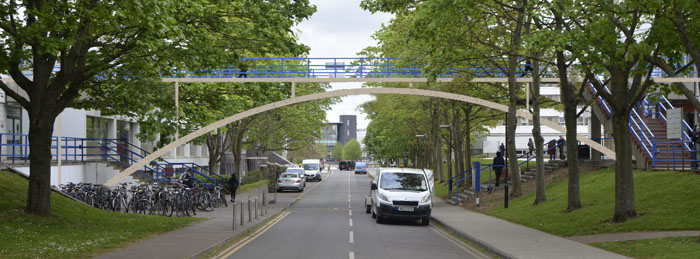
Above: render of constant-stress arch bridge replacement design proposed by Wanda Lewis for the University of Warwick in the UK.
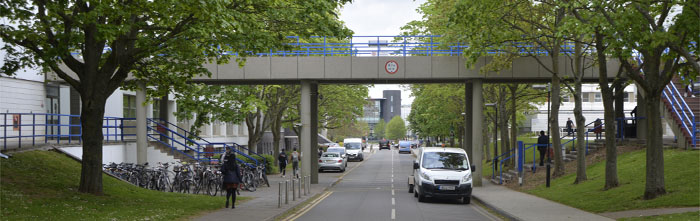
Below: existing bridge linking university science and library blocks.
How does this approach differ from structural optimisation?
All that structural optimisation approach tends to tell you is that the optimum arch is the arch with the minimum weight and, for this arch, the span-to-height ratio must be such and such. What I am saying is: choose your span-to-height ratio to suit the site conditions, but make the structure work in the constant stress field under statistically prevalent load; in the case of masonry arches, this load would be the self-weight of the structure.
The basic problem with the optimisation of arches is that a lot of research in the area is carried out by theoreticians who have no idea about design and margins of uncertainty. They don’t differentiate between stress and strength. I do, by saying that the constant value of stress used in shaping the structure needs to have a much lower value than the design strength of the material and that value will go up under ultimate load, but must not exceed the design strength.
Theoreticians give you just one value for stress, presumably equal to the ultimate strength, but, if you optimise for that, it means the arch will be optimal only for the case of ultimate load; when that load is not there, the arch will work in a non-optimal way by developing a non-constant stress. These are the arguments.
Is the constant-stress arch the optimal design approach?
Yes, for the reason just given. The word ‘optimal’ is much used and abused. You can have a family of constant stress arches of a variety of span-to-height ratios. They will be optimal and, amongst them, there will be one with a specific span-to-height ratio that will give you the structure of least weight. The point here is that structures of least weight limit the number of optimal design options and they may not be as durable as other arches of constant stress.
What are the potential benefits of a constant-stress arch bridge compared to traditionally designed arch bridges?
The most popular form in traditional design of open spandrel arch bridges is a parabolic curve.
My research indicates that this form can have up to 300% stress variation under permanent load, which impacts material usage and durability. In contrast, arches working in a constant stress field most of the time are likely to be more durable. They also have inherent aesthetics. We have many cases of masonry arches failing all over the country, as documented by Bill Harvey. Admittedly, these are mainly in-filled arches, but the point remains: although an attempt is being made to understand the mechanism of their failure, the question of their shape is not given sufficient attention.
Constant stress arches offer sustainable and durable solutions to our future infrastructure design.
Why have no constant-stress arches been designed before?
Biomimicry in this area hasn’t taken off because it is much easier to say, ‘I’m going to design a parabolic arch, what is the loading and cross section? Oh, the cross section is too small, let’s increase it, repeat calculation, job done.’ It’s quicker, but these designs are not materially efficient or durable.
The current situation can be attributed to the way we are educated. There’s always been this disconnect between architectural and engineering thinking and the two need to be connected.
Where progress has been made in terms of design efficiency is in countries like Switzerland or Germany, where the education of engineers and architects involves education in both fields. And in the UK, we have architects who ‘don’t do numbers’ and engineers who ‘don’t do aesthetics’, only numbers.
If we can draw on design principles observed in nature, I don’t think we can go wrong.
What are the limitations of this approach?
When I started looking at the distribution of the material, and calculated how the cross section varied along the length of the constant stress arch, I discovered there is such a thing as a limited design space for these structures. In other words, although you can specify your span-to-height ratio, you can specify your loading and stress, for a certain combination of these input variables, you may not be able to create a constant stress arch.
Having said that, the design space still gives you a huge number of combinations of span-to-height ratios and values of stress, to be able to generate almost limitless number of these arches. Here, one can again draw a parallel to nature: trees grow into a certain shape, following the constant stress direction and not another way; yet, there are so many forms of trees.
A point raised by some academics is that I assume that the deck exerts pressure on the arch continuously, and to achieve that I would need to have a wall between the deck and the arch, not discrete columns. Well, this is a very common assumption in structural analysis, and provided the columns are spaced quite closely, it is a good approximation. In our recent publication in Computers and structures, dealing with moment-less but not constant stress arches, my research team analysed a bridge very similar to the Hoover Dam Bridge where the column spacing of around 10% the span was used. The results showed that the change in stress due to the local concentrations of the applied load, was around 10 to 11%. This is relatively small, compared to much higher margins of safety used for loading and strength of materials.
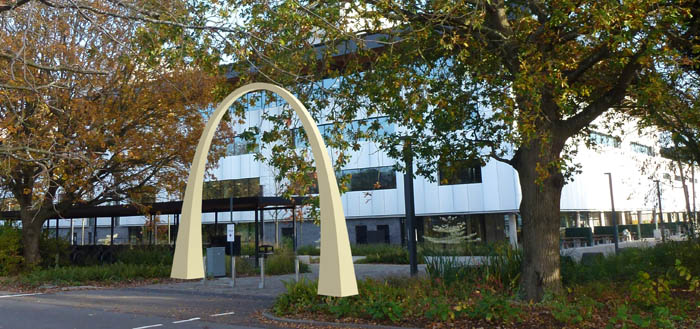
Render of free-standing constant-stress arch with a span-to-height ratio of 1 (Wanda Lewis)
How would a constant-stress arch be built?
These arches can’t really be built in situ. You need to get the shape absolutely right, because there is a very strong interaction between geometry and stress. If you get the geometry wrong, literally by tens of millimetres in, say, 50m span, it makes a significant difference to the stresses you will generate. So, you have to ensure accuracy in construction, which adds to short-term cost, but you gain in terms of enhanced durability and cost-effectiveness.
Are there any plans to build a constant-stress arch bridge?
I have designed free-standing arches with the span-to-height ratio of 1. The two arches are designed by the same analytical form-finding method and use exactly the same amount of material. I also designed a replacement bridge between the science and library blocks of the University of Warwick. There is funding coming; I was provisionally told that in 2024 there would be space and budget to build these structures. The replacement bridge is an asymmetric arch with a span-to-height ratio of about 4.5, fitting into the existing landscape where the difference in the support levels is almost 2 m. It is a slender structure, with up to 40% variation in the cross-section area, and a span of just under 24m.
 Wanda Lewis has been based at the University of Warwick since 1986, where she works as professor in the School of Engineering. She has a keen interest in finding optimum structural forms using natural design principles; an approach that has taken her into biomedical, automotive and aerospace spheres.
Her paper, Mathematical model of a moment-less arch, was published in the Proceedings of the Royal Society A in 2016 and her second, Constant stress arches and their design space, was published in 2022.
She is currently focusing on bringing her research on natural arch forms into practical applications.