
The total cost of the project is US$3.46 billion, falling within the Government of Canada's initial estimates. This amount includes the US$3.24 billion contract between the Government of Canada and the Signature on the St. Lawrence Group, which covers the construction period, to begin in June 2015 and end in the fall of 2019, as well as a subsequent 30-year operating period. The agreement includes the design, construction, financing, operation and rehabilitation of the corridor project, including the new Champlain Bridge, the new Île-des-Sœurs Bridge and reconstruction and widening of the federal portion of Highway 15.
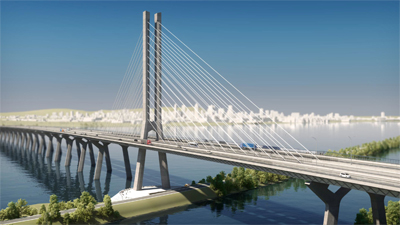
The private consortium building the 3km-long bridge for the St Lawrence corridor is called Signature on the St. Lawrence (SSL), and is comprised of SNC-Lavalin and partners ACS Infrastructure and Hochtief PPP Solutions.
Construction of the new Champlain Brige’s piers is expected to begin in winter and the deck will be constructed in summer 2016.
The new bridge will carry two three-lane corridors for vehicular traffic and a two-lane transit corridor capable of accommodating a planned light rail transit system. It will also include a multi-use path for pedestrians and cyclists.
It replaces the existing Champlain Bridge, a steel truss cantilever bridge with approach viaducts constructed of prestressed concrete beams supporting a prestressed concrete deck paved with asphalt. The bridge crosses the Saint Lawrence River and Saint Lawrence Seaway, connecting the Montreal boroughs of Verdun and Le Sud-Ouest to Brossard on the South Shore.
Champlain Bridge is one of the busiest in Canada, with some US$20 billion worth of international trade crossing it every year.
An architectural review panel of architect Poul Ove Jensen from Dissing+Weitling, local firm Provencher Roy, the City of Montréal, Mission Design, Heritage Montréal, the Ordre des ingénieurs du Québec and the Ordre des architectes du Québec developed the design for the new bridge in collaboration with Arup. Groupe SM has also worked on the highway components.
This is the first time that a Canadian public private-partnership procurement has included a definition design to ensure that the architectural vision is realised in the finished structure.