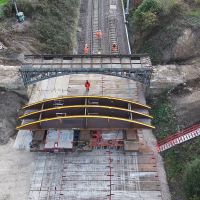
At about 2.40am on Wednesday 11 September 2024, one of the last passenger trams of the early hours trundled over the River Elbe on the Carola Bridge (Carolabrücke) in the German city of Dresden. Twenty minutes later, a 100m length of the deck was lying in the river. A catastrophic collapse had occurred, although thankfully with no one hurt. Was the collapse a complete surprise? Or had it been just a matter of time?
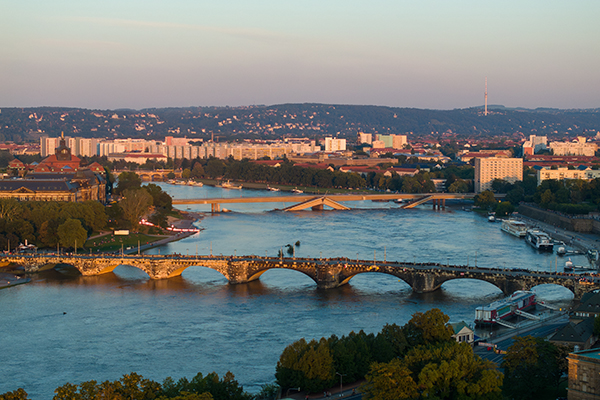 Signs that all was not well with Carola Bridge go back to the late 1970s, just a few years after opening (Deutschland Abgelichtet/Shutterstock)
At the beginning of 1945, despite what the rest of Germany was going through, the beautiful city of Dresden had been relatively unscathed by the ravages of World War Two. That was soon to change. In February, Allied bombers delivered a devasting raid on the city which created the infamous firestorm, killing tens of thousands of its citizens. Just a few weeks later, the Soviet military machine arrived. One last action of a somewhat futile resistance saw German forces blow up the 60-year-old Carola Bridge in a vain attempt to stop the Red Army entering the city.
After the war, Dresden found itself in East Germany and had to rely on limited sources of building materials for its reconstruction. For any form of prestressed concrete, there was only one supplier when it came to prestressing wire: Henningsdorfer Steel.
In 1965, the city authorities announced a competition for a new Carola Bridge, allegedly for a slender structure with the requirement that there should be no overhead towers, masts or cables that might obstruct the city’s skyline. The solution: three parallel post-tensioned variable-depth concrete box girders: two carrying highway traffic and the third for pedestrians and two tramways. These were annotated decks A, B and C respectively and all three bridges were opened in July 1971.
With five spans, a total length of 375m, and a main span of 120m, the second Carola Bridge was a big bridge by any standards. Compared to present day practice, however, the decks were not continuous. This may have been due to the fact that a statically determinant bridge was easier to design, or maybe there was a view that stressing post-tensioning strands over this length would have been problematic. The outcome, however, was that all three decks were hinged: two hinges in the main spans and another in one of the side spans. The hinges were formed as two-metre-long steel boxes which, as well as containing two steel ‘half-joint’ arrangements, also housed the anchorages for the post-tensioning to the decks on either side of the hinges. As all three decks were almost identical, the hinges were not only in the same positions, but they also served to join the parallel decks together at these locations.
Within a few years after opening, however, there were already visible signs that all was not well. A late 1970s photograph, looking along the line of the bridge, shows a distinct deflection in C deck’s outer parapet edge beam. In order to understand what was happening, deflections were regularly measured. By 1983, the deflection at one of the main span hinges was about 200mm from the original profile. By 1992, this figure was nearer 300mm.
By now, it was understood that the Henningsdorfer Steel prestressing wire was susceptible to hydrogen-induced stress corrosion cracking (SCC): an electro-chemical process that can cause sudden, brittle failure of wires in tension, with no visible signs of surface corrosion. Recognising the problem, in 1993, the now unified German government issued the standard “Handlungsanweisung zur Überprüfung und Beurteilung von älteren Brückenbauwerken, die mit vergütetem, spannungsrisskorrosionsgefährdetem Spannstahl erstellt wurden”, or “Instructions for the inspection and assessment of older bridge structures built with prestressed steel susceptible to stress corrosion cracking”.
Although these guidelines were later updated, the principles behind them remained unchanged: that, in the event of evidence of potential SCC with the consequent reduction of prestressed steel tendon area, the bridge should be monitored for signs of distress, especially cracking. This was the standard being applied to Carola Bridge for the last 30 years of C deck’s life. The problem, however, was the location of where that cracking might be expected to be found. As the main span sagged, the hinge articulation meant that cracks were most likely to appear on the upper surface of the deck above the central piers… under the surfacing and tram tracks, making crack observation and monitoring very difficult.
The last straw that broke C deck’s back is unknown, but probably just one last wire failing and allowing gravity to take over. This gradual degradation of prestressing wire caused by SCC was undoubtedly the root cause: hidden from view but slowly eating into utilisation factors. The formal investigation (by Professor Steffen Marx of the Dresden Technical University) established that about 68% of the tendons were damaged to the point of failure. It also suggested that wet weather during construction might have been a factor which triggered the initial SCC and accelerated the ongoing process. The report also cited that familiar problem of chloride-laden water adding another level of corrosion although, at Carola Bridge, only playing a bit part in the overall scheme of things. As well as the engineering issues, Professor Marx found no fault with the City authorities: the bridge had been thoroughly and regularly inspected and was fully compliant with all appropriate standards, including the Federal SCC monitoring guidance.
In the immediate aftermath of the collapse, A and B decks were closed to traffic. As one of only four crossings of the Elbe in the city, this obviously led to traffic congestion and inconvenience. River traffic was also impacted: the Elbe is used for commercial barge traffic as far as the Czech Republic. As with most modern bridges, Carola C deck also carried utility apparatus including two large-diameter district heating pipes, adding to the consequences of the failure with winter approaching. Strapping a flexible heating pipe to the nearby Augustus bridge provided a quick-fix temporary solution.
While demolition of C deck began almost immediately, the focus turned to A and B decks. Whilst the connectivity of the three decks at hinge points had caused some relatively minor collateral damage, it was perhaps unsurprising that investigations soon revealed similar issues as with their erstwhile neighbour and the decision was taken to demolish the other decks. Although the Dresden city authority has agreed to a third Carola Bridge, a new bridge is still at the planning stage with a commitment to start construction some time in 2027.
As a last twist with regard to Dresden’s recent history, an additional level of risk was encountered during demolition: legacies from the 1945 air raid in the shape of unexploded ordnance. In the first few weeks of C deck removal, three ex-RAF 250kg bombs were located in the vicinity of the bridge abutments, prompting a rethink of the demolition methodology with extra precautions having to be taken.
But was Carola Bridge just a one-off collapse for Germany? The evidence says not. Bear in mind that Dresden was not the only city to suffer unimaginable bomb damage, not to mention the fact that transport infrastructure was a key target for the allies towards the end of the war. And, especially in what was east Germany, the only source of prestressing strand was also Henningsdorfer Steel. Perhaps the problems are only just beginning.
In March 2025, a major bridge on Berlin’s outer ring road – the Ringbahnbrücke - was suddenly closed following the discovery of cracks during an inspection. In April 2025, the Wuhlheidebrücke, another major bridge in the east of the capital was also closed. Near Lüdenscheid in the west of the country, the Rahmede viaduct was suddenly closed in 2021 – due to structural concerns – and has since been demolished with a replacement under construction.
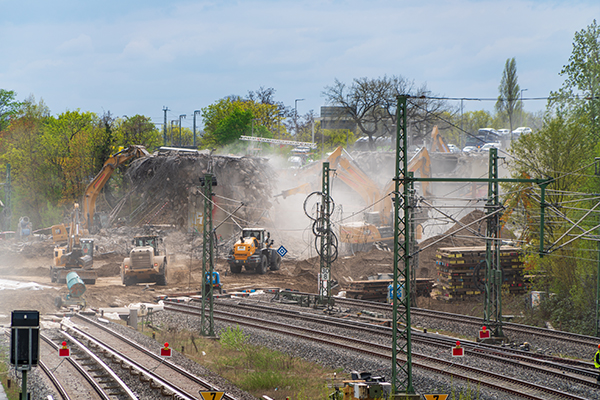 Berlin, Germany, 15 April 2025: Ringbahn Bridge is demolished following the discovery of cracks (Shutterstock)
Each of these adds to the growing list of what is known in Germany as ‘bröselbrücken’ – crumbling bridges. As of June 2025, that list was estimated to stand at 4,000 autobahn bridges and another 12,000 on other roads. And, of course, post-war reconstruction was not limited to bridges. Similar issues are coming to the fore with public buildings and schools. The recently appointed Chancellor, Friedrich Merz, has already promised to pour billions of euros into the problem. Returning to the war theme (perhaps the bookends of this piece), an interesting slant on that commitment is that increased expenditure on defence can be used for some strategic bridge upgrades, on the grounds that being able to move military hardware around the country is an essential requirement of a sound defence policy. Bridges must be ‘kriegstauglich’ – fit for war.
But is this just a problem for Germany? Clearly not; post-war infrastructure construction was significant in almost every country in the world, probably peaking in the 1970s. So all those bridges are now at – or about the same age as – Carola Bridge and her other German cousins. And just because most countries did not have to rely on Henningsdorfer Steel for prestressing strands and may not have problems arising from hydrogen-induced stress corrosion cracking, there are many other details which should be a concern. Bridge owners are very aware of the ones we know about, not least in our post-tensioned bridges. It is now widely recognised that poor detailing, occasional careless workmanship, and inadequate supervision, in a cocktail with chloride-laden water, can drastically reduce a bridge’s life.
The solution for bridge owners anywhere in the world is to follow the German example, to fully understand structural behaviour, minimise risk and be prepared to take appropriate action. There will undoubtedly be some more Carola Bridges that sneak under the radar but hopefully many more will be found before tragedy strikes.
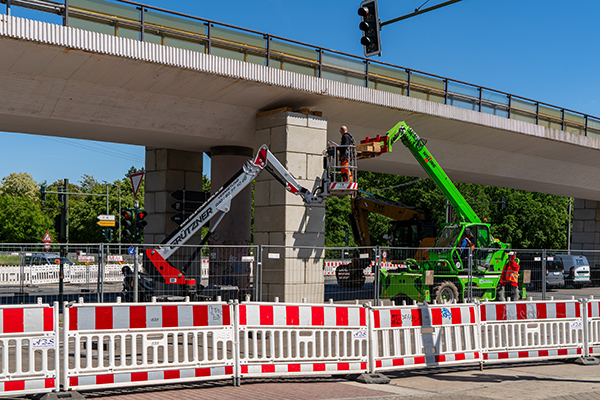 The Wuhlheidebrücke to the east of Berlin was closed in April 2025 and demolished by the summer (Shutterstock)
Richard Fish is an independent bridge consultant and a leading UK authority on bridge failures. His book, Bridge Failures and Lessons Learnt, was published in 2025 (Bd&e issue 119)