The original bridges were destroyed during serious flooding in the region between Tuscany and Liguria back in October 2011. Some of the local rivers broke their banks and the flooding also caused severe environmental damage: villages on the coast were submerged by mud, and these three bridges were destroyed by flooding of the Magra River and its tributaries the Mangiola and Teglia. An international design competition was launched in the wake of the disaster, to find the best solution to replace the three lost bridges.
Some guidelines were specified; the three bridges had to have homogeneity of form, be capable of being rapidly constructed, and should be properly integrated into their beautiful surroundings. The budget for the three bridges, which have a combined length of around 500m, was limited to Euro 14 million. Studio de Miranda Associati won the design contest with a solution proposing three steel suspension bridges.
Although the competition took place in 2012, it is only now, five years after the bridges were destroyed, that they are finally reaching completion. After an arduous struggle with Italian bureaucracy, the bridges are now at an advanced phase of construction by contractor Castaldo, with the Stadano suspension bridge reaching closure last November and due to be inaugurated this month. The design choices for the three bridges were driven by a range of different constraints aimed at finding the best solution.
The owner Regione Toscana specified that any hydraulic obstruction of the river should be avoided by the elimination of intermediate towers, requiring the creation of a central span with a minimum length of 130m. The second design constraint was that the level of the new deck must be positioned 1.5m above the water level that was predicted to occur during a 200-year return period flood. This condition made it necessary to design a very slender deck. Thirdly the design had to address the emergency nature of the project and the needs of the population; the bridges had to be capable of being built using rapid construction methods exploiting prefabrication and creating modular elements that could be built this way, as well as reducing the weight of these elements.
Together these criteria eliminated the use of a simple girder bridge. The bridge designers were require to design bridges whose size and impact were at an appropriate scale to the landscape and suited the character of the region, which includes some medieval villages. This was specifically in relation to the height of the vertical structural elements, but also related to the slenderness and transparency of the construction elements. This condition effectively also eliminated the cable-stayed bridge form. And the fifth condition was that the designer should create a homogenous approach to the intervention to ensure that the bridge projects had a unified form. The intention was to have a coherent formal quality of work that would respect the various functional and economic demands; this has been a constant theme of the design choices.
On the basis of these design constraints, the focus was on the suspension bridge as the formal solution that best responded to all the requirements and that would also unite the three structures. The suspension bridge is a traditional and yet modern bridge type; in its early form, still used in many developing countries, ropes anchored on each side of the crossing have the deck suspended from them to permit people and animals to cross. In developed countries it is considered relatively traditional since it represents one of the first construction systems which was used to build bridges with longer spans during the development of steel structures at the beginning of the 19th century.
Also interesting to note is the fact that it was in Tuscany that this kind of construction was first applied in Italy, starting in 1833 with bridges designed by Alessandro Manetti, Carlo Reishammer and the Seguin brothers. Of course it is also a modern structural type, creating the longest bridge spans in the world such as those on Denmark’s Storebaelt Bridge and Japan’s Akashi-Kaikyo Bridge, which has a 1,991m span.
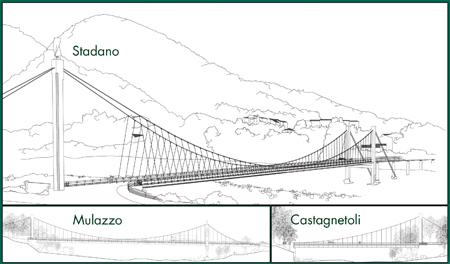
The three solutions for the new bridges have the common theme of being suspension bridges, but each of them has a defining characteristic. The Stadano bridge has a pair of masts on one side and a single mast on the other, so the two principal cables converge and the hangers are inclined; Mulazzo has four towers, two of which are in concrete and two in steel, and Castagnetoli has one tower and a single longitudinal cable from which the deck is suspended, with a self-anchored structural system.
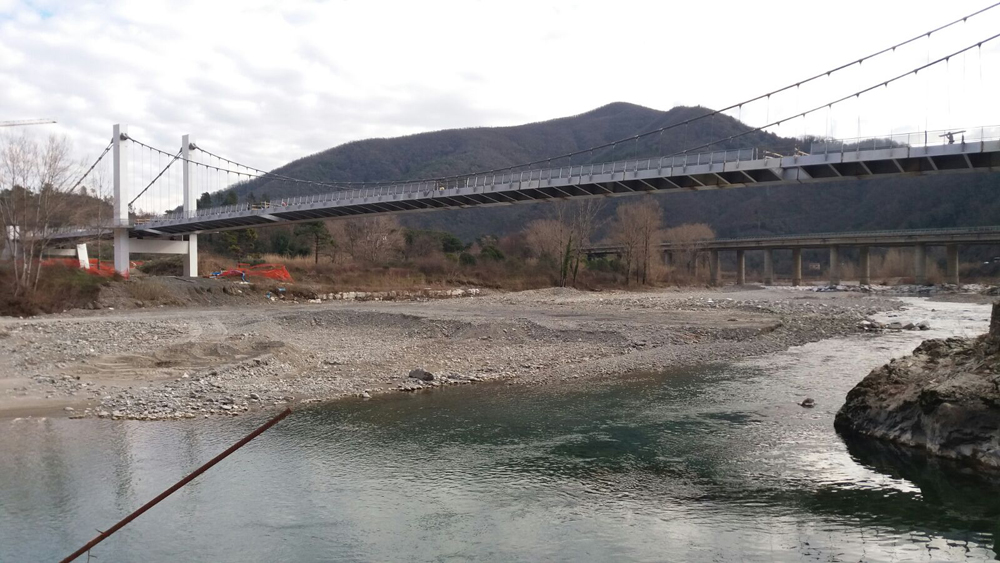
The Stadano Bridge crosses the Magra river is oriented on a north-south axis, has a 139m-long main span, an approach bridge on the north side with four spans, and a small span on the south side. The total length of the bridge is almost 295m. The tower on the south side is a single mast with reinforced concrete structure and rectangular cross-section, set behind the abutment to leave space for the deck, which is curved in plan in the last segment. The two towers on the north bank are also reinforced concrete and the suspension system is made by two cables, each one formed by a pair of locked coil ropes that start in the single tower and separate to go one to each of the two towers on the other side. The deck is 12m wide and carries two highway lanes and two footpaths each 1.5m wide.
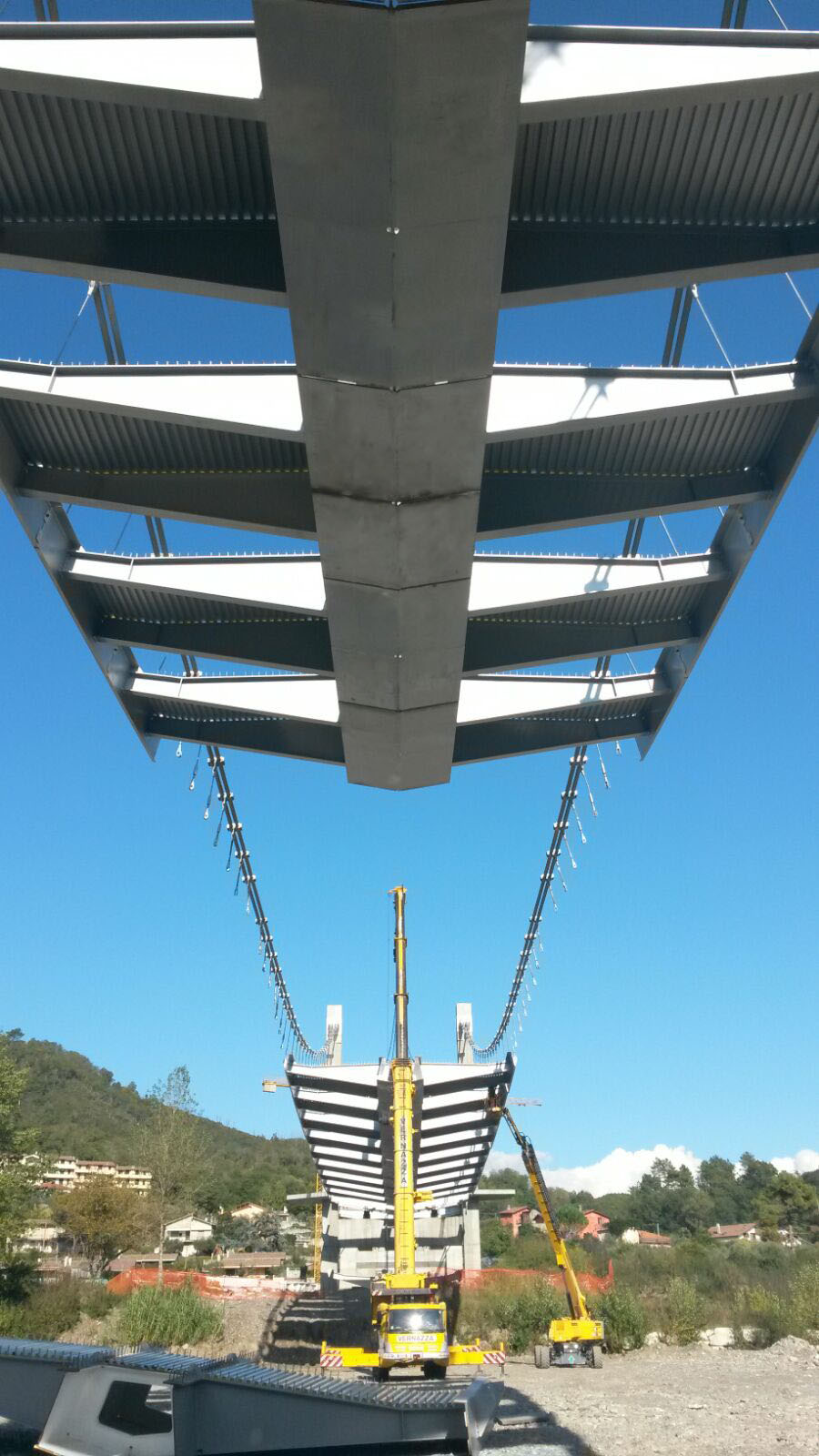
The deck structure consists of a central stiffening steel box girder and transverse steel I-beams with the central box girder providing strength and rigidity in the vertical plane. In service the deck works together with the reinforced concrete slab as composite structure, making an element with high flexional stiffness. The transverse I-beams have a tapered profile and they cross the central beam, support the slab and connect the deck structure to the cables. The hangers are vertical cables which suspend the deck from the main cables by means of steel fabricated clamps. They have hinge connections at both ends, making assembly of the connections, and hence the deck, easy and fast.
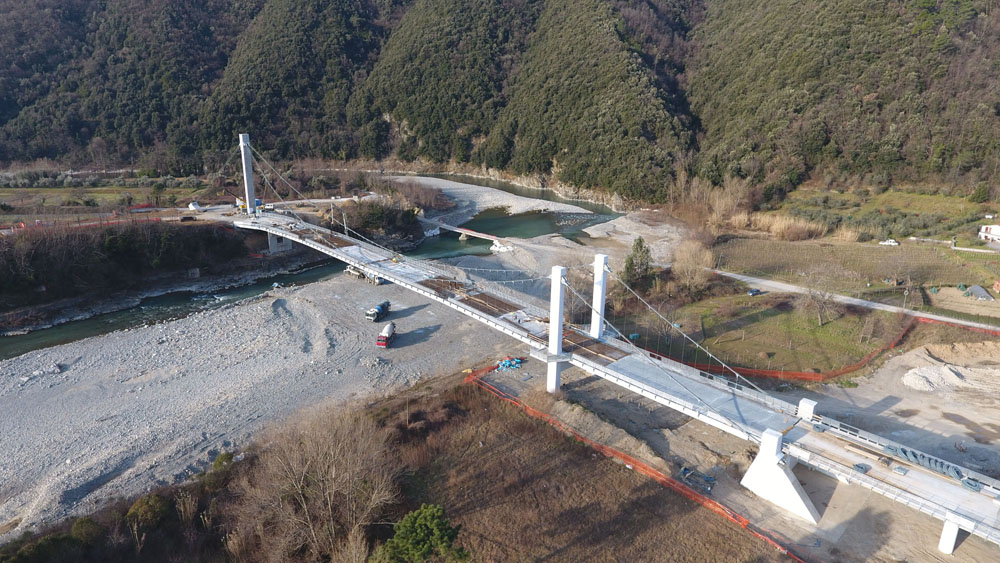
The choice of a pair of locked coil ropes for the main cable was intended so that they could be prefabricated and to allow a simple lifting and assembly procedure for installation at the towers. Each rope has hinges at both ends, while the lateral anchorage cables have a fixed anchorage at the top of the towers and adjustable joint at ground level. The suspension bridge form, while a classic choice for long spans, has not been used much in Italy, and never for spans between 60m and 140m. The project represents an innovation in Italy and an interesting challenge, as well as challenging the common perception that suspension bridges are not an appropriate choice for medium and small spans.
This configuration allowed extensive use of prefabrication of bridge elements and a construction process characterised by an assembly that is 90% dry and hence very quick to build. The modularity of the elements enabled rapid production and construction, taking advantage of a scale economy of the elements. The protection system for the steel structures is realised with fluorinated coating, which is more durable and efficient than traditional poliuretanic paintings.
For cables and hangers the protection is Galfan, which is a modern product based on an alloy between zinc and aluminium, and is claimed to be more effective than traditional galvanising. The Magra river is characterised by sudden and unexpected floods, making it dangerous and expensive to build temporary supports in the river. For this reason the construction method proposed was one which did not need either supports of provisional foundations, but used the main cables as the support element for all the construction phases. The elements of the structure are light, and can be assembled in total safety from the dry riverbed during the nine-month long low water season.
In the event of floods, work can be postponed or delayed without any impact on the river. After construction of the reinforced concrete foundation and towers, the main cables were mounted using a small crane, which was also subsequently used to erect the hangers. The deck was brought to the site in parts which were small enough to be delivered without the need for exceptional transport, and were quickly fixed on the hangers thanks to a simple linchpin. They were able to be connected manually and the entire 200m deck was erected in ten working days, representing a very good result.
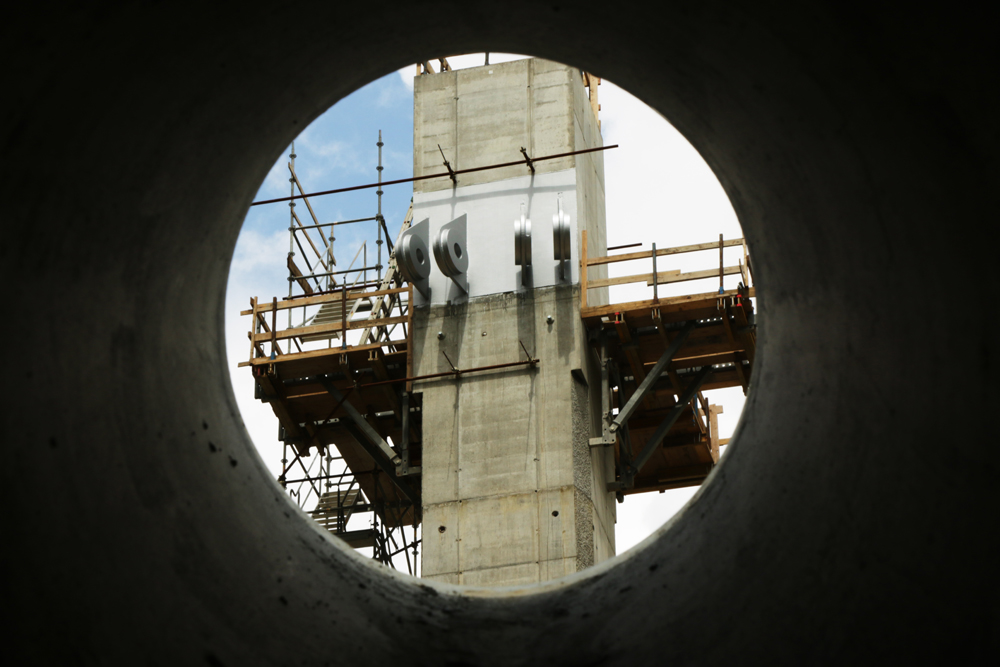
Once the deck structure had been assembled a series of corrugated steel sheet panels were erected and concrete pouring began. Welding was used to permanently connect the segments of the deck, and the concrete slab was cast. The economy of this bridge, which is designed to be largely prefabricated, depends on good logistics and coordinated timing of the construction, fabrication and assembly of the elements, as well as the bridge and the approach bridge being built simultaneously, to enable the time and jobsite cost for the contractor to be reduced and the bridge to be built quickly. Initially the three bridges were intended to be built by the same contractor, and the time schedule was developed so that the three bridges could be built one after the other. The plan was to have an assembly line for fabrication which would also deliver economy, and that the learning curve between the three bridges would enable the second two to be built even quicker.
However the owner, Regione Toscana, eventually decided to divide the work into three contracts and let each one separately. The masts on Mulazzo Bridge have now been built, and the deck of Castagnetoli Bridge is already assembled with main cables due to be erected shortly. All three bridges are due to be completed this year.
Mario de Miranda and Elena Gnecchi Ruscone are engineers and partners at DMA – Studio de Miranda Associati