But after making rapid progress this year, the contractor has just finished all the weather-dependent work and as Bd&e went to press was getting ready for commissioning of the new system. The airtight sleeve with its injection and exhaust points was in position, plant rooms installed and the gantries which were used for the cable work had been removed from the bridge. Final preparations were being carried out for the start of the system commissioning procedure, with completion of the work expected at the end of this month (November).
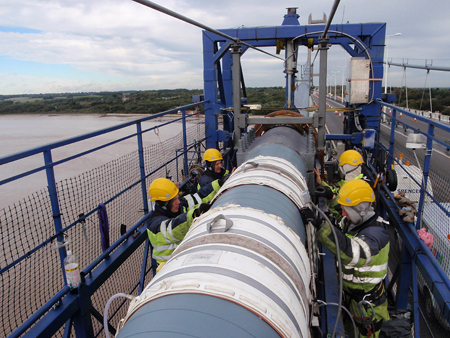
The installation of the dehumidification system follows similar contracts on other UK suspension bridges – first the Forth Road Bridge in Scotland, and then the Severn Bridge between England and Wales. On both of these bridges a large number of wire breaks was discovered but the cables on Humber were found to be in a much better condition when they were opened up in 2009. The installation of the system is largely precautionary, admits Humber Bridge Board design & major projects manager John Cooper.
Internal inspection of the main cables took place last year, some 28 years after the bridge was completed and almost 30 years since the cables were spun. In this regard the inspection coincided almost exactly with the recommendation in the US NCHRP Report 534 guidelines.
The inspection procedure was carried out by Flint & Neill Partnership in association with Amman & Whitney. Main contractor C Spencer provided access and wedged the cables open for inspection, then compacted and rewrapped the cables after the inspection. Flint & Neill reported on the inspection results following extensive wire sampling and testing by Bridon and Corus laboratories.
Although the inspection showed wire corrosion, as found on the UK’s other bridges, cable strength was virtually unaffected, says Cooper. But the Humber Bridge Board managers had already accepted that cable dehumidification is currently regarded as the best way of preventing further corrosion, and decided to install the system when they received the inspection report.
The approximately US$9.6 million contract was let in January this year, again to contractor C Spencer; once the companies four specialist gantries had been installed the following month, work started on site in March. Aecom is employed as the client’s representative on the scheme and is responsible for designing the system and overseeing the installation and commissioning process.
The cable-wrapping process is being carried out from four separate gantries designed and manufactured by C Spencer. Three of these have been used on previous contracts, but the fourth had to be specially designed for the north side of the Humber Bridge, where the side span is much shorter than on the south side, and hence the main cables are not only steeper, they have a larger diameter than those on the rest of the bridge.
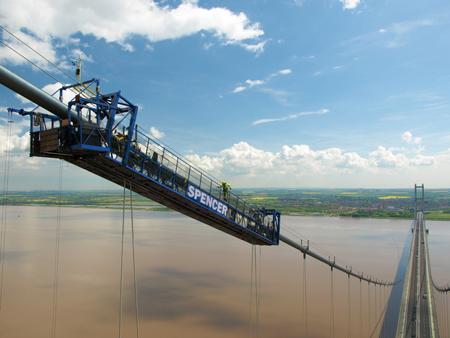
The original schedule for the work ran on into 2011, with a break for the winter period during which time no cable wrapping could be carried out. The cut-off for the winter period was the end of October 2010, but rather than just mothballing the project till next spring, the site team has now packed away the wrapping equipment for good and is preparing for commissioning. The schedule was based on C Spencer’s previous contracts at the