This article was published in issue no 82 of Bridge design & engineering; see what else is in this issue here, or subscribe here for full benefits and immediate access to our web archive.
Seismic protection is being installed on four viaducts on a new railway in Algeria for national railway company Agence Nationale d’Etudes et de Suivi de la Réalisation des Investissement Ferroviaires (ANESRIF). The railway line, just west of Algiers, is a double-track electrified rail link between Birtouta and Zeralda which is being built by main contractor Yapi Merkezi and is in Algeria’s maximum earthquake risk area.
The challenge of the project was to limit the impact of the seismic design on the total cost of the four viaducts on the line.
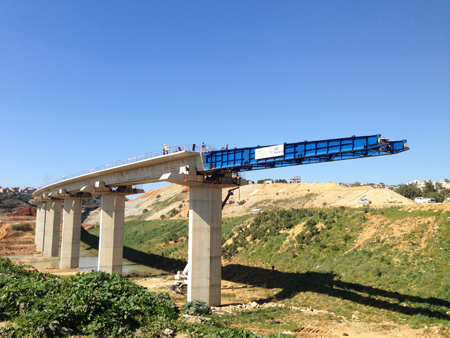
Construction of the four viaducts is being carried out by incremental launching
Specialist subcontractor Freyssinet is responsible for supplying the earthquake protection on the civil engineering structures. The firm proposed a technically and financially advantageous solution; earthquake protection devices that also act as fixed points during normal operation. These devices reduce the volume of the piers and piles. The mass of the deck was also reduced by optimising the prestressing system and the duration was shortened by optimising the launching method.
Freyssinet was employed to supply a range of services and products, including checking the seismic design, designing the deck, developing the construction methods for the deck, supplying the bearings, joints and earthquake protection devices, prestressing and launching gantry, and carrying out the launching operation.
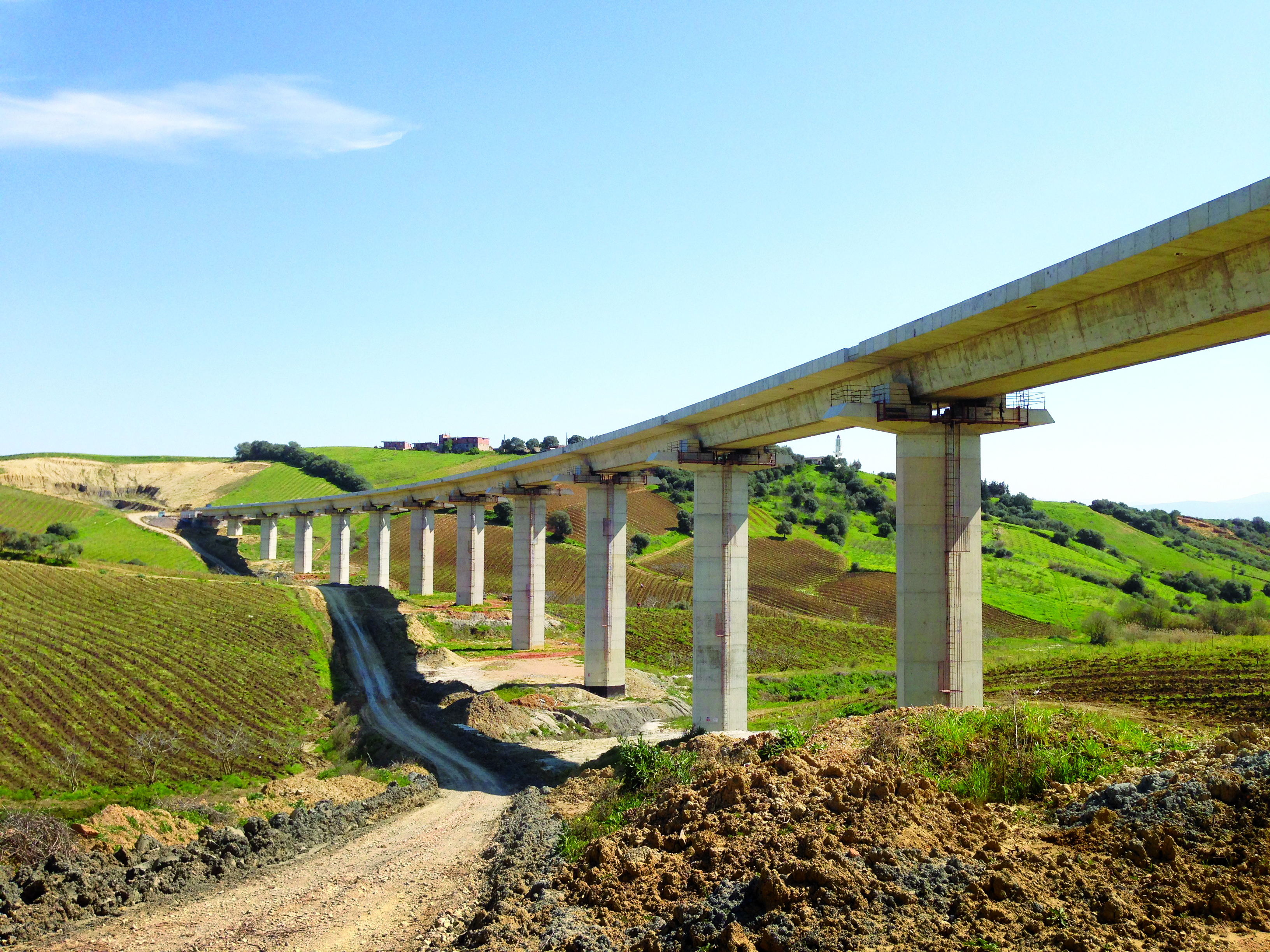
The four bridges have between nine and 17 spans, and range in length from 334m to 660m. The central spans are 40m long and the cross-section is a post-tensioned concrete box girder. Two of the bridges were launched using a push-pull system, the other two used strand-jack systems.
Three phases of post-tensioning were carried out; the first at the yard, the second during launching, and the third a continuity phase. The deck was launched on temporary bearings, by incremental launching methods, and permanent bearings and seismic devices were installed after launching.
The structures on the BTZ line are designed to be fitted with longitudinal and transverse devices that act as fixed points during normal operation, dissipate energy during an earthquake and return the structure to its original position after an earthquake. This design choice was a natural response to the project’s constraints.
The Algerian earthquake regulations, the Seismic Public Works Code (RPOA 2008), require railways to remain operational after they have undergone ultimate seismic action, hence the structure’s behaviour must remain in the elastic field. This means that seismic energy cannot be dissipated by plastic hinges, which impose significant forces on the bearings, piers and foundations.
Furthermore, the soil is poor quality, with layers of weak friable sandstone, silty clay and shelly clay. As a result, the initial design envisaged a large number of long piles.
A solution was developed using seismic devices to optimise the initial design. A beam finite element model was produced for each of the four structures and non-linear elements were added between the piers and the deck, representing dissipation devices. Non-linear temporal analyses were performed to check the seismic design of the structures and the size of the fluid dampers was determined in such a way as to reduce the seismic forces by a factor of four in the structure and foundations.
Two types of dissipation device are being used: Freyssinet fluid dampers, and Freyssinet prestressed damping springs. The prestressed damping springs perform three functions; during normal operation, they act as fixed points; during an earthquake, they dissipate energy, and after an earthquake, they return the structure to its initial position.
These devices will provide longitudinal and transverse protection for all four structures. Longitudinal prestressed damping springs are installed on the abutments, and all of the central piers are fitted with transverse prestressed damping springs, providing stability on the railway tracks during operation and earthquake. Longitudinal and transverse dampers were added to increase the total level of damping. All of the bearings on the central piers are free sliding pot bearings and the end piers, which do not have the damping springs, are fitted with guided elastomeric bearings, which restrict transverse displacement.
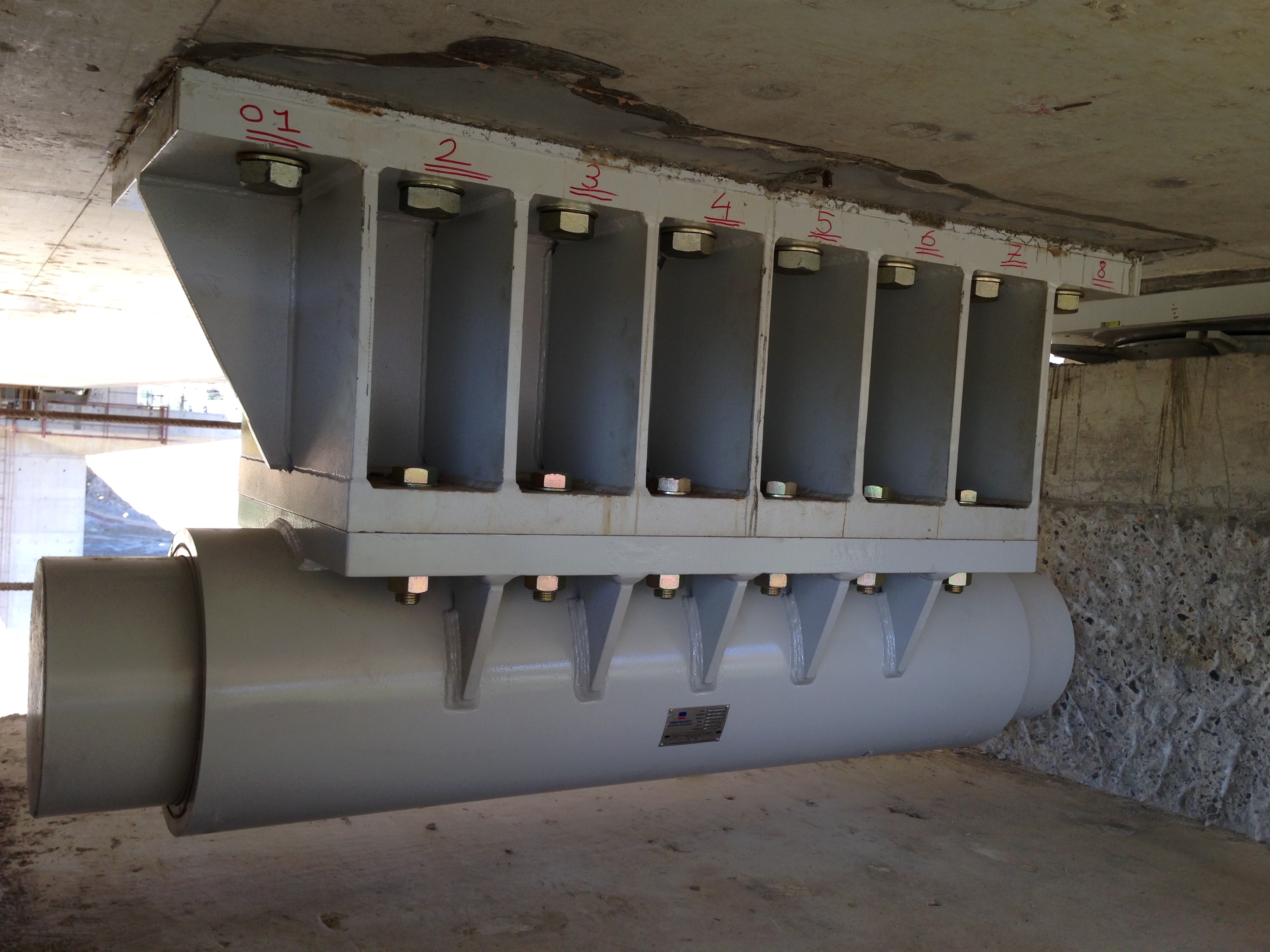 Transverse Isosism prestressed damping spring during installation
Freyssinet developed the Isosism earthquake protection range in accordance with NF EN 15129, which sets out the safety factors and validation tests applicable to such devices. A standard device catalogue has been produced to meet general specifications.
To protect the four viaducts in this project, two different options were considered: to choose standard types of device that could be selected from the catalogue, in order to optimise production, or to tailor the characteristics of the devices in order to minimise the forces on each pier and, as a result, the reinforcement of the piers and the dimensions of the piles. The decision was taken to use an intermediate option.
The overall earthquake protection system was designed iteratively, and this led to the use of a small number of types of device and other structural accessories. These included one type of prestressed damping spring with a range of strokes; one type of longitudinal fluid dampers with a range of damping levels; two types of transverse fluid dampers, with a range of damping levels; four types of pot bearing with different strokes; one type of laminated elastomeric bearing with different sliding plates; two types of fuse element and two types of expansion joint.
A comprehensive test procedure was established to certify the earthquake protection devices, based on NF EN 15129. This included pressure tests, where the strength of the devices was checked at 125% of nominal capacity; low-speed tests to ensure they met the behaviour requirements under slow movements such as those caused by thermal expansion; and behaviour law tests at up to 300mm/s and ±280mm stroke.
In addition the devices were tested for their ability to dissipate energy during repeated stress cycles; the strength of the seals throughout the service life of the devices was tested, and the total stroke of the devices was tested.
These tests were performed at Freyssinet’s Isolab laboratory and, for the higher speeds, at the laboratory of the Centro Europeo di Formazione e Ricerca in Ingegneria Sismica — European Centre for Training & Research in Earthquake Engineering in Italy. The tests were successful and confirmed the reliability of the product range.
Four structures on the BTZ line have been fitted with earthquake protection devices, enabling a reduction in the reinforcement of the piers and size of the piles. This led to a reduction in the overall cost of the project. The construction method optimisation which was carried out in parallel also resulted in the total duration of the project being shortened.
The devices were produced and tested while the initial construction work was being completed, and were installed on the structure after the launching operation. Three of the bridges are complete and the fourth is still under way. The line is expected to come into operation later this year, increasing services to the West Algiers region
Bassem Ben Hamadi is project manager and Charles Cynober is seismic engineer for Freyssinet