

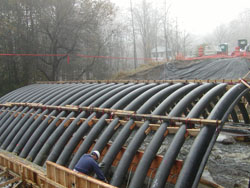
It is time for the bridge industry to start working towards a 'green' standard by which to design and build bridges. Scott Snelling suggests how this could work
Green design has entered the public consciousness and the mainstream newspapers and magazines. Taxpayers, voters, politicians and policy-makers want to be assured that public funds are being used to build environmentally-friendly infrastructure projects. The American Society of Civil Engineers recently launched an initiative to create a standard for defining and certifying green infrastructure projects and professionals. It is not yet clear when ASCE will be ready to roll-out such a standard or whether another organisation will be first to do so, but they are likely to be very similar to the standards that exist in other industries. The Leadership in Energy & Environmental Design standard certifies green buildings and is administered by the US Green Building Council, a non-profit organisation founded in 1993.
The Sustainable Project Rating Tool was developed by the US Army for its facilities - since 2000 all new army facilities and infrastructure has been built to green standards.
The International Federation of Consulting Engineers is developing a Sustainable Construction Assessment Standard and the UK's Institution of Civil Engineers already has its Civil Engineering Environmental Quality Assessment & Award Scheme - both of these are broadly applicable to civil engineering works, but are not bridge-specific.
Greenroads was introduced in the USA this year to certify roadway and pavement projects - it was developed at the University of Washington with funding from the federal US Department of Transportation as well as several state and regional departments. Greenroads documentation states: "A future system focussed on structures [bridges, tunnels and walls] could be incorporated into Greenroads, but none currently exists."
Of course such a green standard will need more than just a publisher, it will require a dedicated staff of professionals to audit project applications and documentation. Until this standard is available, however, bridge professionals can apply two primary green strategies to their work.
The first is to maximise the use of recycled materials, the second is to design for minimum life-cycle costs. Bridge owners who wish reduce environmental impacts can incorporate these strategies into requests for proposals for new bridge projects. Designers meanwhile, can use existing specifications for the recycled materials discussed below and may also consider the maintenance implications of their design decisions. Contractors can divert construction waste from landfill, and policy makers should fully fund bridge maintenance programmes in order to prevent wastefully premature rehabilitation and replacement projects.
Green design is about considering the environment as one of the design criteria, and including it as an integral part of the decision-making process on a project. The goals of green design are to reduce life-cycle costs, energy use, greenhouse gas emissions, pollution emissions, waste, and the use of non-renewable resources to sustainable levels. The American Society for Testing & Materials standard E2114 defines that sustainable development should 'meet the needs of the present without compromising the needs of future generations'. Engineers working in all industries, including the bridge industry, are responsible for making the necessary changes towards sustainable development.
Bridge projects already use many recycled and industrial by-product materials, but there are opportunities to specify more recycled materials while simultaneously reducing costs and increasing performance. Recycled materials that are relevant to bridge projects include steel, concrete, wearing surfaces, reinforced plastic piles, and construction waste.
Steel is already highly recycled and recycleable hence there is no opportunity for bridge engineers to specify green steel. Structural and reinforcing steel in the USA contains some 96% total recycled content (59% post-consumer) as a matter of course. Steel recycling is economically driven by the material's scrap value of approximately 25 cents per pound.
Concrete can be crushed and recycled - downcycled - as aggregate or fill, but has no scrap value, and recycled materials or by-products, such as mine tailings, can be used instead of virgin aggregate. However, the most significant environmental impacts of concrete are associated with cement production - the energy used and greenhouse gas emitted when concrete is produced vary drastically depending on what cement is used.
Portland cement is energy intensive to produce and is estimated to be responsible for 5% of the world's carbon dioxide emissions. China is the world's largest carbon dioxide emitter, 20% of which is attributed to its cement kilns. The production of Portland cement emits about one ton of carbon dioxide for every ton of cement produced.
Pozzolan cements, meanwhile, effectively require zero energy to produce, and emit no carbon in their production, since they are made of volanic soils or industrial by-products such as fly-ash, blast furnace slag, and silica fume. Typical bridge concrete specifications call for an admixture of 15% pozzolan cement to be blended with 85% Portland cement, but the majority of industrial by-product pozzolans continue to be landfilled and there is opportunity for bridge engineers to economically specify higher percentages of pozzolan cement. Only a proportion of the pozzolans that are landfilled are suitable for use as cement in structural concrete, however.
On projects which use standard design-bid-build procurement routes, concrete tends to be the traditional Portland cement-based mixes, for reasons of tradition as much as anything else.
But recent design-build projects have seen the successful use of concretes with high percentages of pozzolan cement - up to 85% - because they have proved to be the lowest-priced concrete meeting the required physical properties. The reductions in energy use, greenhouse gas emissions, and landfill have been regarded as happy side-effects. Such concretes may take hours longer to set, but can produce higher strength, lower permeability materials once cured. For example the Cooper River Bridge in Charleston, South Carolina was able to use uncoated rebar to meet its 100-year design life requirement, due to the low permeability of the high pozzolan-blend concrete. Meanwhile the new Saint Anthony Falls Bridge in Minneapolis, Minnesota received positive coverage in the New York Times for its use of environmentally-friendly pozzolan blend concrete.
Wearing surfaces commonly take advantage of many recycled materials such as, reclaimed asphalt pavement, reclaimed concrete pavement, tyre crumb rubber, shingles, and more. Using scrap tyre crumb rubber has been found to increase pavement life and reduce road noise. The Greenroads standard favours energy-efficient warm-mix pavements, instead of traditional hot-mixes. The User's guide for by-products and secondary use products in pavement construction published by the University of New Hampshire provides a thorough and up-to-date reference to existing standard specifications for recycled materials.
Reinforced recycled plastic piles have been successfully used for pier protection fenders on bridge projects. According to research by Joseph Alling of the US Naval Postgraduate School in 1998, although the costs per pile are nearly double that of timber, plastic piles have significantly lower life-cycle costs since they absorb more energy and