An ageing bridge only 30m in length and 46m in width would under normal circumstances not warrant nearly three years for replacement works. But in acknowledgement of the multitude and complexity of challenges that surround the East 138th Street Bridge’s replacement, this is the time span that has been contractually allocated.
The existing 1938-built East 138th Street Bridge serves around 150,000 vehicles per day and is located in downtown New York City, around 1.3km south of Yankee Stadium. It spans the Major Deegan Expressway and acts as a grade-separated diamond interchange. The bridge is only 8m away from Madison Avenue Bridge to the west, which is a primary access point to Manhattan across Harlem River. In addition to six lanes of vehicular traffic, it carries pedestrian and cycle lanes. It also forms part of the route of the high-profile New York Marathon.
Adding to the congestion is a plethora of every utility imaginable underground, including a 4.6m-wide, 3m-high combined storm and sanitary sewer line parallel to East 138th Street, running under the expressway below. To complicate matters further, the replacement project is charged with leaving a 17.6m-wide envelope below the new abutments in order to accommodate the possible future expansion of the aforementioned combined sewer line.
To deliver this complex project NYS DOT decided to use 3D model-based contracting rather than traditional 2D engineering plans. The aim was for the model to be detailed enough for use both for the tender process as well as for construction.
It is the second project in three years that NYS DOT has undertaken using 3D modelling technology, but the differences between the two couldn’t be starker. The replacement highway bridge carrying Route 28 over Esopus Creek was relatively straightforward, involving the construction of a 244m-long steel girder bridge in a rural environment (Bd&e issue 102) as opposed to a heavily congested urban location. The success of the first project served as proof of concept that NYS DOT’s new processes could enable 3D model plans to be used as contractual documents. It also provided confidence that the same process could be used again.
Preliminary concepts began to be produced in March 2020, with NYS DOT handling the majority of the bridge and road design in-house, using its preferred software, Bentley’s Openroads Designer, Openbridge Modeler, and Prostructures. A tripartite approach was taken to build the 3D model, with the roads and bridge aspects split between relevant departments at NYS DOT, and consultant Greenman-Pedersen appointed to undertake the utilities aspect.
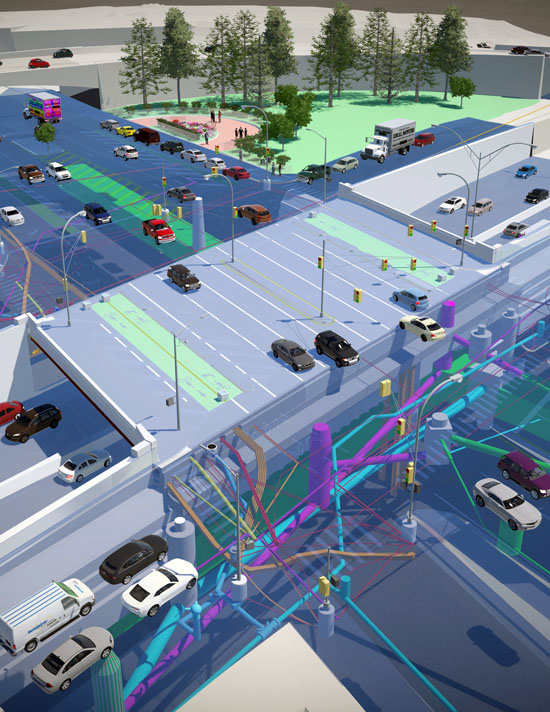
All records related to utilities in the area were requested from the various stakeholders and the locations verified on site. The incorporation into the model of the proposed and existing utilities – some of which were previously only represented in plans dating from the mid-1900s – is expected to prove advantageous during construction. “Just because we’ve modelled it doesn’t mean we know everything that is underground, right? There are always surprises that pop up and having the models available is going to allow us to be much more flexible and address any surprises more quickly when they do happen,” points out Brenda Crudele, NYS DOT director of structures design.
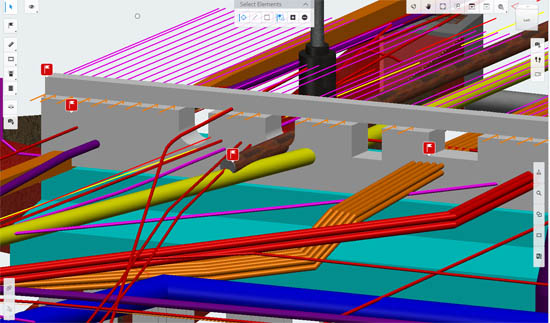
Clash detection using Itwin
During design, the model was shared with 180 reviewers across 15 agencies using the central platform Itwin Design Review software, a web-based service that enables users to review designs and raise issues (with due dates if necessary) without any additional software. This was found to be particularly useful at a time when NYS DOT staff were working from home due to the pandemic. “One issue we uncovered early on in the Itwin design review was that the proposed utilities didn’t match up to the penetrations modelled in the bridge back wall for the abutments,” says Zack Maybury, NYS DOT principal engineer and design squad leader. It was an issue easily remedied at modelling stage, “However, if this had been a traditional 2D project we might not have figured out the XZY coordinates didn’t correlate until much later, potentially during construction,” he says.
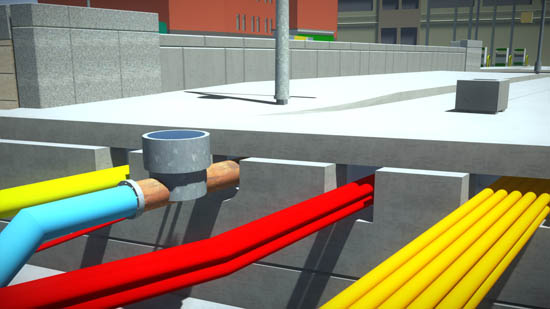
Clash detection resolved in Itwin
Creating a model containing both proposed and existing utilities – some of which were planned to be abandoned or removed, also raised some issues. “So we went about it in changing utility colours to signal which were existing or to be abandoned or removed, with additional information in the metadata. One of the first comments was that our proposed utility was running through an existing one, which we were able to remedy as the existing one was going to be abandoned. Under traditional 2D plans this could be simply signalled by hatching the line of the existing sewer or existing gas line and putting a little legend at the corner of the plan indicating it was going to be removed or abandoned. However, we don’t have the same means and methods in a 3D environment,” he says.
While dealing with the network of underground utilities beneath the structure provided a significant challenge, the decisive factor that drove the complexity of the project was the absolute need to maintain traffic flowing across the bridge during its construction. “We presented a number of alternatives for staging but none of them met the primary objectives due to the fact they didn’t have enough lanes available to serve Manhattan in AM hours and the traffic leaving Manhattan in PM hours,” says Maybury. After much stakeholder involvement, a final alternative was agreed upon that met the objective of keeping six lanes of traffic open, three eastbound and three westbound through the peak hours. “And then we were allowed some closures outside peak hours so we could facilitate some of the construction. Unfortunately, that resulted in a duration of construction that is almost three years,” says Maybury.
The complex construction sequence devised was communicated to stakeholders through the use of Bentley Synchro software. After importing the 3D model into Synchro, a 4D simulation could be built depicting the major steps of construction and traffic management. The more traditional approach would have involved hundreds of plan sheets and a lot more time, believe both Crudele and Maybury.
Accelerated bridge construction methodology is planned for the replacement of sections of the structure within a four-part staging process that involves demolishing a portion of the existing bridge, excavating, undertaking foundation work and then bridge construction.
So that the bridge deck can be placed relatively quickly at each stage, modular deck units formed by two steel girders with a precast concrete deck will be installed, followed by connecting UHPC closure pours. “In previous projects you demolish half the bridge, build, then demolish the other half and build. But due to the fact we had to keep so many of those lanes open, while providing access to bike and pedestrian traffic, that was the best solution we could come up with in order to fulfil all those objectives,” comments Maybury.
As the bridge is situated over a major expressway, with ramp intersections at each quadrant, the geometric tie-ins at each of the unique corner details for the bridge were focal points during 3D modelling. Each quadrant must tie into the existing elevations of the roadway ramps running perpendicular to the bridge. To resolve these geometric differences, the precast deck on the modular deck beams will be held back in the four corners of the bridge and cast in place after all the modular deck beams in a stage have been erected. This will allow for the variations in slope on the curb/pedestrian ramps to match up exactly in the field.
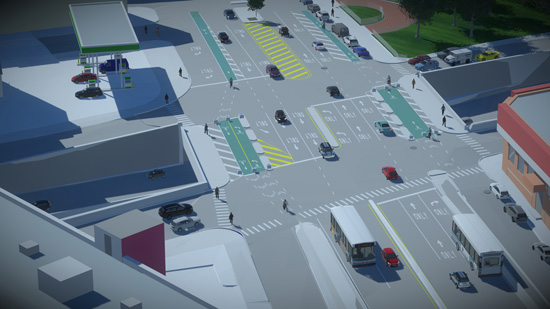
Rendering of the East 138th Street Bridge
The most complex structural challenge of the project is building the bridge abutment over the 17.6m-wide space reserved for the expansion of the outsized sewer line. In order to support the abutments, NYS DOT devised and modelled a solution that involves drilled shafts either side of the clearance envelope. These drill shafts will support a horizontal steel carry-beam system laid on concrete pedestals atop the shafts. “So we have a bridge to carry our abutments to carry our main bridge,” says Crudele.
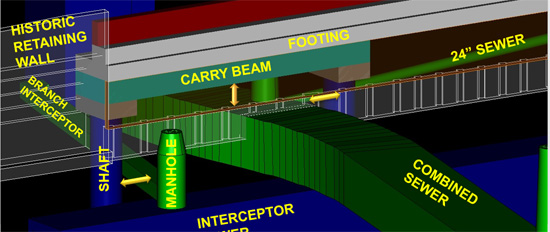
The carry beam provides a 17.6m-wide space below the abutment for the future expansion of the combined sewer
In summer 2021, NYS DOT awarded the US$47.4-million replacement project to ECCO III Enterprises.
As opposed to the first model-based contract that had been awarded for the Esopus Creek project, which was based on lowest price, this contract was awarded on best value. This means that one half of the bid was scored on price and the other based on a submitted proposal. “The bids themselves are not public, but I can say that there was only a 2% cost difference between the estimate bids for the top two, so we’re happy with that,” says Crudele.
The successful implementation of model-based contract delivery has been a steep yet useful learning curve, “We are now taking in all that feedback, all those lessons learned, and regrouping and determining what is our path forward,” says Crudele. “We’ve learned that it is challenging to do a complete project with a complete 3D model, and that there might be more low hanging fruit. There might be other ways where we can do a portion of the project with a 3D model, and get more benefit for the owner, ourselves, and the contractor, and make everything more efficient from design and construction exchange,” she says.
Although there are no model-based contracting projects in the horizon, going forward NYS DOT is looking to develop a digital approach towards asset management. “That is one of the things we’re going to be working on this year, how we can maintain that data throughout the lifecycle of a project, and the service life of that bridge or highway,” says Crudele. Among the questions to be answered relate to data management – where data is stored and how it is used by bridge inspectors who may be unused to working with 3D models. “We don’t expect them to jump into the full 3D model.
“Even though the information is fantastic and there, it’s not really accessible to everyone at this point,” says Crudele. “I would love to just export a file and give it to them.”
This article first appeared in Bd&e issue 106, published January 2022.