The Supreme Court of Korea has upheld a lower court judgment awarding damages to EDI after finding that its conceptual bridge designs were unlawfully copied in a submission for the Gyeongdo District Access Road (Inland-Island Bridge) Construction Project turnkey tender.
The Gyeongdo District Access Road project was first conceptualised between 2011 and 2013 by the Gwangyang Bay Area Free Economic Zone Authority (GFEZ). The turnkey tendering took place in 2020-2021, and the winning proposal came from a consortium led by Namyang Construction, which included Barum Design.
While the aesthetic design work for the winning submission was handled by Barum Design, the court found that the aesthetic form was misappropriated from EDI’s earlier conceptual designs, which had been developed years before for other projects.
The construction of the bridge began in May 2021 but faced significant delays due to partial route changes and shifts in the lead contractor. It is currently progressing with a target completion date of July 2027.
The legal battle began in May 2021. In the first instance, the district court ruled against EDI in June 2024, stating that “bridges are functional structures with limited engineering forms, and aesthetic similarities are inevitable due to the standardised nature of structural elements.”
However, in the second-instance appeal, the Suwon High Court reversed the decision in July 2025, recognising the bridge’s conceptual design as a copyrightable work and awarding KRW60 million (US$45,000) in damages – a portion of EDI's initial claim. In its ruling, the High Court emphasized that the creativity of functional works like bridges should be judged by whether their symbolic elements possess a distinct form and appearance.
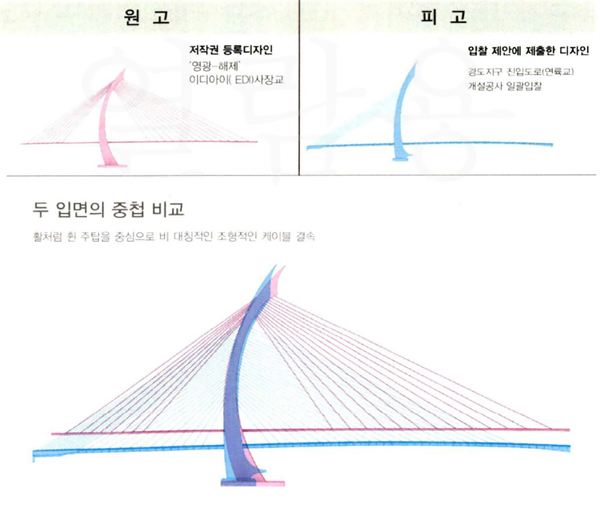
Comparison of both cable-stayed bridge designs, EDI design in pink (extracted from the Appraisal Report by the Korea Copyright Commission (October 2023))
The court stated, "EDI’s designs possess characteristics that are the product of the author’s mental effort, going beyond general expressions for practical function; thus, their creativity is fully recognized." The court specifically highlighted the originality in the curved pylons and symbolic arch forms. Furthermore, the court recognised ‘access’ to the original work, noting that a former EDI employee had joined Barum Design prior to the competition. The Supreme Court affirmed this ruling on December 4, 2025.
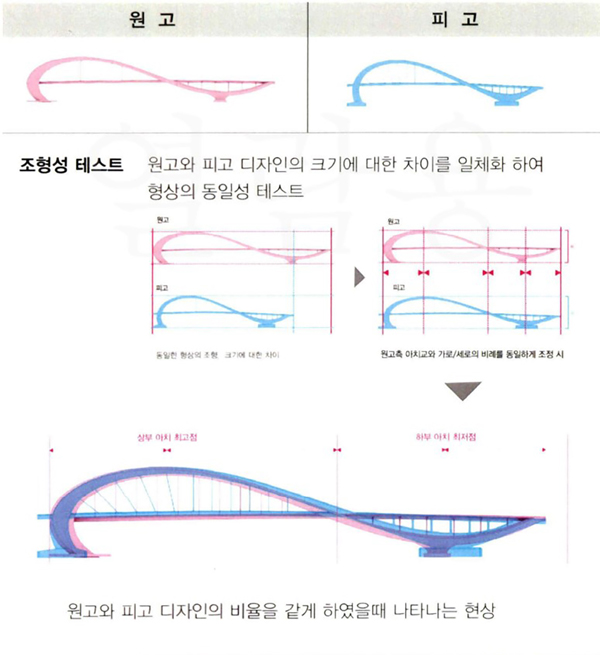
Comparison of both network arch bridge designs, EDI design in pink (extracted from the Appraisal Report by the Korea Copyright Commission (October 2023))
In the legal documents submitted during the proceedings, EDI clarified the purpose of the litigation: "Bridges remain part of our daily lives for 50 to 100 years. To create original landmarks that meet the public's demand for beautiful scenery, design competitions even assign points for aesthetics and landscape. Yet, the industry and authorities have remained indifferent to the illegal misappropriation of the core element to do that – the aesthetic design. This lawsuit was intended to send a wake-up call to the bridge industry and commissioning authorities."
As of late 2025, EDI is preparing follow-on legal actions against GFEZ and the consortium to resolve remaining intellectual property issues regarding the unauthorised use of its designs.