.bmp)
Many of the students set to use Princeton University’s new footbridge when it opens in autumn this year will be unaware that they are also participating in a research and educational programme. Conversely some of the students from the university’s civil engineering department will be all too knowledgeable about the structure, having helped to instrument and monitor it.
Created as a part of Princeton University’s Natural Sciences neighbourhood, the bridge will connect the western campus, which houses the Lewis-Sigler Institute for Integrative Genomics in the Icahn Laboratory and will have a new neuroscience and psychology building, currently under design, with the eastern side which is home to Jadwin Hall physics building, a new chemistry building, and Lewis Library.
As well as its functional purpose the bridge also has strong symbolic and aesthetic impacts; in addition, it is equipped with various monitoring systems with the intention of transforming this structure into a multipurpose research and teaching laboratory in the field of structural health monitoring and beyond.
According to designer Christian Menn, the alignment was more or less set; the bridge had to cross the main road and an access road to the Princeton Football Stadium, as well as connecting three university buildings. A smoothly-curved x-alignment on plan satisfied all these requirements.
The bridge is situated in a wooded area; Menn’s approach is always to try and preserve the existing landscape and to integrate his bridges as much as possible. For this reason he avoided use of a cable-stayed structure and proposed a light, elegant deck supported by branched columns formed of dark brown Corten steel. The single, slender columns result in an extremely transparent bridge, with the columns difficult to distinguish from the trunks of the trees.
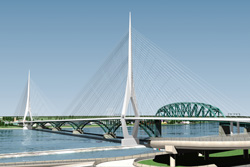
The structural system is unusual; the deck balances on a single, hinged arch, which runs along the central axis of the deck, and which is laterally stiffened by the deck. The analysis and the structural detailing of the bridge was quite demanding, says Menn, which is one of the reasons the structural engineering department used an extensive system of instruments to check the actual behaviour of the bridge.
The Streicker Bridge has a main span and four approach ‘legs’ creating the x-shape. Structurally, the main span is a deck-stiffened arch and the legs are curved continuous girders supported by steel columns. The legs are horizontally curved and the shape of the main span follows this curvature. Arch and columns are weathering steel while the deck is reinforced post-tensioned concrete. The slender and elegant deck-stiffened arch represents an efficient solution to bridge the span of 34.75m keeping the deck thickness of only 578mm and arch diameter of 324mm.
Malfunctioning of bridges can have serious consequences; even when there is no loss of life, populations suffer if infrastructure is partially or completely out of service. Structural deficiency has both direct and indirect economic impacts. The direct impact can be the cost of reconstruction, whereas the indirect impact involves losses in the other branches of the economy. Full collapse of heritage bridges, or bridges declared to be structural art monuments, also represents an irretrievable cultural loss for the society.
Structural health monitoring can help mitigate risks, prevent disasters, and enable owners to plan maintenance work in an optimal manner. The information obtained from such monitoring is used to plan and design maintenance activities, increase safety, verify hypotheses, reduce uncertainty, and widen the knowledge concerning the structure being monitored. SHM helps prevent the adverse social, economic, ecological, and aesthetic impacts that may occur in the case of structural deficiency, and is critical to the emergence of sustainable civil and environmental engineering. The need for structural health monitoring in recent decades has rapidly increased, but despite this, it is rarely used on real structures since an efficient approach for its implementation has not yet been developed.
Structural health monitoring has been applied to the Streicker Bridge with the aim of transforming it into an on-site laboratory for various research and educational purposes related but not limited to structural health monitoring.
The research will focus on an efficient general approach for widespread implementation of SHM, and it will address important SHM challenges such as collecting the long-term data sets necessary for understanding the real structural behaviour; identifying change in strain patterns caused by unusual behaviour and establishing robust damage detection algorithms; characterising SHM’s contribution to the sustainability of the built environment, and bridging the education gap between university research, industry, and practitioners.
Besides addressing general SHM challenges, four fields of research will be studied. Monitoring methods for deck-stiffened arches and curved continuous girders will be investigated; long-term performance of various types of sensors will be studied, such as short-gauge, long-gauge and truly distributed sensors; development and testing of new sensors and monitoring systems will be carried out, and SHM related to Streicker Bridge itself will include verification of the design, study of the long-term performance of the bridge, and long-term monitoring benefits.
Structural health monitoring of this bridge will also serve as a support to the university course on SHM and several other courses related to structural analysis and design, as well as to short courses given to practitioners.
Two fibre-optic sensing technologies are currently deployed: discrete long-gauge sensing technology based on Fibre Bragg-Gratings and truly distributed sensing technology based on Brillouin optical time domain analysis. Fibre-optic sensing technologies are used since the optical fibres have high sensitivity, durability and long-term stability. The FBG long-gauge sensors can monitor average strain, average shear strain, average curvature, deformed shape, and temperature in inhomogeneous materials such as concrete, and allow global structural monitoring in both static and high frequency dynamic mode.
The Brillouin optical time domain analysis sensors offer average strain, integrity, and temperature monitoring. Each type of sensor is interrogated by an appropriate proven and reliable high-performance reading unit. Collaboration with Smartec, a member of Roctest Group, and Micron Optics, and their prompt delivery of SHM instrumentation, made it possible to embed the sensors in concrete during the construction. Two different monitoring systems were applied in order to compare their performances and the two monitoring approaches they offer – structural monitoring based on long-gauge sensors and integrity monitoring based on truly distributed sensors. The monitoring system on Streicker Bridge will be gradually upgraded with the other state-of-the-art technologies.
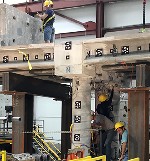
The instrumentation of the main span and south-east leg was carried out in August and October last year, respectively, mainly by undergraduate and graduate students of Princeton’s Department for Civil & Environmental Engineering, with assistance of Turner Construction Company and its subcontractors AG Construction Corporation and Vollers Excavating & Construction. Monitoring started straight after the concrete pour - at the creation of both the construction material and the structure. Data relating to important phases of the structure&r