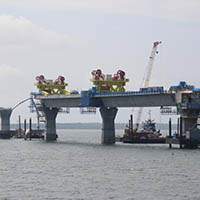
The pontoon repairs took place at a drydock where cracks were sealed to ensure that is watertight to meet its 75-year design life. But the contracting joint venture of Kiewit, General and Mason (KGM) has now towed the pontoon to a Manson facility on the Duwamish River to remove six round concrete columns built on the pontoon last year. A total of 10 round columns and two box columns were built on top of Pontoon W to support the future highway.
In December 2012, KGM determined one column needed to be replaced because the rebar cage inside the pontoon shifted slightly during the concrete pour. Since the first column was replaced, additional tests have shown that six other columns have the same construction issue. The remaining three columns have been approved through the quality assurance process and meet all contract requirements.
Since the contractor is responsible for the column repair and all associated costs, WSDOT gave KGM an opportunity to evaluate and propose potential repairs. KGM has determined that the best way to ensure that the columns meet all contract and quality requirements is to remove and replace these six columns.
KGM spokesman Tom Janssen said, “Kiewit/General/Manson is committed to the quality of the SR 520 Floating Bridge, and it is our responsibility to correct this issue. Our quality programme identified this issue and reported it to WSDOT. After additional testing and analysis, we determined that removing and replacing these six columns will help ensure the highest quality construction. The testing of other columns has ensured that they meet our strict standards and the specifications of the contract.”
Over the next three to four weeks, KGM crews working at the Manson construction facility will carefully remove the six, 17.7m-tall round concrete columns. The columns then will be reconstructed either in the Manson facility or on Lake Washington, depending on equipment availability. The removed columns will be dismantled and the concrete and steel rebar will be recycled.
The cracks on the pontoon itself stemmed from a WSDOT design error. Pontoon W is one of four first-cycle pontoons to undergo repairs due and the design error has been corrected by modifications in all pontoons built after the first cycle. Pontoon T was repaired in Portland and towed back to Lake Washington in August. “We’re very pleased with the results of the repairs implemented on pontoons T and W in drydock,” said Dave Becher, Washington State Department of Transportation construction manager for the project. “We have ensured the watertightness of these pontoons by using epoxy injection, transverse post-tensioning, and applying carbon fibre wrap - all repairs endorsed by our expert review panel.”
As of this month, 32 of 77 pontoons for the new floating bridge are now complete.