
East Bridge is one of six new crossings planned for an industrial area under development in the city of Chengdu near the newly opened Chengdu Tianfu International Airport. Currently under construction, the East Bridge spans Jiangxi River as well as a green space planned to follow the river’s flow through the city. In 2019, an international bridge competition was launched for each of the six structures, for which a consortium of Carlos Fernández Casado (CFC) and Shanghai Municipal Engineering Design Institute (SMEDI) presented three proposals, winning with their bid for Chengdu East Bridge. The client, Chengdu Hi-Tech Industrial Development Zone, required that the structure cross the river without the need for intermediate piers while also minimising the functional and visual impact on the adjacent park and connected pedestrian routes.
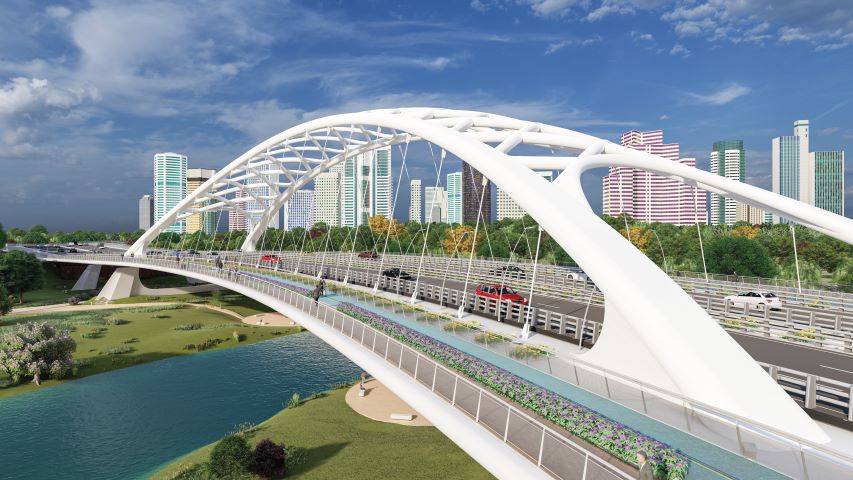
Original and innovative design solutions were also expected since the crossing was intended to become a future landmark in the new urban environment. “Since light girders were preferable to avoid bulky solutions, arch and cable-stayed bridges came naturally as the preferred options for this span range,” comments Javier Muñoz-Rojas, CFC’s project director for the Chengdu Bridges competition, adding that the selected solution comprises a self-anchored arch structure with a main span of 152m over the river and two additional spans of 24m and 36m. “The most relevant feature and challenge of the design was how to take advantage of the curvature of the road in plan in the structural solution,” he says.
The bridge axis in plan follows a curve with an initial radius of 350m followed by a transition of 500m radius connecting with a straight line. To avoid discontinuity between the road and the main structural element (the arch), a spatial arch solution with two lateral arch ribs following the road alignment was proposed. “This type of arrangement creates a non-planar geometry of the arches and hence out-of-plane forces on them”, says Muñoz-Rojas, “CFC had already explored the possibilities of these solutions in other projects, including Galindo River Bridge and Endarlatsa Bridge, both in the north of Spain.” There, different systems had been used to control the out-of-plane thrust for each bridge: active forces in the former and variable inertia adapted to the transverse forces in the latter.
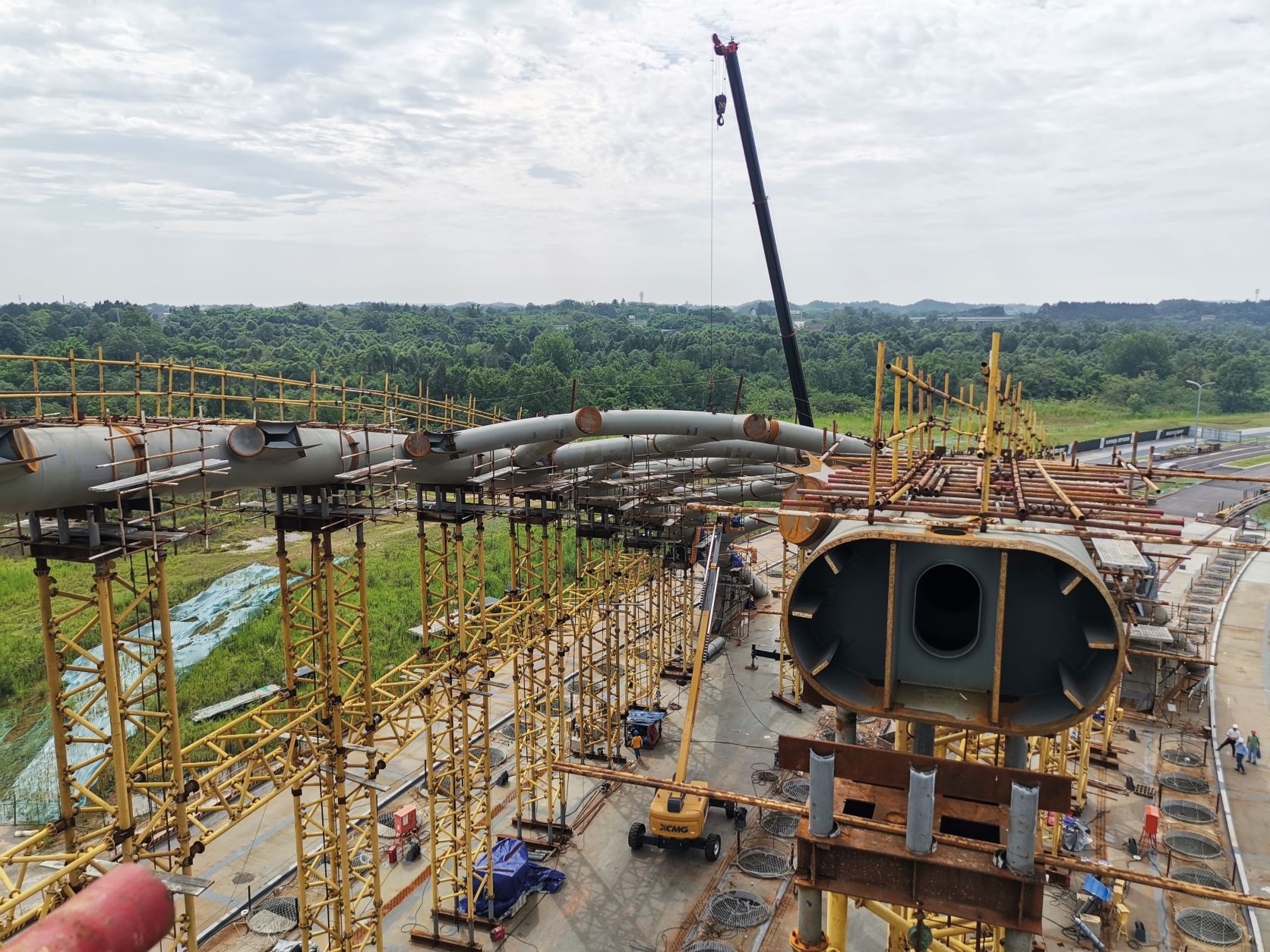 Cutting and welding the stiffening intersecting joints of the tubular sections has been one of the biggest construction challenges
For the East Bridge, however, a new option was explored through the use of transverse bracing between the arch ribs. The result is that the warped arch and its transverse bracing configure an efficient spatial work system avoiding large transverse bending moments in the arches, with deck girder stiffness and the inclined hangers also contributing to this structural response. The structural performance is more complex than with a straight bridge because the transverse bracing not only resists the horizontal actions caused by wind and/or seismic activity as in planar arches, but it also plays an important and active role in distributing the out-of-plane forces between the two arches under any load case.
To create a ‘vault’ effect over the deck and provide a more attractive end result, the transverse bracing is not planar but slightly curved in the vertical, which Muñoz-Rojas says creates dynamic and attractive perspectives both for the pedestrians and for the drivers, “turning the crossing of the bridge into a kind of special experience under a lattice roof”. The tubular steel pipes that make up the transverse bracing result in a plethora of intersecting joints across the bridge. “How to solve the static and fatigue safety problems of these intersecting joints became the biggest challenge for the design and the construction,” says Muñoz-Rojas.
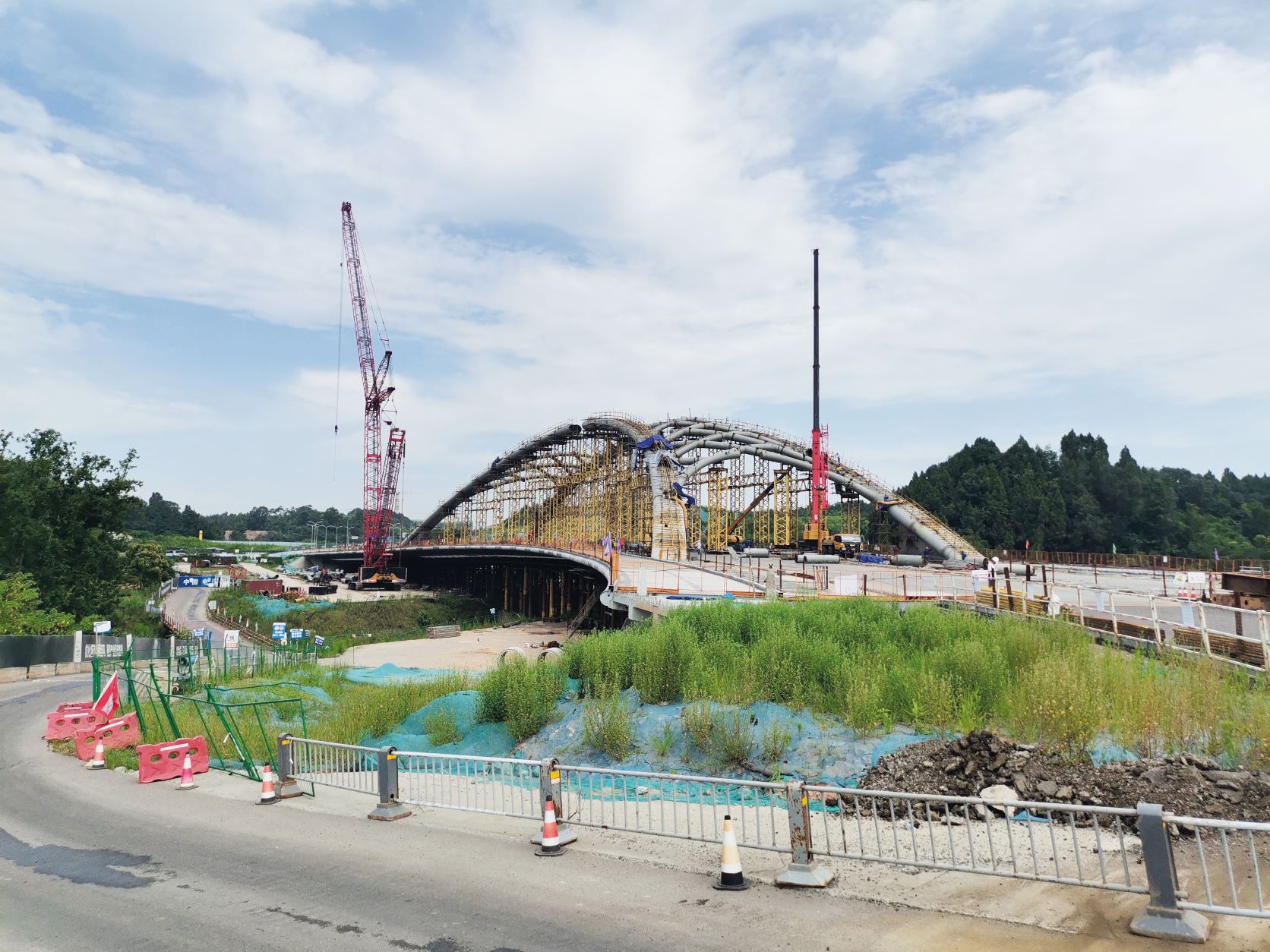 Construction has been under way since summer 2021, with deck and arch erection using a conventional construction system with temporary supports and shoring
The conceptual design and its structural validation during the tender stage was carried out by CFC using Sofistik. A full 3D FEM model was prepared combining beam elements for the arch and the girder steel grid and shell elements for the concrete slab. The analysis included a preliminary non-linear analysis to evaluate the response of the arch and its sensitivity to instabilities due to its non-planar configuration. The design of the joints between the arch and the transverse bracing was evaluated with the simplified formulae of tubular joints.
Chinese authorities and designers were not very familiar with the tubular joints in bridges as proposed for the transverse bracing connections. Accordingly, the initial solutions were discussed with the SMEDI team, resulting in additional internal plates being introduced to provide the tubular joints with extra-capacity due to the non-planar geometry.
Some details were also discussed to adapt the initial proposal to solutions frequently deployed on bridges in China. The most relevant was the modification of the initial composite concrete-steel girder to a pure steel solution with an orthotropic deck. As a result, the final design for the 50.2m-wide deck comprises two main longitudinal box girders connected with transverse beams supporting an orthotropic deck. Each box girder will carry three lanes of road traffic.
The detailed design was developed at SMEDI and led by chief bridge engineer Yue Guinping, Huang Hong, vice chief bridge engineer, and Ying Tianyi, project director of Chengdu Bridges, with CFC acting as advisor. The general analysis was carried out in Midas Civil, Ansys and Catia. During this phase of design, SMEDI carried out FEM analysis with solid elements to verify the X and K-joints under the most demand. This was complemented with scale lab tests of some singular T-nodes in the facilities of the Tongji University in Shanghai with satisfactory results.
A number of minor changes were introduced to simplify construction and erection. Details of the stiffening elements of the orthotropic slab were adapted for local uses because in China, open sections such as vertical plates or L-shaped sections are preferred to the U-shaped profiles that are more commonplace in Europe. “After this experience, we’ve learnt that orthotropic decks are also used or preferred on medium-sized bridges, whereas in Europe this solution is normally limited to very long span or movable bridges,” explains Muñoz-Rojas. Adjustments were made to the circular chamfers in the longitudinal main girders as well as to the geometry of the openings between the pedestrian and the vehicle areas and to the detailing of the hanger anchors in the arch.
In terms of user experience for pedestrians and cyclists, one key area of focus during design was to ensure that road traffic did not impinge on the pedestrian/cyclist experience across the bridge. “The proximity of traffic areas on long crossings can turn a walk into something definitively unpleasant,” comments Muñoz-Rojas. “On the East Bridge, a solution was applied to create independent areas for each of the mobility options, pedestrian, bicycle and vehicle. The first two modes of travel are placed at either side of the two girders, supported by transverse cantilevers.” The bridge’s 36 hangers anchor at deck level outside the traffic areas, which also creates a physical barrier and increases pedestrian comfort.
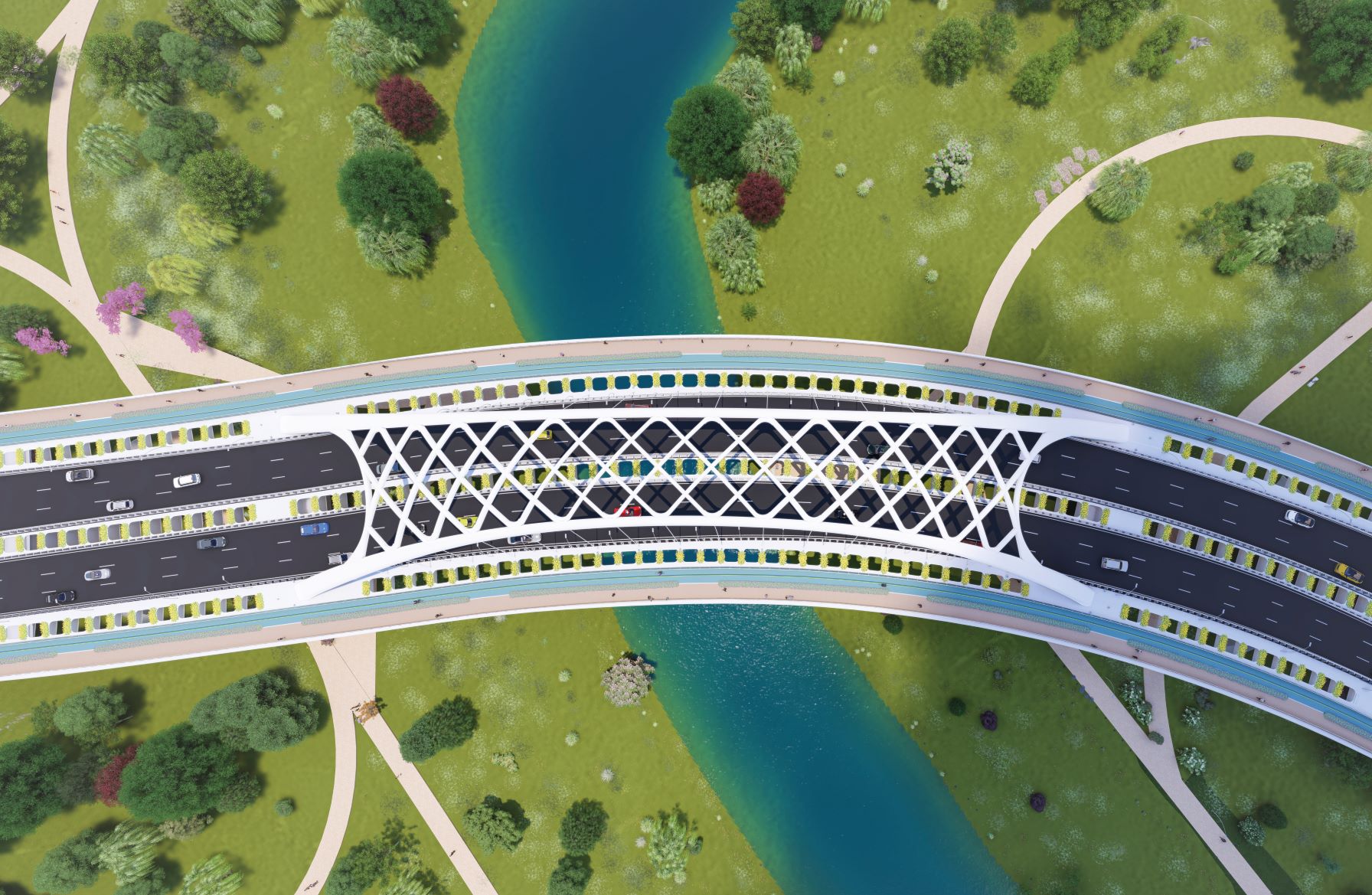 To avoid discontinuity between the road and the main structural element, a spatial arch solution with two lateral arch ribs following the road alignment was proposed.
This buffer is reinforced with planting along the length of the bridge between the hangers and cycle/pedestrian lanes, which helps create continuity between the bridge and the parkland. The experience of pedestrians walking under the bridge along the riverbank has also been carefully considered by creating numerous openings in the deck, which alternate with the sections of planting to allow natural light to pass through, thus avoiding a tunnel effect beneath the bridge.
Construction has been under way since summer 2021, with deck and arch erection using a conventional construction system with temporary supports and shoring. The deck, girder, arch and stiffening tubular elements have been fabricated by Jiangsu Huning Steel Structure & Machinery, which participated in the construction and installation of the Bird’s Nest stadium of the 2008 Beijing Olympic Games. The orthotropic deck and arch weigh in at 470kg and 170kg per square metre, respectively, while the entire bridge weighs some 7,770t.
Steel fabrication is complete, with cutting and welding of the stiffening intersecting joints of the tubular sections being one of the biggest challenges of construction to date, as well as fabricating spatial bending and torsional arch elements from oblate circular sections of large-size and thick high-strength steel. Meanwhile, virtual assembly has been carried out in Catia to enhance efficiencies on site, avoid clashes and improve safety.
Also finished are the foundations and piers, which are about 8m high and 43m wide. The piers are configured with two inclined elements with a variable architectural geometry at the edges of the longitudinal girder of the deck to support the arch. Forces are transmitted through sliding spherical bearings.
Meanwhile, erection of the steel arch structure over temporary supports has begun. According to the project timeline, works should be completed in the first quarter of next year, making East Bridge the first of the six bridge projects to be concluded.
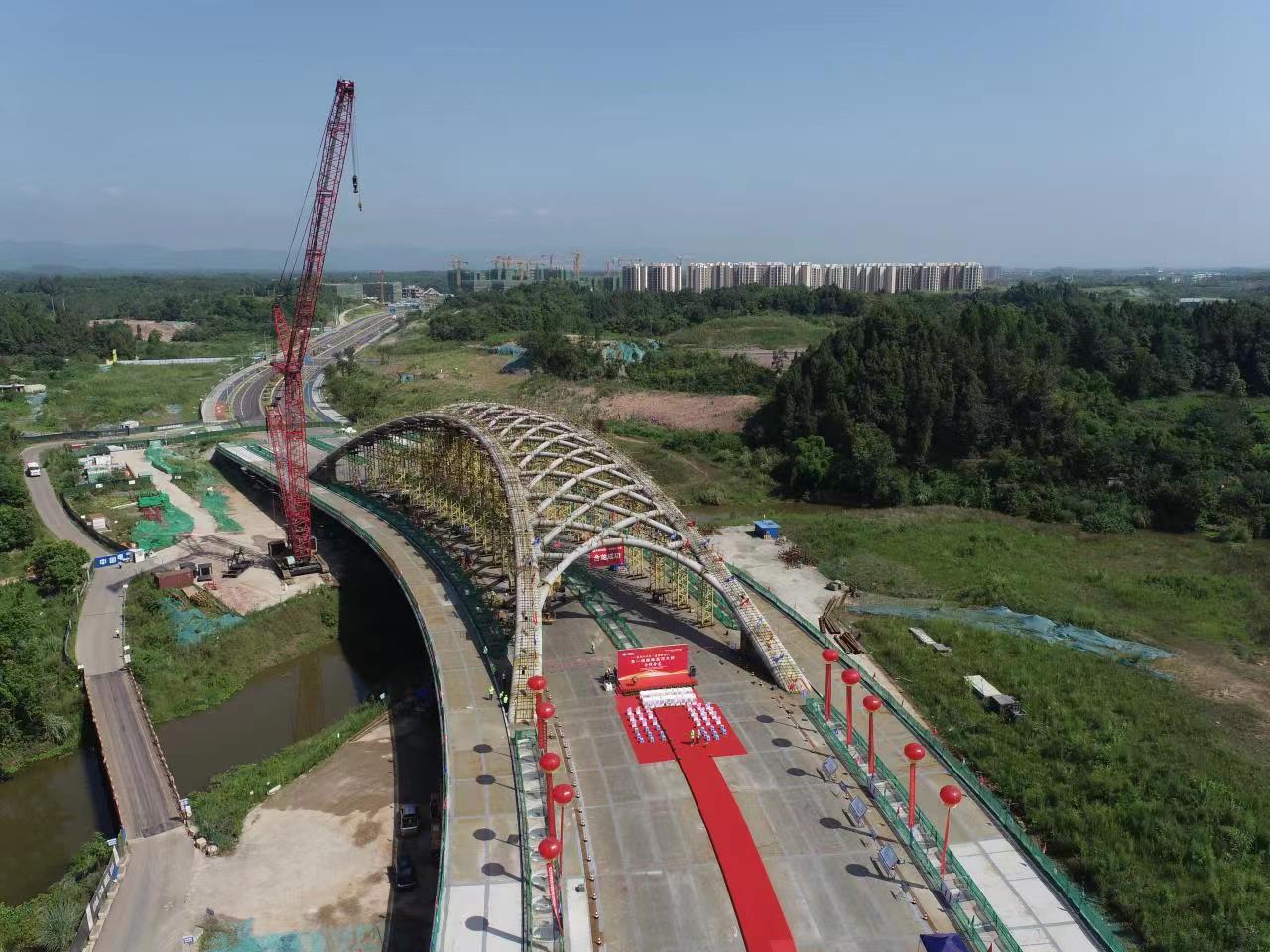 The bridge in early August