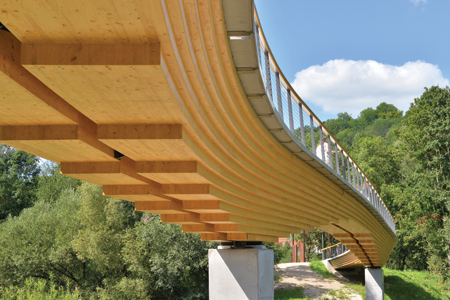
View of the underside showing the construction of the wooden superstructure (Fotograf Walther)
The need for a new bridge in Neckartenzlingen near Nürtingen in southeastern Germany has been under discussion for many years; now the town is celebrating the opening of an innovative timber structure. The town, in the unspoilt Neckar Valley, is located on a national cycle route which until this summer was confined to a busy road bridge. Cyclists had to use a narrow lane right next to the main road to travel into the town centre. With two lanes of highway traffic on the bridge, there was only space for a 1.5m-wide footway and cycle lane, and the bridge also had a dangerous junction for cyclists. The idea of a new cycle bridge over the Neckar was strongly supported.
However financial restrictions meant that the project had been on hold for some time, until funding for cycleway improvements became available from the state of Baden-Württemberg, opening up the opportunity for implementation. In March last year the authorities were finally in a position to start planning, at which point two options were considered.
The location for the new crossing – which is to south of the existing bridge – was selected at an early stage. This location provided the most cost-effective and attractive options for connecting to the long-distance cycle route. Separation of the cycleway from the main road allowed the route to be directed along an embankment; the impact on the natural area was kept to a minimum, but people would still be able to enjoy the unspoilt riverbank area.
Since the Neckar River curves at the bridge location, it seemed appropriate to choose an S-shaped plan geometry. As far as bridge type was concerned, two options were compared; a two-tower suspension bridge and an alternative with a continuous support beam mounted underneath with a ‘block laminated’ timber beams. This consists of glulam beams which are then glued together to form a block, hence the glueing process is in two directions.
The decision to select the latter was made both for design reasons, and also as regards bird protection. This option has no projecting components; while it is important to point out that there is no scientific evidence of any risk to birds from this type of bridge, this choice eliminated any danger of additional debate delaying the project.
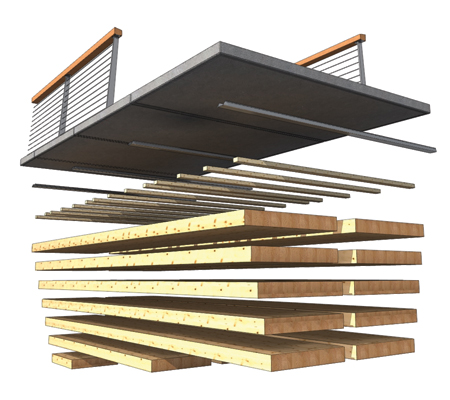
An exploded view of the bridge superstructure (IB-Miebach)
The block-laminated option also produced a distinctive feature using simple means, which is also created through the staggered and curved blocking tray made from glued laminated timber.
With a total length of 96.3m, it became obvious that dividing the bridge into three spans was a practical system, so that it crosses the Neckar River on a 44.5m-long free span in the middle of the structure, with two 25.9m-long spans, one on each side. For feasibility reasons, it was decided from the outset to provide a two-part cross-section, with a gap in the centre providing space for cable conduits.
The basis for the construction is defined as a simple, continuous three-span Gerber beam, the section height of which varies according to the bending moments. The variation in cross-section, which makes the bridge so visually distinctive, is due both to the statics and to efforts to optimise the production process of the wooden structure. For construction, glulam beams with a decreasing cross-section were simply stacked on top of one another and glued.
The idea was to emulate the form of timber cantilever bridges, whereby supporting elements are stacked one on top of another on the support point. Towards the end of each cantilever arm, the number of supporting elements is reduced, thus resulting in an aesthetic narrowing towards the centre.
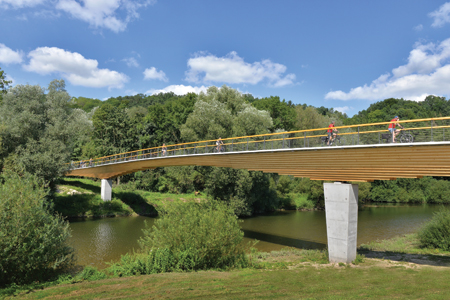
The bridge crosses the River Neckar in an unspoilt valley (Fotograf Walther)
In order to transcribe the static system into easy-to-produce components with cost-effective butt joints, the choice of Gerber hinge joints proved successful: in the central area of the main span, articulated joints were designed at the zero bending moment locations. This resulted in the piers each having cantilevers of approximately 36m, with the main span being completed by a drop-in section of approximately 24m length. The curved section produces torsional moments through the eccentric bearing on the support points; these are absorbed into the intermediate supports through fixed steel profiles. Torsion-resistant supports are likewise created at the abutments. The fixed profiles only transfer torsional moments and horizontal loads across the bridge axis and in order to ensure tension-free rotation around the Y-axis, sliding bearings are located on the flanges of the steel profiles.
The vertical loads are transferred into elastomeric bearings via support areas reinforced with fully-threaded screws. The coupling of the two adjoining blocks is done using transverse bulkheads which are connected with fully-threaded screws.
The choice of timber for the structure was a deliberate one, with integration into the unspoilt surroundings being one of the most important criteria. Also, the challenging geometry resulting from the two curved bridge elements particularly lent itself to the material. Economical construction can easily be achieved using compact glue-laminated timber construction.
Last but not least, the historical context of the location provides another reason for using timber. In the past, it was here that timber from the Black Forest was loaded onto rafts on the Neckar River, from where it travelled downstream to enter the European timber trade. This timber was an important source of income for Neckartenzlingen, and the nearby Zum Flößer hotel provides a reminder of this local tradition.
Having chosen a timber bridge, it was important to provide a system to protect the supporting structure against exposure to the weather and guarantee a long lifetime. This crucial function was allocated to the covering: precast concrete elements with a waterproof coating are placed on the timber structure, with ventilation provided below and water channels in the joint areas, to create a permanent ‘roof’ over the timber supporting structure.
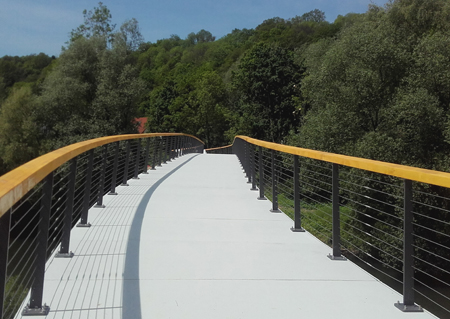
Bridge deck (IB-Miebach)
The concrete slabs are nearly 2m long and 3.6m wide – the same width as the bridge - hence there are only transverse joints. Since the ventilation gap has a height of approximately 50mm, drainage channels can be unobtrusively accommodated there.
In order to prevent driving rain coming at from the sides, the falling angle of which is specified in DIN 68800 in Germany as 30° to the vertical, the supporting structure has been designed to meet the recommended parameters. The shape of the staggered blocks is oriented along this 30° line and is protected by the protruding cover.
According to the BMVI (Federal Ministry of Transport & Digital Infrastructure), in theory protected wooden structures can have a lifespan of up to 60 years; potentially even 80 years, as claimed by a study carried out by the German Society for Wood Research.
Hence with suitable protection, timber structures could be considered to have a lifespan equivalent to bridges built of steel, reinforced concrete or other materials.
What’s more, with this timber protection concept, chemical systems are theoretically no longer required. In this case, only a primer for preventing fungal growth and blue stain, and repelling moisture and dirt was applied, in particular to prevent soiling of the supports during installation.
High-quality modern wood glue and bonding technology is a basic prerequisite for designing with timber. The development of high quality adhesives has been instrumental in timber becoming a high-performance industrial material. With finger-jointing technology and glue-lamination, large-scale glulam trusses with lengths of more than 45m can be created. These individual trusses, curved into almost any shape, are then glued into blocks. In this case, the block gluing can be done with perfect twisting and curving on two axes. In the process, high-quality adhesives guarantee that any knocks and cavities of up to 5mm that happen during production will be filled with a load-bearing material.
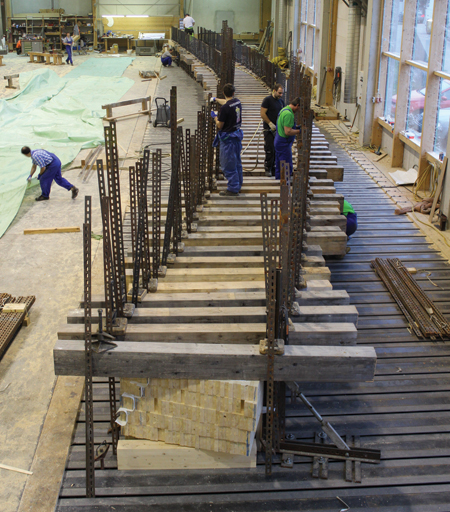
The glued elements are clamped together in the factory (Schaffitzel Holzindustrie)
In most cases, dimensions are limited by transportation requirements, and ultimately also the weight in some cases, since the most commonly-used cranes quickly reach their limit with individual cubic volumes of more than 50m3. Knowledge of the gluing process is helpful too, so that the open times – the time between application of the glue and closing of the presses – can be kept within the short permissible range. In block gluing, the gluing is mostly done manually owing to the large individual components, meaning that it must be individually glued and stacked support by support before they are braced in the glue press with large clamps.
By choosing staggered blocks instead of a diagonally cut cross-section, unnecessary wastage in the production was avoided and the economic efficiency was improved.
An innovative moisture monitoring system which should provide additional security has been used for the first time, in collaboration with the Fraunhofer Institute in Munich. The timber supports are at their maximum in the intermediate pier area where they are almost 2m high. Since protection against driving rain at less than 30° to the vertical has only a theoretical basis, the moisture monitoring system will provide increased assurance.
The structure was encased near the supports with wooden lamellae glued in three layers, between which two metal meshes are fully bonded in the form of an ‘intelligent glue joint’. These metal meshes with their central wood lamella can provide evidence about the moisture content of flat components through measurement of the electrical resistance. Compared to the solely selective measurements which were previously possible, this is a clear advantage.
A power supply connected to the lighting guarantees low-maintenance monitoring in the form of remote data transmission which enables the moisture content of the wood to be monitored in real time.
If, against all expectations, critical moisture values are recorded in the long term, then additional measures may have to be introduced. This includes the possibility of slat cladding on the sides with wooden boards in front of them. This form of timber protection is a tried and tested measure to combat direct weathering and moisture.
Foundations for the bridge generally use conventional construction methods. The intermediate pillars are founded on the Neckar gravel on flat foundations which were installed in relative safety from flooding, within watertight steel sheet piles. One particular difficulty was that increased flood protection, as required by the construction insurance for example, was simply not feasible. Higher sheet piles would have made it impossible for the bucket excavator to reach into the construction pit. Ultimately, in practice this issue was solved by careful site management and the establishment of action plans to be brought into operation at specific water levels.
At the abutments, where suitable founding material was up to 12m deep, a bored pile design was proposed. Three bored piles each with a diameter of 880mm were used to carry the vertical and horizontal forces, with pile lengths varying from 14m to 18m, on top of which reinforced concrete slabs were constructed. These pile head slabs, along with the chamber walls, form the end of the bridge. This combination of bored pile foundations at the abutments and surface foundations at the intermediate piers can only be used without a problem if the system is unaffected by settlement. Since the superstructure was designed to be flexible at two points owing to the Gerber joints and is thus statically determinate, this system will be unaffected by settlement.
Two ramps of 12m and 20m length form the ends of the bridge. These are surrounded on one side by trough-like supporting structures made from steel-reinforced concrete.
The use of a sustainable material such as timber was a decisive factor in the local authority’s decision. Timber is the only renewable raw material for load-bearing structures, and it has a very good ecological balance; for every 250m3 of timber used, some 250t of CO2 is locked away. Additionally, timber bridges like the one in Neckartenzlingen with its protection system have a very favourable durability when compared to steel or concrete bridges. This aspect must also be taken into account when considering the actual sustainability.
As well as the significant CO2 storage, appreciably less primary energy is required for production than with other materials and, at the end of its service life, the material is suitable for thermal disposal.
Before a timber solution was chosen, a steel box girder bridge with a similar, tapered shape was considered. However, the cost estimate carried out at the time anticipated a significantly higher financial outlay, so this option was not investigated further. The need for protection against corrosion for a steel box girder design was critically assessed; either an airtight box girder would have had to be fabricated, or accessibility would have been necessary, neither of which seemed ideal.
The decision by the Baden-Württemberg local authority to build a timber bridge not only strengthens the local timber industry but also actively promotes these sustainable timber structures.
The Minister of Forestry, Peter Hauk was present in person for the installation of the bridge in order to get his own impression of the innovative structure. “The climate change mitigation effect of timber from sustainable forestry is indisputable, and increasing numbers of communities are relying on the use of our timber,” he said. “With the construction of this unique bridge, Neckartenzlingen is highlighting the exemplary function of the public sector in this industry.”