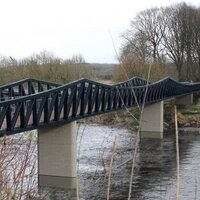

A recent volunteer mission to Ethiopia completed construction of a new footbridge over the Blue Nile River. William Billings tells his personal story of the expedition
Despite our continued efforts, the bus was not going to reach the summit of the Ethiopian mountains. It had overheated and we limped along for several miles, repeatedly stopping to wait for the engine to cool and adding more water. Now all 16 of us were forced to admit defeat. Having already travelled for three and a half hours from Bahir Dar on a bumpy dirt road, we would have to look for an alternative means of crossing the mountain to Mota, still several miles beyond the summit.
Eventually our leader, Ken, was able to hitch a ride on that lonely road and seek assistance. I was glad the sun was out, and it was not too hot, since we had to wait hours for help. But it was a spectacularly clear day with mild shirt-sleeve temperatures and the light was great for photographing the surrounding countryside. I had plenty of water to drink and I wasn't in charge of anything, so I enjoyed the unscheduled stop.
After a while some barefoot children came by, herding their goats and a cow. Some time later a family walked by beside their donkeys. Across the valley we saw dozens of small farms with ripening crops. On reflection, what a great place it was to be stranded! Several hours later a peculiar old bus rounded up by one of our team came to rescue us; the bridge-building expedition was on the move again.
It was November 2009 and Bridges to Prosperity founder Ken Frantz was leading a group of volunteers to the Blue Nile gorge, where we would build a new suspension bridge, replacing the 400-year old stone Sebara Dildiy ('broken bridge'). As a Rotarian I had raised money for the charity, but I had never been involved in any actual bridge building. In an hour-long telephone conversation, Ken had convinced me to go to Africa with his group of volunteers. His enthusiasm and his belief that more than 200,000 people stand to benefit from the new bridge was contagious.
The mission was returning to the site of the very bridge that first spurred Ken Frantz to set up Bridges to Prosperity eight years ago. Since he carried out the first repair on the bridge, continued deforestation has led to higher floods, to the extent that it was no longer feasible to repair the old bridge.
Construction of a new suspension bridge had started earlier in 2009, higher up the slopes of the gorge, above the flood waters. The latest mission involved a group of 24 volunteers and Rotarians from the USA and Ethiopia converging on the bridge site to install the decking and fencing, and complete the approaches.
After agreeing to go, I realised that I didn't know any of the other volunteers, and that began to worry me. What kind of person would actually volunteer for such a project? You had to pay your own way, take 18-hour flights, sleep on rocks after trekking 16 miles, and then work all day in scorching hot sun in an area infested with malaria-carrying mosquitoes. It certainly wouldn't be a bunch of couch potatoes. I wouldn't meet the other volunteers until we checked in for our flights from Dulles Airport in Washington, DC and I began to worry that the others might be gung-ho, macho types. That really concerned me; in my experience, macho outdoorsmen were usually incredibly fit and robust. They paid little attention to pain and seemed to place no value on creature comforts.
I had just passed my 64th birthday, and was still recovering from two thyroid cancer surgeries. As a part of my recovery plan, I had been cycling several miles a day, so I was confident I could walk the 16 miles, but it would have to be at reasonable pace.
Packing for the trip was very stressful. Each time I went over the recommended list I pictured more disasters that could happen. Thoughts of sprained ankles, infected cuts, serious falls, heat exhaustion, dehydration, and intestinal problems were all running around in my head. Making the process more difficult was the anti-malaria drug I was taking; apparently Mefloquine can increase anxiety and I was already feeling extremely anxious! I concentrated on the packing list and upgraded any questionable backpacking equipment. This was to be my first adventure where I was not in charge or acting as a guide, however since I was not responsible for anything, I also had no control!
At Dulles, I discovered our group included, among others, a professional life guard, an Alaskan mountain guide, a military survival instructor, a young college student, a guy who swims between continents for kicks, and a retired man who spends his time climbing mountains around the world. This was going to be interesting. We flew to Addis Ababa then on to Bahir Dar where we rented a bus and began what was to be a tortuous journey to Mota, the closest village to the bridge site.
As far as I was concerned, building a suspension bridge couldn't possibly be as difficult as actually getting to the bridge site. The most difficult leg of the trip was the 16-mile trek from Mota, 4,500 feet down to the Blue Nile River gorge. The good news was that we didn't have to carry our camping equipment, food or water - we had hired porters to do that. The bad news was that we had walk 16 miles, or worse yet, ride a donkey. I have ridden horses most of my life, but the thought of riding a tiny donkey down a treacherous mountain trail with a steep drop was unnerving. I decided that I would just take my time, enjoy the scenery and walk the entire way. I trusted my old feet a lot more than I trusted a little donkey.
When we departed Mota, the trail was busy with people coming from the opposite direction. Our fellow travellers were from the surrounding countryside and were heading to the market in Mota. We saw people laden with everything including live chickens, all sorts of bags, wood, and anything else they wanted to sell. All of them had handsome faces and wore colourful clothing. The countryside was beautiful and so very peaceful. In less than an hour we had left behind all signs of modern life and been transported to back country. The first half of the walk was fairly easy; we were high on the Ethiopian Plateau, and there was a cooling breeze. I found this part of the trek magical, because of the timeless beauty of the area. No power lines, no telephone poles, no fence posts, no roads, no billboards, and no litter; not even so much as a candy bar wrapper. Just small farm plots, a few animals herded by children and a grass hut every now and again. The red dusty trail was deeply rutted and covered with prints of bare feet. I had three small digital cameras, nine charged batteries and seven 8GB memory cards. I was ready!
As the trail led on, the steeper terrain became much more difficult and I had to work to keep my footing on the loose soil. As we lost elevation, we also lost the cooling breeze, and the trail became steeper and narrower. It was at about this time that Corey fell off his donkey as he ducked to avoid some wicked thorns hanging over the trail. Fortunately, he wasn't hurt, but it reinforced my decision to stay off the animals. I was taking my time and was eventually passed by everyone in our group, except the three hikers who were officially assigned with bringing up the rear. Heidi, Brigitte, and Corey were barely in their thirties and were all in top physical condition. They made their livings as lifeguards, and mountain guides so I was relieved that they were very understanding when I explained that I had to pace myself and take a ten-minute break every hour.
Each time I stopped to rest and check my blisters, an older Ethiopian lady, carrying two nine-foot planks for our bridge, would pass me. She was barefoot, had no trekking pole