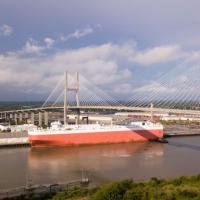
30 Years of Innovation, Integrity, and Ingenuity

Khalil Doghri, 62, vice president, Freyssinet
Freyssinet carries the name of Eugène Freyssinet, the visionary French engineer who invented and patented the technique of prestressed concrete. His pioneering spirit laid the foundation for a company — and a discipline — defined by pushing boundaries. When I joined the company in 1987, that legacy was alive and well, vivid. We were already working on complex bridge structures that demanded not just technical expertise, but creativity, collaboration, and courage.
This was a time when construction was evolving fast and was implemented before standards could set boundaries to development. This was an era of exciting technical progress, during which all stakeholders would jointly develop their know-how and understanding to meet a given project need. In the late 1980s, engineering was still largely analogue. Drawings were done by hand, calculations were manual, and site coordination relied on phone calls, faxes and face-to-face meetings. Over the years, we’ve witnessed a digital revolution: CAD gave way to BIM, and today we work with digital twins, real-time monitoring, and AI-assisted design. These tools have not only increased precision — they’ve transformed how we think, plan, and build. This greatly contributed to the shortening of project durations. For instance, the Normandy Bridge project was launched in 1987, after several years of design from the French administration (Setra), and the bridge was opened to service in 1995.
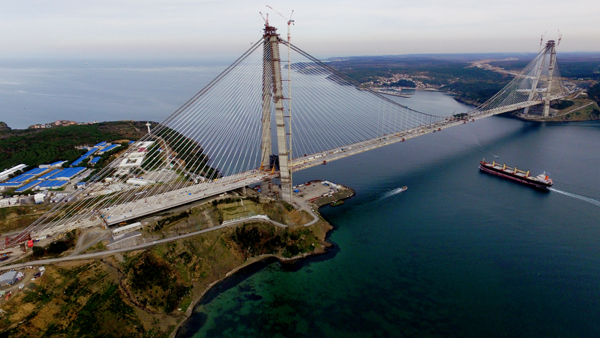
The Yavuz Sultan Selim Bridge in Turkey was constructed in less than three years
More recently, the Yavuz Sultan Selim Bridge project launched as a design-and-build contract in 2012: Construction started mid-2013 for an opening in 2016. The Normandy Bridge was the foundation for some incredible technological advances and new methods of design and construction, while construction time was divided by two or more. Things just go faster nowadays, and it seems AI, parametric design and integrated digitalised processes for design and build will push this trend even further.
Throughout my career, I’ve had the privilege of contributing to projects that not only pushed technical boundaries but also set new benchmarks in our field. I was lucky enough to be involved in several very different positions that allowed me to embrace the complexity and the diversity of the construction industry from different perspectives.
As I started as a structural and technical engineer, I had the opportunity to embark on some highly technical projects that allowed me to gain a real expertise, as well as a taste for the engineering of projects. When constructed in the 90s, the cable-stayed Normandy Bridge in France held the world record for span length at 850m. It was a milestone in cable-stayed bridge design, using parallel prestressed concrete strands and, for the first time, Freyssinet’s Isotension system. Imrahor Bridge in Ankara, Turkey is a cast in-situ balanced cantilever bridge where form travellers were used to build a single box girder accommodating four traffic lanes.
I later moved to some more commercial and operational positions, throughout the world, and finally was appointed regional manager for the Middle East, where I could be part of projects that supported the region’s development boom. This included the Dubai Metro Phase 1 in 2005: spanning 57km, this project marked a turning point in urban transit where we deployed steel launching gantries for segmental span-by-span deck construction. In 2016 there followed the KAFD Monorail in Riyadh, Saudi Arabia. This modern monorail system was formed of precast, post-tensioned curved beams — a complex yet elegant solution for navigating the district’s architectural landscape.
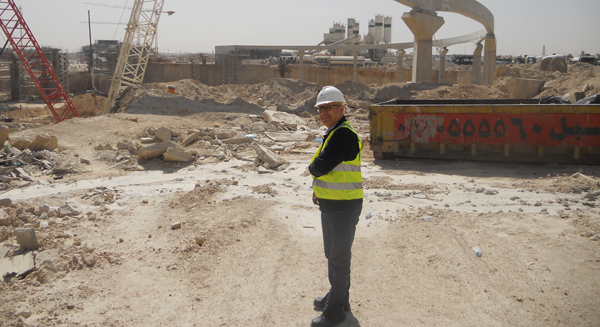
Khalil Doghri at the site of the King Abdullah Financial District monorail in Riyadh, Saudi Arabia
In 2019, I had the opportunity to set up the first concrete 3D printing factory in Dubai, marking a pioneering step for the Middle East. This experience allowed me to explore how to promote a new and innovative technology within the relatively conservative world of construction.
Concrete 3D printing is still in its early stages and requires further development before it can be fully integrated into mainstream construction practices, especially in bridge building. However, once matured, this technology promises significant benefits, including the ability to create complex shapes without formwork, reduced use of concrete, and minimised steel reinforcement — contributing to both design freedom and sustainability.
Over the years, I’ve also witnessed some significant evolutions in regulations and materials, which have reshaped how we design and build: The introduction of the BPEL code in France, followed by the adoption of the Eurocodes, have all have emphasised the use of ultimate limit states for both concrete and steel. The use of high and ultra-high compressive strength concrete has opened new possibilities in terms of slenderness, durability, and load-bearing capacity. Together with 3D printing, they offer some possibilities we could only have dreamed of 15 years ago.
We have also seen durability and sustainability clearly become a — if not the — key topic in the construction industry. I would even say that it has been the cornerstone of Freyssinet’s approach over the past 25 years. This has resulted in several innovations in post-tensioning protection, including new grouting materials and sheathed and greased strands for external cables, but also many innovations in asset preservation techniques that we now implement on a daily basis. Lastly, as regards seismic and dynamic protection, we have developed and installed anti-seismic devices and damping systems for bridges in seismic zones and cable-stayed structures.
One of the most important evolutions I’ve witnessed is the growing emphasis on assets, infrastructures and bridge maintenance and rehabilitation. Extending the service life of existing structures is not only a matter of safety, it is a cornerstone of sustainable infrastructure and economic responsibility. This is part of what every civil engineer should aim at. It also chimes well with the way our company was founded — one of the first application of the post-tensioning technique was to stop the sinking of the Havre marine station. But this approach was not acknowledged as an industry priority until after the unfortunate high-visibility collapses witnessed in the past 15 years, such as the Genoa Viaduct collapse, which have acted as a real trigger within the industry.
In this arena, Freyssinet has become a key player in the post-tensioning domain, applying advanced techniques such as cathodic protection of steel, external prestressing reinforcement, carbon fibre reinforcement of concrete members, and high-strength shotcrete used for the reinforcement of concrete and it preservations. As an engineer, being involved in such a pivotal era is highly fulfilling and exciting, as it requires addressing technical issues within our infrastructure with a fresh eye.
Another major trend of recent decades has been the rise of aesthetics and urban integration, where the architecture of bridges has taken on a new level of importance. No longer seen as purely functional structures, bridges are now designed to enhance the visual identity of cities and landscapes. Their shapes, materials, and integration into the environment and local landscapes are carefully considered — not just by engineers and architects, but by the communities they serve. It is an opportunity to keep innovating and keep the pioneering spirit alive. Being part of an architectural approach, whenever relevant, challenges our structure-oriented mind while allowing engineering to receive yet more recognition.
One of the most significant evolutions is the transformation of the safety culture. Thirty years ago, safety was often seen as a checklist box — important, but not always central to project planning, if ever addressed. Today, it is a core value, deeply embedded in every phase of construction and engineering, and in all everyday behaviours.
The introduction and widespread adoption of full personal protective equipment — helmets, high-visibility clothing, protective glasses, gloves, and safety boots, earplugs, harnesses — has become standard across all bridges sites. But safety goes far beyond equipment, it is a full approach. We now implement safety inductions for every worker and visitor entering a site; daily pre-task meetings focused on the specific risk of the day; dedicated access systems to ensure safe movement at height and in confined spaces; specific training programmes tailored to each role and risk level; and comprehensive safety plans which are integrated to quality assurance and construction methods. This has not only reduced accidents, but it has also fostered a mindset of shared responsibility and continuous improvement.
What will the next three decades bring? I believe we’ll see even greater integration of data, automation, and sustainability. Modular construction, AI-driven maintenance, and climate-adaptive infrastructure will become the norm. But just as important will be the values we carry forward: integrity, curiosity, and a commitment to the public good.
Looking back, I’m grateful for the journey that Freyssinet has afforded me. It has been more than a company — it’s been a school, a family, and a platform for innovation. I’ve seen bridges rise all-over the world in different countries and cities, and I have been lucky to meet many passionate fellow engineers from different backgrounds and countries. And through it all, I’ve seen our discipline grow — not just in complexity, but in purpose.
BIM – the next 30 years

Vanja Samec, 64, chair of IABSE Task Group 5.6 – BIM in Structure Management
Bridges are a vital, but also extremely vulnerable part of transportation infrastructure. Infrastructure growth mirrors the changing demands of population expansion, and as the global population continues to increase — projected to reach 9–10 billion by 2050 — our infrastructure systems, particularly bridges, will come under increasing stress. With higher load cycles from both passenger and cargo transport, as well as more extreme weather events due to climate change, bridge networks worldwide are expected to operate under even more challenging conditions.
Environmental pressures and the ageing of bridge structures already present significant hurdles for owners and operators. Over the next 30 years, these challenges will multiply. Historically, the bridge industry has placed priority on design and construction, often at the expense of digitalisation in operation and maintenance (O&M). Yet O&M is not only the longest phase of a bridge’s life cycle — it is also the costliest. Looking forward, it is expected that this imbalance will be corrected, with increasing emphasis on digital strategies to support inspection, evaluation, and intervention planning throughout the service life of bridges.
The task of managing ageing infrastructure is only growing in complexity. Around the world, bridge authorities struggle with massive volumes of inspection data, a lack of common standards, and fragmented digital systems. A universal and open digital framework for bridge management is becoming an essential requirement. In this regard, the digital transformation of the bridge sector will be a defining trend of the next 30 years.
Digital transformation involves more than adopting new tools. It represents a fundamental restructuring of how infrastructure is designed, operated, and maintained. In the future, artificial intelligence, cloud and edge computing, big data analytics, robotics, and next-generation sensors will converge to create fully connected ecosystems. In such a system, assets — represented as digital twins — will continuously communicate, forming the backbone of a bridge-focused Internet of Things (IoT). Smart bridges will not be a futuristic concept — they will become the expected standard.
In practical terms, the bridge community is moving towards broader adoption of digital solutions. High-end bridge software must continue to be grounded in deep engineering knowledge, and its application should remain focused on quality, sustainability, and safety. As we look to the future, critical factors like increasing bridge ages, climate impacts, and bridge collapses will continue to push owners toward preventive, rather than reactive, maintenance. The shift from periodic inspections to real-time monitoring, and from manual documentation to intelligent data analysis, will define the next generation of bridge asset management.
Since 2020, I have chaired Task Group 5.6 within IABSE Commission 5, which is dedicated to existing bridges. The group’s focus is on integrating Bridge Management Systems (BMS) with BIM technologies using open standards. Our members, drawn from both industry and academia, represent a wide geographic and professional range, and the group continues to grow. The vision is to develop an open, transparent digital ecosystem that connects asset-level data (inventory, condition, risk) with structural-level data (modelling, performance, deterioration) through interoperable BIM workflows.
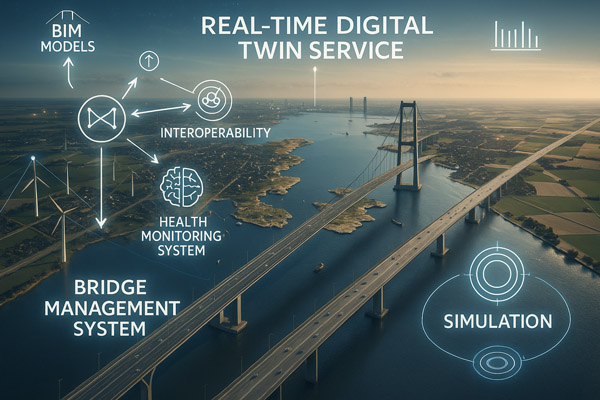
A glimpse of the future: the full integration of bridge management systems with BIM technologies
The next 30 years will demand BMS that are not only digitally integrated but also capable of supporting real-time and predictive analysis. These systems must enable full lifecycle tracking of changes — from design to as-built to as-maintained to as-demolished — including updates from structural monitoring systems, sensor data, and visual inspections. Open BIM technologies, supporting semantic, technical, and organisational interoperability, will be essential for this transformation.
Our task group conducted a global survey to understand bridge owner perspectives on BIM. We received 28 responses from 15 countries across Asia, Australia, North and South America, and Europe. The results were illuminating. While most bridge owners (over 75%) already assign unique identification codes to their bridges, major gaps remain. A lack of standardisation across inspection and maintenance platforms remains a significant barrier. Furthermore, most owners still rely on 2D documents, with limited integration of 3D or 4D BIM. Yet the demand for more visual and real-time information is increasing.
In the coming decades, bridge managers will expect — and require — systems that offer not only data storage but also visualisation, simulation, and decision support. Key functionalities will include:
- Accurate geolocation and visualisation of damages and deformations within the 3D model.
- Use of augmented reality and mobile technologies to support efficient inspection and data entry.
- The ability to issue tenders and manage contracts based on detailed digital models.
- Long-term forecasts of structural condition based on actual performance data.
- Integration of traffic loads, weather data, and environmental conditions into deterioration models.
One of the most persistent obstacles to achieving this vision is the availability of accurate and updated BIM models. While ‘as-designed’ models may exist, ‘as-built’ and especially ‘as-is’ models are frequently missing. To address this, future bridge projects must include comprehensive digital deliverables from the outset. Retrofitting digital twins to existing bridges is also essential.
Governments will play a major role. In South Korea, for example, BIM deliverables are already mandated for public infrastructure. Such policies will likely expand. Meanwhile, bridge owners must also consider data and cybersecurity. As BIM becomes a central data hub, user access control and secure collaboration become essential requirements.
In conclusion, while bridge professionals already recognise the transformative potential of BIM, the full benefits will only be realised through greater standardisation, improved tools, and stronger integration across systems. BIM and BMS will evolve as linked, data-rich frameworks that support more effective and efficient bridge management — not only informing O&M but also feeding valuable insights back into design.
Over the next 30 years, bridges will no longer be managed as static objects but as dynamic, responsive systems. Digital models will not just describe what a bridge is, but predict what it will become.