
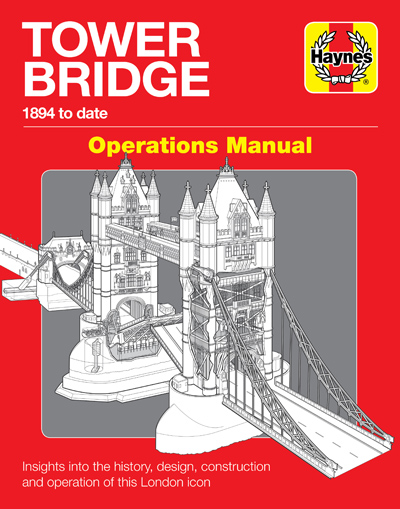
By John M Smith
Published by Haynes Publishing
ISBN: 978 1 78521 649 7
Price: £25/US$29.95
www.haynes.com
For the uninitiated, the Haynes Manuals are a series of practical guides primarily focussed on the maintenance and repair of automotive vehicles.
Founded in 1960, the company has sought to diversify its output in recent years, producing light-hearted parodies of its own products on topics such as ‘Babies’ and ‘The French’. This latest edition is also a departure from Haynes’s traditional product line, but although there is little opportunity for a garage tinkerer to get their hands greasy on a 42m-tall combined bascule and suspension bridge, the book instils a deeper appreciation of the feats achieved in the bridge’s construction, and should appeal to the publisher’s core audience of engineering enthusiasts.
The author starts by creating a strong impression of the historical context that drove the bridge’s inception, and does an excellent job of describing the infrastructural problems faced by the city in the 1800s, as well as the variety of bold solutions put forward to overcome them by building a river crossing east of London Bridge.
These include a double swing bridge and a transporter bridge with the capacity to carry 100 vehicles and 1,400 pedestrians on a platform transported by rollers.
The inherent complexity of some of the concepts makes it seem unlikely they would have stood the test of time had they been realised, but their inclusion sets the stage nicely for the writer to explore the development of the winning proposal by architect Horace Jones.
Smith does not spare the reader any detail on the way the design was received by sections of the engineering community at the time, providing quotes from The Engineer that reveal a lukewarm reaction: “The shape and position of the curved chains, the combination of such chains and bracing with a lattice or trussed girder, are all ideas long ago exploded as an erroneous system of construction.”
However, as emphasised in the book itself, the design did evolve – albeit not as much as The Engineer might have wanted – and the author uses a combination of pictures, his own words and those of structural engineer John Wolfe Barry to walk the reader through that process.
In general, images are used very effectively to punctuate Tower Bridge’s 125-year story, and the various Victorian technical drawings and renderings presented are pieces of art in themselves.
While these are rightly given the page space they deserve, it is a shame that some of the modern photos are not so impressively displayed, with one or two noticeably low-resolution offerings present.
Nonetheless, the narrative is strong enough for this to be a minor gripe, and the journey continues in the latter third of this nine-chapter book by delving deeper into the lives and careers of the key figures behind the bridge’s creation and the ways the structure has evolved since its completion in 1894.
Perhaps the most underappreciated of these changes is the fact that in 1960 the burden of the dead weight of the high-level walkways was moved from the outer footway girders to the superstructure of the main towers, and the writer dedicates much of Chapter 7 to ensuring this detail does not escape the reader.
As Smith writes, “Tower Bridge was designed to deliver an extremely high level of availability”, and the fact that it still does 125 years after its construction is testament to the work of not only those that contributed to its construction in the first place, but also those who have replaced and renovated components since then to allow the structure to remain fit for purpose.
This Haynes Manual underscores the most salient points on that journey and skilfully delineates the devil in the detail. In an age where planned obsolescence has engendered a throwaway culture and a sustained lack of investment sees many bridges irreparably damaged by the ravages of time, London’s iconic Tower Bridge serves as a reminder of what can be accomplished with proper servicing.
This perhaps epitomises the mission of the Haynes Manual, whose creator John Haynes sadly passed away in February, three months before this charming edition was published.
Khalifa Bokhammas