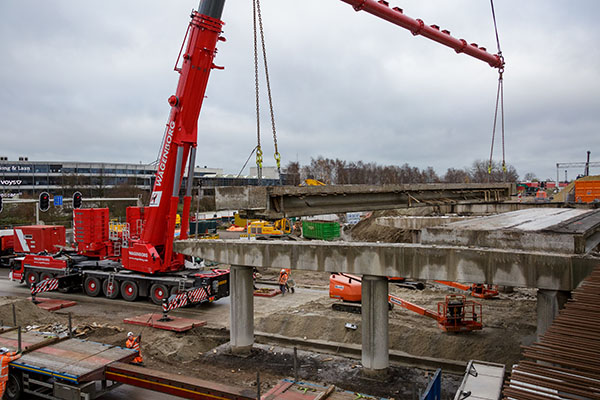
Girders were retrieved from the Europaweg Viaduct carrying the A7 expressway in Groningen
Within the aim of achieving sustainability and circularity, more and more concrete structures in the Netherlands are being fully or partially reused after demolishing. However, the crushing of concrete elements for reuse can be regarded as 'downgrading' the material, while the possibility of dismantling complete structural elements from existing structures is seen as a challenging procedure, not least because existing structural precast elements are often built with 'wet connections' that usually must be cut out. Additionally, for the design of new structures it is important to know beforehand what reusable elements are available and potentially suitable for reuse.
That there is currently no clear regulation on how reclaimed concrete elements can be incorporated into new structures is something that constructors and the competent authority in the Netherlands are highly aware of. CROW-CUR Guideline 4:2023 is expected to go some way into remedying the situation by identifying the pain points and providing practical guidance for each step of the way.
At the start of the collaboration a pre-advisory committee was set up to ascertain the views of the Dutch concrete sector. This was followed by identifying the type of information that would be relevant for this process as well as finding out the knowledge gaps for the potential reuse of concrete elements in the short and long term.
It should be noted that only factory-made, precast concrete of non-residential, residential, and civil structures currently fall within the scope of this guidance, but in-situ cast concrete elements may be a next step that will extend the scope of the guidance. Indeed a start has been made to develop a basic assessment methodology for the quality of concrete elements. At this stage, the guidance aims to provide clarity to the concrete sector on the best options for reuse of concrete elements that have been removed during the course of construction works.
The guidance provides information about the reuse of prefabricated concrete elements in newly designed structures and existing structures with added concrete elements. It aims to boost confidence in the construction chain with regard to quality assurance when reusing prefab concrete elements. While the guidance seeks to provide practical, added value to the process, it is not a working document because the reuse of prefabricated concrete elements is still a relatively unexplored practice, with many developments of techniques, methodologies, testing and regulations still remaining. General considerations for reuse of precast concrete elements are provided, however.
The guidance consists of a general part and two appendices. One appendix deals with hollow core slabs and another with prefabricated prestressed bridge girders. It is foreseen that, just like for the European standards under EN 13369, more appendices for specific structural precast concrete elements will be added to this guidance in the future.
Guidance for the entire reuse process is covered, starting with collecting information about the elements and the current situation in which they are applied. In general, if more information is readily available of the existing structure/element, this supports the correct decision-making in the reuse process. Reuse may also be possible when not all information is available, but this does lead to more uncertainties and cost increases, since missing information needs to be retrieved via the implementation of (non-)destructively tests.
In order to decide whether or not elements require dismantling, one should (ideally) not only have insight into the original design of the structure and the element, but also know how the reused elements could be applied in further projects. After all, seldom is a new project the same as the ‘donor’ project. Adding complexity to the situation is clarity around when the decision to dismantle particular elements is – or should be - taken, a significant factor that can not only hinder the dismantling process but also reduce the possibility of future reuse. In the opinion of the authors, precast prestressed concrete elements should always be dismantled for reuse. We call this mind-shift ‘reuse, unless…’.
The next step in the reuse process is dismantling the elements from the existing structure. The guidance indicates which steps must be followed in this process and which matters must be considered. It is important to label the elements accordingly, and subsequently keep each element’s ‘passport’ fully up to date. Additional attention should be given to ensuring the integrity and stability of the structure during dismantling and further transport, as well as the safety of those carrying out these processes.
The guidance pays a significant amount of attention to the processes between disassembly and reuse. Activities during this step of the reuse process are storage, inspection, modification, repair, finishing and delivery of the elements. However, it is important to mention that not all these steps are necessarily applicable. The most sustainable result is achieved if elements are adjusted as little as possible to fit within the new construction project. One should also look critically at any damage – which may have been caused during disassembly or processing – for potential repair. In many cases such damage may be only cosmetic and thus not affect the structural safety or durability of the element.
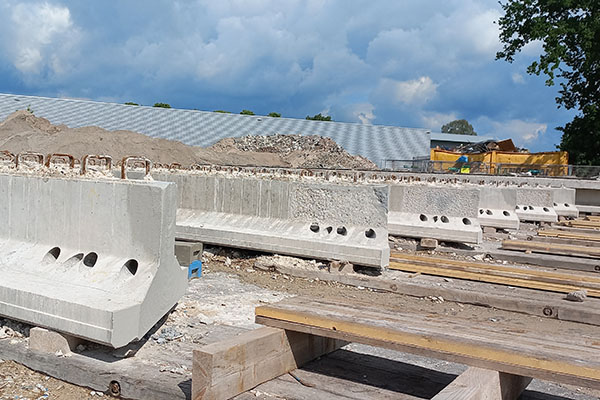
Girders in storage after modification for reuse
The same approach holds for performing tests on strength or durability of the existing elements, as the elements’ original design and performance – as ascertained during their first ‘design life’ – should provide sufficient assurance regarding any applicable deterioration mechanisms that could affect the elements.
Reused elements must be integrated into new designs. The process of linking the supply of an existing element to the demand for the design of a new structure is called ‘matchmaking’. The guidance distinguishes between two ways in which matchmaking can take place. First is demand-driven matchmaking. In this case, a design is made for a new structure and an element is sought that fits, or that can be made to fit, within the preconditions of the design.
The second matchmaking method is supply-driven, where elements that are already available - or will be in the short term - are first explored within the database or hub location. The design of the new structure is then based on the preconditions offered by these elements. In almost all cases, the most circular result can be achieved through the supply-driven application of reused elements.
In both matchmaking routes, elements have to be stored for a certain period between the time of dismantlement and reuse. Accordingly, attention should be paid to storage conditions that preserve the elements well, for example as regards climatic influence, support position and the load-bearing capacity of the subsurface.
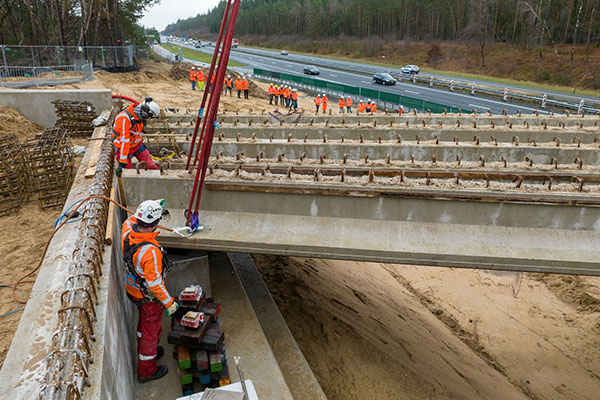
The end spans of a viaduct over the A1 expressway were constructed using 16 girders removed from the Europaweg Viaduct
For the use of existing elements in new structures, structural safety must be demonstrated by means of a calculation. However, there are currently no specific standards for this kind of structural assessment with reused elements. The guidance states that although the target reliability level must always be new construction (Eurocode), attenuation paths can be used in consultation with the competent authority.
In the Netherlands, it is possible to use a capacity determination according to standards for existing concrete structures (NEN 8702), which often allows a higher shear capacity to be calculated. As precast producers use a ‘standard’ mix per element type, it is possible to derive safe, lower-bound values of the actual concrete strength based on previous tests on these structures. Only if more strength is required are extra tests needed on a few elements, in order to prove the increased concrete strength. In addition, it is possible to assume a lower assessment level under the label of 'reconstruction', with a lower reliability than that on which the Eurocode is based. Another mitigation path that is provided is an adapted traffic load model, in which case an element could, for example, be reused outside of the main road network if the traffic loads in the main road network cannot be met.
Finally, advice is provided regarding the onward transport of the reused element. An important aspect here pertains to the lifting/transport plan. In order to be able to carry out proper management and maintenance in the future - and to have the possibility of reuse (third life) - it is necessary to retain all relevant information. The guidance provides guidance on what information is relevant for the delivery (‘passport’) file.
The authors hope that with this guidance the process of reusing structural concrete elements will be boosted. Every reused element can save about 90% on carbon emissions when compared with new materials, so it is a way of making a major positive impact on our environment and society. Our ambition for the near future is to transform this guidance into a directive or code, so that reuse can soon become ‘business as usual’.
Ad van Leest and Geoffrey van Bolderen are, respectively, project manager and technology consultant at CROW. Danny Jilissen is structural engineer and Rob Vergoossen is expert in concrete bridges, both at Royal HaskoningDHV.
CROW-CUR Guideline 4: 2023 is available as a hard copy (in Dutch) at www.crow.nl/publicaties/crow-cur-richtlijn-4-2023-hergebruik-constructieve
The guide can also be freely downloaded after (free) account creation on the CROW online platform at www.crow.nl