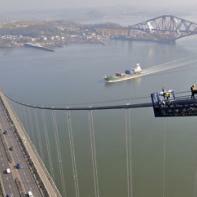
Workers began the compaction operation on 14 April and are using four hydraulic compaction devices to compress the 137 individual strands for the cable, which is almost a mile (1.6km) long. The SAS is the signature element of the new East Span of the Bay Bridge and crews are scheduled to complete the compaction of its single main cable by 7 May.
The project for client Caltrans is being built by a joint venture of American Bridge and Fluor Enterprises to a design by TY Lin International and Weidlinger Associates.
Compaction began at the top of the 160m-tall single tower. Workers move the compactor down toward the road decks, with the assistance of winches, 1.5m at a time. The compactor places temporary galvanised carbon steel bands around the main cable at 1.5m intervals. The strands are also compacted between the jacking and deviation saddles as they pass around the western end of the span. The cable is not compacted at the top of the tower as the individual strands pass through a cable saddle. Crews use a different compactor as the cable approaches the road decks at the east end of the span.
After compaction, workers will begin attaching the 114 cable bands, which permanently hold the cable strands and also serve as anchor points for the suspender cables on the main cable. The temporary bands are removed as the permanent cable bands are attached.
The cable weighs approximately 4,800 tonnes. Each strand contains 127 high-tensile strength steel wires, for a total of 17,399 wires.
It is the longest single looped suspension bridge cable in the world. Unlike traditional suspension bridges where the cables are anchored into the ground, the self-anchored suspension bridge’s cable is anchored in the road decks.