Fundamental shift in roles and perception
Poul Ove Jensen, 87, Dissing+Weitling
When I worked on my very first bridge project some 30 years ago, the bridge world was, in many ways, very different from what it is today. Most important for me as an architect has been the change of people’s perception of bridges; the new role for architects in the bridge design process; and the development of computer-based design and communication tools.
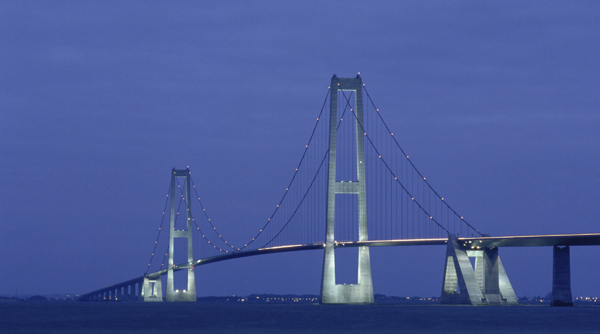
The Great Belt Link links the islands of Zealand and Funen in Denmark
The project was the Great Belt Link which had been the dream of the Danish nation since the 19th century. Now it was going to be realised but – surprisingly – most of the population was against it. However, at that time opposition to new bridges was not just a Danish phenomenon. Perhaps that was not surprising, because in the post war period there had been a rapid development with a general focus on speed and costs. Many brutal large infrastructure projects marred cities and landscapes and the impact on the environment was often disregarded. That was considered the price for development but it led to widespread resentment against infrastructure.
However, by the end of the 20th century there was a growing concern for the environment. The Great Belt Link authority is one example of a client that recognised that the impact on marine life and the waterflow in the Belt should be minimised. The visual environment was also considered and they insisted that the bridge should be beautiful. And, again surprisingly, at the opening of the bridge the public opinion changed completely. Suddenly everybody loved the bridge.
I think the Great Belt Link and the public’s reactions to it were typical at that time, and I see the end of the century as a significant turning point in bridge design. Bridge authorities around the world gradually realised the need to consider their bridges’ impact on the environment and that bridges could be more than a solution to traffic. The potential of bridges as symbols was rediscovered: a bridge could be a landmark, a focal point and a tourist attraction. It could be used to brand a city or a nation.
During this period there were several international bridge design competitions with a strong focus on aesthetics. I was lucky enough to be on the winning team of two of them, Poole Harbour in the UK and Stonecutters in Hong Kong. In both competition briefs the importance of aesthetics was stressed and for Stonecutters it should be the focal point of the city.
Suddenly all clients wanted a bridge that was unique, a so-called signature bridge or, to use a somewhat misused word, an icon. This created a fantastic new market for architects. Previously architects were rarely involved in bridge design and when they were, the task was usually nothing more than beautifying engineering design. Now we were needed for concept development. The architecture was no longer an add-on but an integral part of the design.
There is, however, a flipside of the coin. As a result of the demand for something unique, many designs are wildly expressive and contrived. Bridges may attract some immediate interest, the famous 15 minutes of fame, but will be forgotten because they lack the timeless beauty that bridges designed for a lifetime of 125 years should have. Often such designs turn out to be unbuildable or prohibitively expensive.
A fundamental change in all bridge design work came with the development of computer technology. When we worked on the Great Belt project the engineers did DWG 2D drawings and to some extent also used computer programs for structural calculations. We architects made our drawings and hundreds of cardboard models by hand. It was a tedious and time-consuming task compared to the electronic tools used today. These tools have not just made the work faster and easier but have also made it possible to design structures that were unthinkable 30 years ago, technically as well as aesthetically.
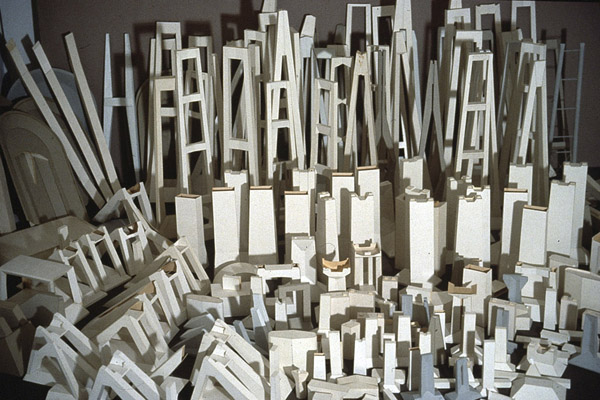
Dissing + Weitling's cache of cardboard bridge models
The change came gradually. It began slowly with 2D CAD drawings. Initially the programs were slow, and primitive compared to today’s Revit. Then came the 3D programs, also slow, complicated and used only for presentation purposes. But we were all excited. Gradually they became more advanced and today there are no presentations without perfectly photorealistic visualisations, even with drive-through or fly through videos. However, all of this is made primarily for presentation and marketing purposes and doesn’t lead to more beautiful bridges.
The real change came when 3D modelling became a design tool. Computer programs that were fast and easy to use totally changed the design process. When we today start working on a new project, we may begin with a few rough hand sketches, but we go 3D on day one. First, simple models of one or more concepts based on the design brief, then you detail and optimise until you can zoom in on the option you believe in.
One advantage of this process is that modifications that would take hours to make by hand can be done with just a few mouse clicks. Another advantage is that it is possible to make models of highly complex structural forms that would have been impossible to visualise by hand. But most importantly is that at any stage of the process you can view the model from all angles and ensure that you are on the right track.
All these tools offer an opportunity to refine and lift your designs to a new level. However, it must be kept in mind that these wonderful programs are merely tools that don’t provide solutions. Pretty picture doesn’t mean pretty bridges.
In the design process, efficient communication with engineers and other members of the design team is vital. The introduction of the internet and e-mail was a revolution that made communication fast and easy. The next step was virtual communication platforms like Teams and Zoom that made long distance collaboration possible without expensive air travel. Most recently, online whiteboards like Miro have made it possible to ensure all members of an international team are on the same page.
While in my view face-to-face meetings are still ideal, during the corona pandemic lockdown we all learned that it was possible to establish a good and efficient working relationship regardless of where in the world the other team members were located.
Digitalisation has led to an unprecedented internationalisation of bridge design work. The entire world has become a potential marketplace for us architects, and it has made it possible for our small firm to operate in some 40 countries around the world. Adding to our previously core markets in the so-called Western world of Europe and North America we now have the Middle East, India and Southeast Asia.
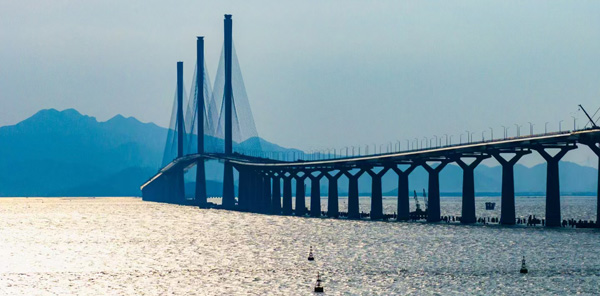
The triple-towered, cable-stayed Huangmaohai Bridge in Guangdong, China
Of those, China stands out as the largest. In the last 20 years an enormous number of bridges have been built there, perhaps more than in the rest of the world altogether. The engineering is mostly done by highly competent local engineers, but the market is open to foreign architects. After being part of the winning scheme in two international Chinese design competitions, we established a working relationship with a large engineering institute. Together, we have worked on a considerable number of very large bridge projects. There is always a strong emphasis on the appearance of a bridge and, while bridges in Europe tend to be quite expressive, in China harmony is the key word, reflecting the general Chinese culture.
A considerable part of our work in recent years has been replacement of bridges built only 50 to 60 years ago. Some need to be replaced due to lack of maintenance or deterioration which have made them unsafe, but also because most no longer can cope with today’s traffic loads. Their designers just couldn’t envisage today’s number of vehicles and their weight.
This is not surprising but nevertheless we are designing bridges for a lifetime of 125 years based on today’s modes of traffic and traffic loads. It is unlikely that the traffic in 125 years will be anything comparable with the current practice of privately owned and driven vehicles. How are people going to use the bridges we build in 2150? I think this is something worth thinking about.
Another issue that needs to be addressed is sustainability. 30 years ago, when I worked on the Great Belt Link the environmental concern was mainly about reduction of the blocking effect at the waterflow through the Belt, and the impact on the marine life. Today, the reduction of the carbon footprint touches upon all aspects of bridge building. Carbon emissions must be minimised not only during fabrication and construction but also when the bridge is in operation. It must also be ensured that its materials are recyclable in the future.
Working conditions and practices may have fundamentally changed in the last 30 years but the question still remains: has the quality of our work also changed? Are the bridges we build today more beautiful than the bridges of 30 years ago?
There is no doubt there are more bridges of a higher quality, due to changing perceptions and the demand for landmark bridges. However, in my view, all the wonderful tools that have made our life so much easier and provided so many new opportunities do not directly lead to more beautiful bridges.
There is still a human factor that hasn’t changed. Bridge design is still largely based on logic and analyses, but you always come to a point where the analyses no longer give the answer. Then you must trust your intuition and make your choice, which is when it gets interesting. But also dangerous, because this choice is what makes the difference between a great bridge and an ordinary bridge. Will artificial intelligence replace the human choice? I don’t think so. And I don’t wish to think so.
Towards greater contextual sensitivity
Martin Knight, 57, Knight Architects
Thirty years is a long time – for me a whole career as an architect – but I find it interesting to look back a little further to understand the context for my entry into the world of bridge design. In 1992 the Royal Institute of British Architects (RIBA) hosted a major exhibition of Santiago Calatrava’s work, at 66 Portland Place in London.
This lavish celebration of the 41-year-old Spanish architect and engineer’s extraordinary designs featured paintings, sketches, photographs and, most memorably, models of his unique bridges and structures.
The work dazzled with its confidence and beauty but was easily mistaken at the time, and since, as self-indulgent structural gymnastics. Yet the words which accompanied the imagery spoke passionately about urban regeneration and providing new public places. Calatrava spoke about creating a sense of common identity and pride for communities decimated by industrial decline or divided by 1960s transport infrastructure.
I realise now the form was engineering and the function was architectural although, at the time, it appeared to me and to many others that the reverse seemed true.
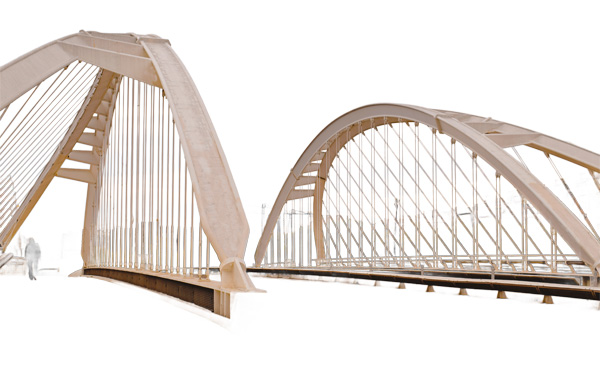
Bac de Roda Bridge in Barcelona, designed by Santiago Calatrava (Shutterstock)
The appearance of the work was immediate, yet its optimistic purpose often took years to take effect, if at all. It was the extraordinary style of the designs which simultaneously inspired architects and appalled engineers. To varying degrees, this different understanding – between the structural purity of an engineered form and its societal purpose, between scientific pragmatism and artistic optimism – has remained a feature of 21st century bridge design ever since.
Connected through their support for his controversial East London River Crossing, the Calatrava exhibition coincided with a famous seminar on bridge design held by the Royal Fine Art Commission (RFAC). This was chaired by the flamboyant Lord St John of Fawsley and attended by leading engineers and architects including Calatrava, Benaim, Leonhardt, Menn and Grimshaw. In debating how to best commission bridge design, issues of quality control and the perceived limits on visual excellence, the seminar brought aesthetics to the fore and defined what would become recurring themes ever since.
These two high-profile events focused attention on bridge design at a time when many cities sought to mark the approaching Millennium moment with some form of civic gesture, often competing against each other to achieve what became known as the ‘Bilbao effect’, courtesy of the Frank Gehry-designed Guggenheim Museum. Motive, means and opportunity combined and the late ‘90s was a frantic time of design competitions, particularly for footbridges. Frequently set up to be architect-led, in the United Kingdom these competitions resulted in the construction of outstanding examples including the Millennium Bridge in London, the Gateshead Millennium Bridge and York Millennium Bridge as well as numerous failed competitions and unbuilt designs. Recognising the ‘Millennial party’ nature of the time, the Happy Pontist blog dryly observed in 2015 that the 1990s was a period of iconic designs “from which designers and their clients are still suffering a bit of a hangover”.
Although from time to time the party spirit is rekindled, the Post Millennium period brought a tightening of budgets and an increasingly mature understanding of the carbon cost of construction. In addition, the value provided by cultural identity and improved connectivity, especially for pedestrians and cyclists is better understood.
This understanding has led to a rich divergence in philosophy and styles, with the general trend moving away from the pursuit of ‘iconic’ solutions and towards structures which are more contextually sensitive and easy to live with. These forms exploit new manufacturing and analysis techniques and provide solutions with traditional materials, including wood, stainless steel and stone. Engineers and architects in bridge design are increasingly focused on why a project is needed and who the beneficiaries will be, rather than defaulting to the extremes of flamboyant form or bland function dictated by expedient construction. Communities and stakeholders are increasingly influential in choices, so that they can arrive at solutions together.
It is now understood and valued that great bridges create great cities and reinforce an urban identity, which is vitally important to people. This was recognised by Calatrava and RFAC 30 years ago but now, if we are to build anew, the carbon and financial cost must be justified in terms wider than traditional business cases or journey time savings.
The challenges for the next 30 years
Arianna Levantesi, 31, Knight Architects
We live in a time of contradictions. The introduction of the computer has enabled the exploration of unprecedented geometries and complex surfaces, freeing us from the constraints of physical construction. Ever since, large structures have multiplied: exceptionally long bridges, towering skyscrapers, airports as large as cities. They have not lost their evocative power, but support for them is far from unanimous. The increasing damage caused by the climate emergency and the Covid-19 pandemic provide undeniable proof of how aggressive urbanisation disrupts the planet’s balance. This creates an incongruity, with its simultaneous pursuit of technical and economic progress and the urgent call for slowdown and degrowth.
The challenge of the next 30 years will be aligning our advanced technologies with environmental respect, without it being misinterpreted as a step back or regression. To achieve this, we must reconsider the concept of progress. Historically, progress was defined as human dominance over nature, a result of science and technology’s ability to bend natural elements. Today, that view no longer holds; conservation of natural resources must take precedence. While progress was once recognised in highly artificial structures, we must now find it in coexistence with nature. This should not be misinterpreted as a return to the past. Rather, a more challenging and nuanced path forward.
Structural performance can align with environmental efficiency, but it requires closer integration with other disciplines. We must emphasise the temporal nature of our work: the built object is a single moment in a dynamic process. Construction is not the arrival point, but the beginning of a new phase of maintenance, management and adaptation to changing contexts. This offers fertile ground for exploration. There is an opportunity to expand collaboration beyond architects and engineers, incorporating digital culture, automation and robotics throughout a structure’s lifecycle, leading to a more sustainable and resilient built environment. The innovative design and procurement strategy for the Network Rail Flow Bridge (Bd&e issue 110) anticipates an approach we hope will become increasingly popular, if not the standard. Instead of a linear and sequential workflow, we propose a circular and collaborative model. Each stage of the process and its associated discipline do not follow a rigid sequence, but rather intersect continuously, facilitating skill and knowledge exchange among participants and ensuring an optimal outcome.
Another promising research area is the exploration of new materials. Alternatives to traditional steel and concrete, such as FRP, 3D-printed or self-healing concrete, and biomaterials, are being widely tested. Traditional materials like wood are also being reimagined to support new geometries and spatial solutions. However, this exploration must be coupled with a new aesthetic. A timber arch will always appear less efficient and bulkier (in the traditional sense) than a slender steel arch. The key is to accompany the introduction of new materials with a radical aesthetic innovation, as seen in the 20th century with concrete, steel, and glass, closely tied to Le Corbusier’s Five Points and the Bauhaus aesthetic. Today, the impact of technological innovations and functional urgencies are clear, yet the field of bridge design has not developed a singular aesthetic response to these challenges. In bringing architectural skills relating to people and context, bridge architecture has perhaps found its role and a meaningful contribution.
In this context, reusing and redeveloping existing structures presents a promising solution. By combining technological innovation with the enhancement of the existing heritage, we can address new functional and environmental needs while preserving identity and history.
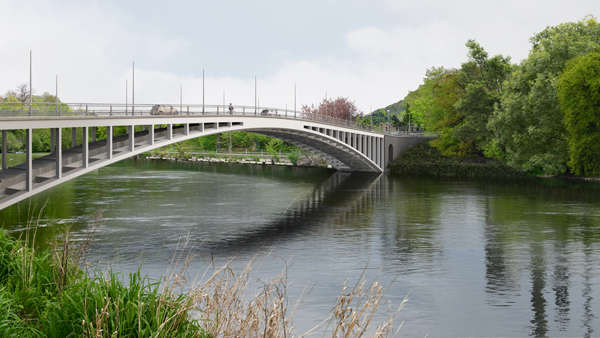
Render of the Trimbacherbrücke’s design proposal showing the existing arch integrated inside the new structure (Knight Architects)
Knight Architects’ proposal for the Trimbacherbrücke competition in Switzerland demonstrates this approach. The design prioritises conservation and sustainability, integrating the existing arch into a new structure. Two slender steel arches envelop the original, creating a harmonious whole with a unique identity. Unlike many interventions on historical structures, where aesthetic value is often preserved alone, the load-bearing capacity of the original arch is maintained and enhanced, reducing the cross-sections of the side arches and emphasising the overall visual expression.
Sometimes, however, we must go further: instead of building less, we must aspire not to build at all. We must challenge conventions and ask critical questions, even if it means rejecting projects based on outdated patterns. The 2023 Gantries for National Highways competition organised by the RIBA exemplifies this. There’s an urgent need to reduce the environmental impact of highway gantries by overcoming structurally inefficient cantilevered solutions. Instead of merely making them aesthetically pleasing, we advocated for a radical rethink, urging National Highways to question the need for such structures. Our submission was commended by the judging panel for proposing the best challenge to the continued and future need for overhead gantry structures.
If until now we have pursued the exceptional, the imposing, the monumental, perhaps it’s time to shift our focus towards the discreet, the essential. We will consider ourselves truly ‘advanced’ when the success of an architectural intervention is no longer measured by its visibility, but by its invisible impact. Giving new life to what already exists, redefining its use and internal function, will be the real triumph. We hope that the effects of tomorrow’s architecture will be deeply felt in communities and the built environment, rather than unmistakably seen.
Engineers share their thoughts in issue 119 of Bd&e.