A new footbridge which has just been completed in Rwanda is particularly notable as being the 100th bridge to be built by Bridges to Prosperity. The charity seeks to combat poverty and improve access to markets, healthcare and education for people in rural areas of developing countries by building footbridges, and works with a number of other organisations and sponsors in order to do this.
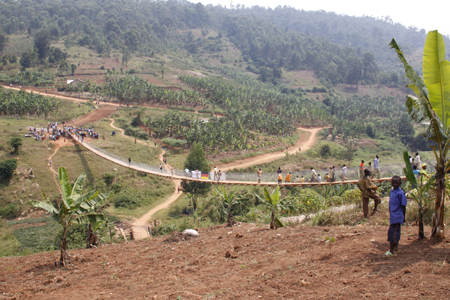
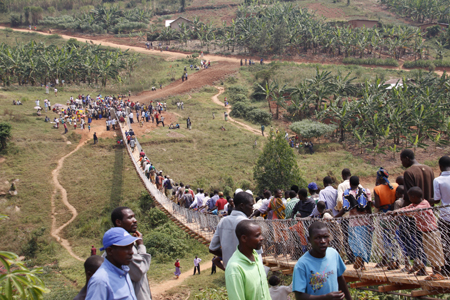
Having worked with US contractor Flatiron Construction for two years, the charity has just completed its first project with Flatiron’s international parent company Hochtief, which is based in Germany. The 95m-long Mayange Nyamabare Bridge in northern Rwanda is typical of B2P’s projects; it is intended to give people in the two communities of Myange and Kibare a convenient means of crossing the Nyamabare River.
The nearest crossings are 20km in one direction and 10km in the other, to which villagers make numerous trips every week, mainly on market days.There are also hundreds of students who need to cross this river five days every week and several hundred local farmers who have to travel from their land to the market. The completion of this bridge will enable some 12,000 people to travel safely and quickly to their schools, markets and health care facilities.
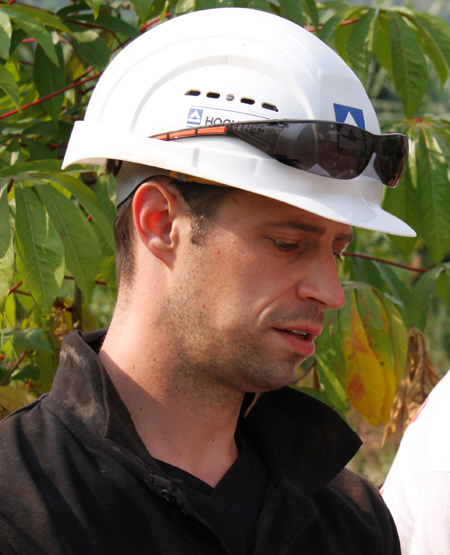
Johannes Keitel
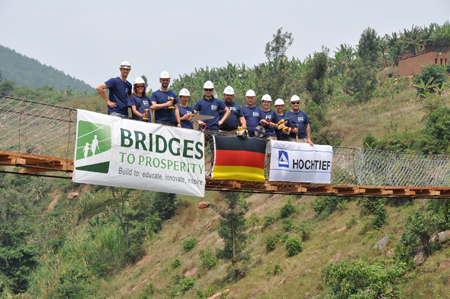
Johannes Keitel acted as project manager for the bridge on behalf of Hochtief, which earlier this year announced its intention to support the footbridge-building charity. He recalls that when the suggestion was first proposed, he agreed immediately, after which the preparation for the trip began. “We started the process of getting the team together, which began with inviting applications. We had 140 applications for the other nine places, which shows the level of interest,” he says, “and we hope that there is the potential to carry out more of these projects in the future.”
From the applications, Keitel tried to build a team which reflected not only the different business units across the company, but also its international scope. On reflection, he would suggest expanding the selection process on future projects to focus on practical points such as language skills, site experience and so on. Making all the practical arrangements for the trip was difficult, says Keitel; not just arranging flights and travel to the site, but also finding accommodation, fixing medical appointments for vaccinations and so on.
The ten members of the team – from Russia, Poland and a number of different offices in Germany – met one another for the first time at the airport in Amsterdam en route to Rwanda, a point which emphasises the part that team-building plays in these projects.
Luckily the team from Hochtief was assisted at the site by Thomas Bang, the construction manager of Bridges to Prosperity, who had already organised the excavation for the anchor blocks and the construction of the towers for the structure. The volunteer crew was responsible for casting the concrete anchor blocks, hanging the cables and erecting the deck and remainder of the bridge superstructure.
What’s more, they were working to an immovable deadline – the opening ceremony had been set for 11 days after their arrival, to coincide with the arrival of the Bridges to Prosperity board and presence of local dignitaries and Rwanadan national media. “The ceremony was set to take place at 1.30pm,” says Keitel, “and I think we finished at about 11am that same day!” But the process of reaching completion of the bridge was a challenge to the team.
None of them had been to Rwanda before, and certainly the specific difficulties of carrying out construction work at such a location demanded a particular problem-solving approach. “We didn’t take any tools with us, so we had to rely on what B2P could supply and what we could find on the local market,” says Keitel.
Some of the practical difficulties, such as the lack of electricity, were hard to comprehend for engineers used to working in developed countries. “It was not easy to find specific tools such as a chain hoist,” says Keitel, “and recharging batteries is difficult if you don’t have a generator. We had to take the batteries back to our accommodation each night to recharge them, and we had to set alarms to wake up every two hours to change the batteries over so we could charge them all.”
Concrete had to be mixed by hand using shovels, and transported by hand too. “It was a very physical process,” recalls Keitel, “and the team-building was also a very important part of the project. There was no room for personal differences, we just had to get on and solve the problems in whatever way we could. It certainly makes you appreciate the infrastructure at home a lot more.”
With such opportunities for personal development, team building and problem solving, the benefits for the employer are obvious. Ho-chtief senior manager Bert Hoekstra is corporate sponsor for the Bridges to Prosperity project and he explains that Hochtief’s interest was prompted by the fact that its American subsidiaries have been involved for some years now.
“Flatiron and Turner Construction have already been supporting B2P for several years and their experience has been very positive,” he says. Flatiron is one of B2P’s strategic partners and last year it extended the collaboration it started in 2009, with a commitment to continue to 2017. “Three bridges in Nicaragua have already been built this year alone,” Hoekstra explains.
“Given the positive feedback and enthusiasm of the American em-ployees and the good experiences of our US colleagues who were responsible for organising the scheme, we at Hochtief in Europe have now decided to undertake a bridge-building project and to ex-amine ways of turning collaboration with B2P into a group-wide involvement. By bundling sponsorship activities and competences, we are hoping for additional positive effects for all parties involved, and are looking foward to building more bridges,” says Hoekstra.
The company is getting involved as a way of addressing the issue of corporate responsibility, and its commitment to society and the environment, Hoekstra explains. “Acting sustainably by promoting the interaction of economics, ecology and social commitment is part of our corporate strategy and has a long-standing tradition within the Hochtief Group,” he says.
This advocacy of sustainability also means making a social commitment, especially in places where the company is active. “We wish to promote local economies and, in particular, give young people access to and opportunities for training and continuing education,” Hoekstra goes on. The company’s vision claims that it is building the future: ‘along with our partners, we expand horizons, link people and organisations, create new ways to think and act’.
By supporting the non-profit organisation Bridges to Prosperity, Hochtief believes it is taking this vision literally and is once again giving it a face. Bridge building is one of Hochtief’s core competences worldwi