
A host of new bridges being designed and built will add to the portfolio of China's bridge city, reports Man-Chung Tang
Chongqing has always been the epicentre for pioneering Chinese bridge engineering. Of the four basic bridge types - girder, arch, suspension, and cable-stayed - the world-record spans for three of them are in China. Two of these three are in Chongqing.
The Chongqing municipality, located in the middle of China, has a population of roughly 32 million - only slightly higher than all of Canada. The mountainous region is bisected by several large rivers, including the Yangtze, Jialing, Wujiang, and Fujiang rivers. Chongqing proper has an estimated 6.5 million residents and is built around the confluence of the Yangtze and Jialing rivers. The presence of these rivers and the topography of the region, combined with city's ongoing plan to boost the local economy have driven the construction of many of the Chongqing's major bridges.
One example of Chongqing's early bridges is the 1966 Niujiaotou Bridge, one of the first major steel bridges in China. In 1981, the city added the First Shibanpo Bridge, a signature long-span prestressed concrete bridge, to its portfolio. The Fendu Bridge, built in 1997 on an shoestring budget, was another of China's pioneering suspension bridges. Today, the city boasts more than 30 major bridges over the Yangtze River and 14 over the Jialing River, all either completed or being designed or constructed.
The Yangtze River is less than 1,200m wide where it runs through Chongqing and the Jialing River is about 600m wide. Since no large ships navigate these rivers in this region, the navigation channels are relatively small - less than 600m. As a result, all of the bridges in Chongqing have span lengths in the mid-range. Even so, the 330m-span Second Shibanpo Bridge is the world's longest girder bridge span and the 552m-span Chaotianmen Bridge is the world's longest arch bridge span. The new Shibanpo Bridge (Bd&e issue no 44) was opened to traffic in 2006.
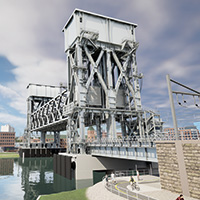
Just downstream from the confluence of the Yangtze and the Jialing Rivers, the Chaotianmen Bridge, which is due to open to traffic this year, connects the southern and northern districts of the city and acts as the gateway to metropolitan Chongqing. Carrying six lanes of traffic and two pedestrian paths on its upper deck, and two tracks of transit on its lower deck, it represents a significant landmark. The community wanted a spectacular structure befitting this important location, and ultimately chose a large truss arch similar to the Sidney Harbour Bridge in Australia.
Navigation at this location requires a main span of 552m; before the Chaotianmen Bridge opened, the world's longest arch span was the Lupu Bridge in Shanghai, with its 550m-long main span and box-shaped arch ribs. The longest truss arch was the 530m-long Bayonne Bridge in New York. The Chaotianmen Bridge was completed without major challenges and is due to open to traffic this year.
The owner of the Chaotianmen Bridge is Chongqing City Construction Investment Company; it was designed by a joint venture of Chongqing Communications Design & Research Institute and Zhongtie Major Bridge Reconnaissance & Design Institute. The contractor was Second Harbor Engineering Company, and TY Lin International performed the peer review.
In recent times, the visual appearance of structures has been greater attention during the planning and design of Chongqing's newer bridges. For instance, the Caiyuanba Bridge's slender half-through tied arch was specifically designed to suit its central location (Bd&e issue no 48).
Other examples of bridges where aesthetic considerations are significant to the design are the Jiayue Bridge and the Second Wujiang Bridge, both of which are currently under construction, and the Twin River Bridges which are currently being designed.
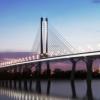
The design of the Second Wujiang Bridge in Fulin addressed three areas: aesthetics, cost savings, and possible ship collision. The town of Fulin is rather hilly, with steep slopes on both sides of the Wujiang River and very little flat land. High levees along both banks of the river are designed to limit flooding, thereby maximising useable land. Because the waterway authority required that the bridge design provide for a minimum vertical navigation clearance of 10m from the highest possible water level, the bridge rises high above the land on both banks. As a result, the bridge's northern and southern ramps are short and steep, with very short end spans of 100m and 150m. For a cable-stayed bridge with a 340m-long main span, these end spans are too short and ultimately, inefficient, but local conditions do not allow a better arrangement. In fact on the south bank, the topography is so restricted that a three-level spiral ramp was constructed to bring traffic from the bridge down to street level.
Other structural types were studied and proved feasible for the site, however an arch bridge would have been too big and too imposing at this location and a suspension bridge would have been too expensive for such a short span. A concrete cable-stayed bridge was chosen as the most economical bridge type for this size crossing at this particular location.
Single column towers with a single plane of cables were selected to achieve a more open appearance. The substructure of a single column tower is also deemed sturdier than a portal type tower with two legs, which helps resist potential ship impact. To solve the problem of the uneven and short end spans, a non-symmetrical cable-stayed bridge with two uneven towers was configured, and the height of the towers above the deck was proportional to the length of the end spans. The sum of the two side span lengths is 250m, or 74% of the 340m main span; while, small, this is still acceptable. With a single column tower, the tower is in the middle of the deck, which typically increases its width by two to three metres. However, a single pole tower is easier to build and costs less than a portal tower, making the cost comparable. Single box section construction is similar to the segmental cantilever method, a common type of construction in China that local contractors are familiar with.
The Wujiang Bridge was completed last year and is due to open this year, once the approaches have been built. The owner of the Second Wujiang Bridge is the Embankment Construction & Management Company of Fulin, the engineer of record is TY Lin International China and the contractor is Zhongtie Construction Group No.8.
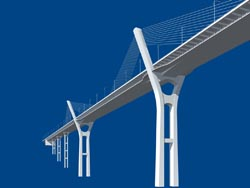
Another bridge currently under construction and due to open this year is the Jiayue Bridge over the Jialing River in the town of Yuelai in the northern district of metropolitan Chongqing. The bridge rises 70m above normal water level and carries six lanes of highway traffic and two wide pedestrian/bicycle paths. The bridge girder is a single cell box with long cantilever slabs on both sides. The pedestrian/bicycle paths, each 5.5m wide, are underneath the roadway cantilever slabs and will be shielded from the hot summer sun and rain which is typical for the area. This design also reduces the total width of the deck girder to 27m.
The Jialing valley is very beautiful and delicate and is set aside for high-end residential buildings, hence aesthetics played an important role in the design. Arch, suspension, and cable-stayed bridges were deemed too imposing for such a delicate landscape, and a haunched box girder was also studied but found to be less attractive. Consequently, an extradosed bridge was selected due to its low tower profile.
The river's navigation requirements set the span length at