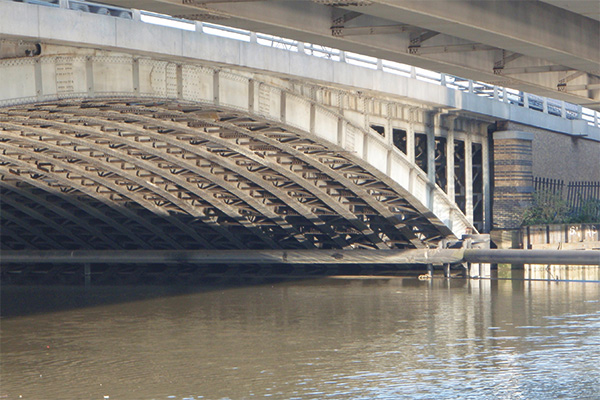
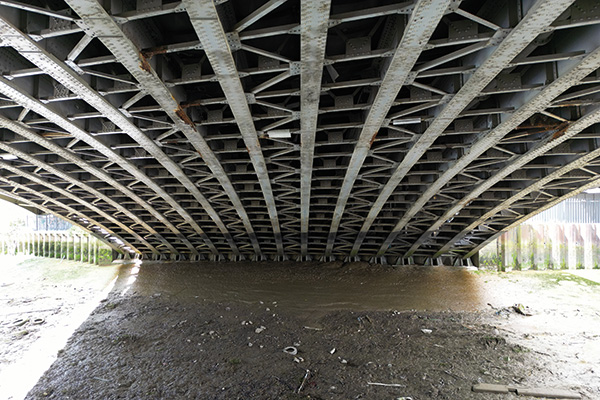
The River Lea Crossing features 16 riveted steel arch ribs supporting the deck (Hewson Consulting)
Setting the standard in sustainable engineering practices, the refurbishment project’s detailed design is expected to yield long-term benefits to stakeholders, the public and the environment.
Originally built in 1934, the River Lea Crossing is a steel arch bridge with a single 60m-long span that carries the busy A13 route across the River Lea in east London.
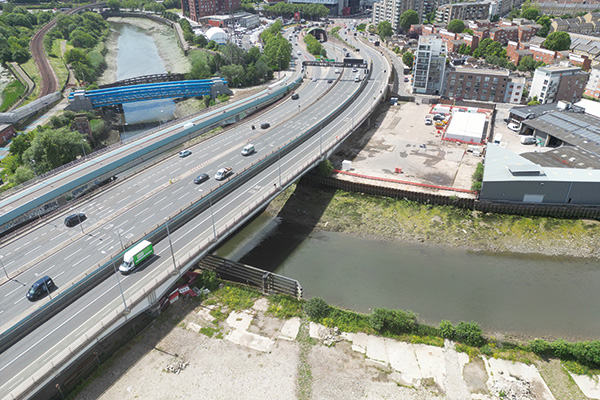
The bridge carries London’s busy A13 route across the River Lea (Hewson Consulting)
The two-pinned arch carries a deck consisting of a framework of buckle plates and stringer beams supported by spandrel posts. It is operated and maintained by Road Management Services (A13) through a 30-year contract with Transport for London, set to be handed over in 2030. As part of this contract, RMS was required to replace the River Lea Crossing.
The bridge had undergone several modifications over its lifespan, including widening of the carriageway and replacement of the original stone parapets with a modern aluminium system. However, the bridge exhibited multiple issues including corrosion, caused by the lack of deck waterproofing and a failing paint system, tidal submersion of the pin bearings and arch springings, and inadequate residual fatigue life.
The bridge’s pin bearings are submerged twice daily by the tide (Hewson Consulting)
Despite the known issues, the rest of the structure was found to be in reasonable condition for its age, allowing Hewson Consulting Engineers to challenge the contractual requirement to replace the bridge. The project team needed to work closely with the bridge owner and technical authority to build confidence in the scheme and demonstrate its benefits.
Gathering the needed evidence began with an extensive programme of surveys, inspection, and monitoring, followed by assessment of the superstructure and substructure, going beyond the normal requirements of current inspection and assessment standards.
In the inspection and testing phase, a detailed laser scan survey was used to verify the bridge geometry and identify discrepancies between the record drawings and the as-built structure. This allowed early contractor involvement to develop refurbishment methodology and facilitate stakeholder engagement. The survey showed abutments had marginally spread and the arch had flattened compared to the theoretical profile in the drawings, affecting arch stresses. It also highlighted that the carriageway thickness was not uniform and the arch was asymmetrically loaded, factors that were accounted for in the assessment.
Ensuring the continued function of the pin bearings was essential to the structural performance, therefore demonstrating that the bearings could still accommodate rotation was a key requirement for the technical acceptance of the refurbishment scheme. Strain gauges fitted to the bearings and the arch ribs in 2019 measured rotations under live traffic loading and established that all bearings were moving satisfactorily and had maintained their performance since the last monitoring in 2004.
Although common, the material sampling and testing of the bridge’s steelwork and concrete allowed the assessment team to use worst credible strengths based on historic records and previous tests.
To help extend the existing bridge’s service life by 120 years – equivalent to a replacement – the team included a fatigue assessment in addition to the traditional load assessment. A custom vehicle spectrum was developed to account for changes in traffic loading over the same period, and for the fact that codes of practice for fatigue were introduced almost 50 years after the bridge opened. The assessment revealed that the spandrel posts, consisting of cruciform sections, were inadequate and would need to be replaced, but the main arch ribs and stringer beams were in acceptable condition.
The analytical assessment included the substructure, which is usually only assessed qualitatively, based on signs of movement or distress. The arch is supported on mass-concrete abutments, located entirely below ground and supported on precast driven piles. One problem was that the condition of the piles was unknown due to a lack of records and as-built information. Instead, an assessment was carried out to check whether the mass concrete abutments could act as raft foundations bearing on the river terrace gravels typical for this part of London. Changing the assumed behaviour of the foundations involved modelling the spread of forces through the concrete to the base of the abutment and verifying the bearing capacity and expected settlements at different stages. Hewson was able to show that a spread foundation would be adequate, which allowed the refurbishment design to be completed without needing to strengthen the foundations.
The development of a robust assessment based on evidence obtained through investigations demonstrated that refurbishment was feasible. The next stage was to demonstrate its benefits over a replacement.
A replacement option was developed in tandem with the refurbishment design, with Hewson working alongside the client to evaluate the two schemes in terms of technical feasibility, traffic impact, noise, air quality, ecology, and whole-life cost.
Refurbishment emerged as the better overall option, significantly reducing costs, time, and embodied CO2. The scheme is expected to cut CO2 emissions by nearly 50%, removing and replacing only 149t of materials out of the original total amount of 960t. Approximately 160t of new steelwork is required, instead of the predicted 375t for a new bridge.
Since the refurbishment will take less time to complete, it is predicted to reduce local traffic delays by about 28% and minimise noise and air quality impacts. Another benefit is that workers will spend less time working at height and over water, thereby minimising safety risks. It is estimated that the whole life cost of the refurbishment, allowing for maintenance, is approximately 50% below the replacement scheme.
Having obtained technical approval for the bridge to be refurbished, Hewson completed the detailed design in mid-2023. Works on site began in May 2024 and are expected to conclude in late 2025.
Reuse is not always the easy option: it requires extensive planning, forethought and a willingness to invest in monitoring and investigation to thoroughly understand the asset. However, the benefits are clear, offering significant environmental, economic, and social advantages.
Hewson is embracing the growing industry shift towards reusing and rehabilitating existing structures, grounded in the principle of ‘use less stuff’. Knowledge-sharing is vital for the industry to change at the pace needed to address the climate emergency. As our infrastructure ages, we need to reflect on our skill set to make better use of existing assets.
The River Lea Crossing refurbishment is an excellent example of how engineers can challenge the brief to promote more sustainable practices. Hewson is committed to building on this achievement by continuing to share its experience and expertise with the wider engineering community and working to establish a legacy of sustainable bridges for the future.
Michael Duvall is associate director at Hewson Consulting