

First-hand observation of the damage caused to bridges by earthquakes is essential for the appropriate development and ongoing refinement of design codes. California has its own seismic design criteria for bridges - currently on version 1.5, whereas many other states in highly seismic regions of the US have adopted the AASHTO Guide Specifications for LRFD Seismic Bridge Design.
Both codes are based on providing a ductile fuse, typically plastic hinging of columns, to allow large inelastic displacements while limiting the force exerted on capacity-protected elements such as girders and foundations during large earthquakes.
Caltrans’ seismic design philosophy is based on three principles: balance, confinement, and continuity. Balance means that bridge structures are designed to be as regular as possible, avoiding large changes in mass, period, or stiffness and enabling all the elements to move together during earthquakes. Confinement means that bridge elements are able to deform without breaking.
Continuity means there is ample rebar development length, specified areas where no rebar splices are allowed, and adequate seat width, without sudden discontinuities where failure can occur.
To see the importance of such detailing and observe the behaviour of bridges of all types and ages under seismic loading, a combined Pacific Earthquake Engineering Research Center/Earthquake Engineering Research Institute team went to Chile on 13 March to study the effects of the magnitude 8.8 earthquake that occurred in Maule on 27 February.
South America has a 4,000km-long fault running along the Pacific Coast where the Nazca and South American plates come together. This boundary is the source of frequent devastating earthquakes including the largest earthquake ever recorded, the M9.5 tremblor in 1960. The recent Maule earthquake was caused by a bilateral rupture that began just offshore and propagated about 270km north, 270km south and deep under the South American Plate.
On 15 March the group travelled south to Temuco and then slowly made its way back to Santiago, a distance of some 700km. The extent of the damage is one of the main distinguishing factors between an M8.8 subduction zone earthquake and other types of earthquake. Damage covers a bigger area but due to its depth and distance offshore, this type of earthquake may produce weaker ground shaking than anticipated given the large magnitude of the event.
This observation is strengthened by recent attenuation models for subduction-type events, because the fault rupture is deep below the ground surface with no near-fault effects that caused damage in Kobe and in Haiti, and because of the long drive between areas where bridge damage occurred. However Chile has no government agency responsible for recording ground motions, and it may take more of these events to determine if subduction-type earthquakes can produce very strong shaking. All the same, ground motions were strong enough to knock down about 20 bridges.
An additional seismic hazard accompanies offshore subduction-type earthquakes – one which can make them more hazardous. When the rupture happens underwater, deadly tsunami waves can occur, striking bridges and buildings already damaged from the ground shaking and sometimes causing damage along coastlines thousands of miles away.
One issue that was significant to the team’s investigation was that many of the bridges were on privately-owned toll roads. Owners such as Cintral are obliged to continue repaying the bonds even on the damaged infrastructure, and they cannot collect revenue while the highway is damaged. This made it necessary for the team to make haste to record the bridge damage, and because of the large area that was damaged, we were unable to get to the tsunami-impacted area north of Concepcion.
A second team led by the US Federal Highway Administration intends to investigate how these bridges along the coast performed for a combination of strong shaking and the subsequent tsunami waves.
The seismic criteria developed for bridges in Chile resembles the Applied Technology Council 6 criteria developed for Caltrans after the 1971 San Fernando earthquake, and which was later adopted as the first AASHTO Seismic Guide. However engineers told the researchers that bridges on private roads are sometimes designed usingthe Spanish Code, which has less rigorous seismic requirements than the Chilean Code.
It is also interesting to note that there are no regional governments in Chile and so even local public roads are owned and maintained by the national government. A similar situation exists for rail with the public Empresa de los Ferrocarriles del Estado maintaining some railways while private owners such as Ferrcarril del Pacifico maintain others. Use of railways has declined over the years in Chile and most transport is now by truck and bus.
Well-seated overcrossings with regular spans and a total length of less than 91m generally performed well during earthquakes because the large embankments and stiff abutments prevent large displacements from occurring. However, several of the bridges crossing the Pan-American Highway, otherwise known as Route 5, came very close to collapsing. They were usually saved by their short abutment stems and good slope paving.
All the same, the design of these short structures was less than optimal. Diaphragms are normally placed between the precast girders of such bridges, even in non-seismic regions, to provide lateral stability during construction. These bridges had no diaphragms and very weak shear keys, which made them incredibly vulnerable to transverse shaking during the earthquake. Instead, vertical rebars inside pipes were attached between the underside of the bridge deck and the girder seats. However, these ‘seismic bars’ had little effect as far as the visiting specialists could tell. Also, they learned that these abutments were not supported by piles.
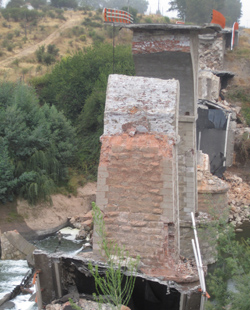 |
|
Rio Claro Bridge |
Since shear keys are typically designed for 75% of the strength of the foundation system, the lack of piles could explain the weak shear key design. Three or four consecutive overcrossings were found to be damaged, perhaps due to topographic or geologic effects, resulting in a long detour for people needing to cross Route 5. A better design would include stronger abutments with diaphragms, shear keys, and piles to provide lateral support for these bridges during the frequent, large earthquakes that occur in the region.
An unusual type of behaviour was observed to have occurred on many of these east-west oriented structures during the earthquake. Many of these crossings twisted around a vertical axis - perhaps the centre of stiffness - regardless of the amount of skew, whether they had a continuous deck or simple spans, or other geometries and details. Or perhaps this rotation was the result of one corner of the superstructure catching on the abutment backwall or shear key, causing the superstructure to rotate around the fulcrum. This behaviour needs further study since the usual assumption is that these bridges undergo translation in three orthogonal directions without rotation.
In Concepcion, Chile’s second city, which has a metropolitan population of abo