
A complex system of buffers is to be installed on the new Stonecutters Bridge to protect it from damage in the event of typhoons and earthquakes. Gianpaolo Colato, Renato Chiarotto and Samuele Infanti report
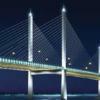
When it is completed in 2008, Hong Kong's 1600m-long cable-stayed Stonecutters Bridge will become one of the world's longest single-span cable-stayed bridges. The bridge, which crosses the entrance to Hong Kong harbour, will have a main span of 1018m.
In order to protect this strategic structure from seismic, wind actions and traffic braking loads, it has been designed with two sets of four 8000kN shock transmission units. During the dynamic action predicted under normal loads, these units are designed to provide a very stiff connection between the deck and the pylons. A specially-designed hydraulic circuit connects all the units installed at the same pylon and enables them to react simultaneously during the dynamic event to avoid torque effects in the bridge structure. The system is also designed to minimise the reaction from slow movements induced by the deck thermal expansion and to prevent unexpected overloads.
The bridge design includes devices even in the transverse direction - in fact, hydraulically-preloaded spherical bearings connect the steel girder to the main pylons with a reaction that depends on the dynamics of the imposed loads.
The dynamic protection system proposed for the Stonecutters Bridge consists of four units per pylon, installed along the longitudinal bridge axis, connecting the deck to the pylon. Each system can accommodate the thermal contraction/expansion movements of the bridge as well as any other low velocity displacements without appreciable reaction, whilst at the same time they ensure an almost rigid connection between the box girder and pylon, when sudden forces occur, or when movements of a critical velocity are applied to the structure.
Each group of units is linked by an hydraulic circuit where the flow control valve is common. This requirement guarantees uniform loading of the units, eliminating any torque effect induced by differential reaction among them.
The objective is to achieve a system that locks during phases of dynamic actions - hence particular attention had to be paid to the stiffness characteristics. A well-designed shock transmission unit, which is sometimes referred to as hydraulic buffer, has to behave like a very stiff spring, locking within a short piston stroke. So the compressibility of the fluid was carefully studied, to minimise the stroke that was needed to develop the design reaction.
Another important parameter was the behaviour of the unit over an entire range of temperature variations. The specific design and the special oil used assure consistent behaviour of the devices over the entire design temperature range - from -5 degrees C to 70 degrees C. The change in volume of the hydraulic fluid over this range was taken into account - this problem was solved using suitable accumulators with nitrogen-filled bags that can expand or contract in order to accommodate the variation in volume, and hence maintain the required pressure level.
The buffers are provided with lateral anchor plates that connect to the steel cross girder diaphragms and the concrete towers. The fixing system relies on tensioning bars, which connect the two adjacent buffers through the lower tower diaphragm. The main body of the buffers is connected to the lateral plates by means of special spherical hinges, which allow the devices to function correctly even when there is axial misalignment, due to either construction/installation tolerances, or angular service movements.
The hydraulic circuit which was proposed for each buffer system is the same as that used on the Storebaelt bridge, conceived by consultant Cowi and designed and manufactured by FIP. By means of this circuit, a continuous, uniform distribution of pressure among the four units of each pylon is assured during both service life of the structure and high velocity conditions such as earthquakes. This in turn assures an equal distribution of loads on the structural elements.
During slow movements of up to 0.02mm/s, oil moves through the external circuit pipes via a special flow control valve from buffer chambers at high pressure on one side to the ones on the other side, which are at low pressure.
When movements are fast or dynamic, the valve prevents the oil from flowing quickly, allowing the buffers to 'lock up'. In order to maintain maximum control over the behaviour of the entire system, the flow control valve can be adjusted within a certain range. Any pipe damage could allow hydraulic oil to leak and damage the structure, so special check valves are incorporated in each buffer. These valves are normally opened by a hydraulic controlled pressure, which is established from the accumulator basic pressure. When the valve closes, due to a rapid reduction of pressure in the circuit, the hydraulic system of each buffer will be isolated, and leakage is avoided.
In order to protect the structure and allow the girder movements during this piping damage phase, the chambers of the same STU are connected by means of pressure relief valves that start to work at a pressure of 60MPa.
The same valves are activated even during an earthquake, or any dynamic event that generates loads creating a pressure of more than 60MPa in the circuit. In this way, the units act like viscous dampers that are characterised by a low damping exponent of about 0.1, providing for an almost constant reaction.
A stiffness test is to be carried out in order to measure the compressibility of the fluid into the hydraulic cylinder loaded up to 8000kN, with the valves closed. The units are designed to withstand this load with a minimum safety coefficient of three. Force and deformation will be measured and recorded during the course of the test.
The hydraulic cylinder will also be tested with a static pressure on both chambers simultaneously at 40MPa for 24 hours. The piping system including cylinders, valves and other accessories will be kept at a constant pressure of 40MPa for 240 hours. Pressure will be recorded during the test, and afterwards the piping system will be examined by the engineer.
Static loading test will determine the resistance of the system to the thermal displacement. Normally the temperature movement will take place with thermal expansion girder velocities. The test will be conducted applying a constant translation velocity to the device in the order of 0.01mm per second and at the same time, the resulting reaction will be noted. The load will be applied in both movement directions in order to verify the unit's behaviour in both tension and compression.
The dynamic loading test is used to verify the maximum reaction at high velocities and is conducted by applying a thrust velocity of 2mm/s to check whether the predicted maximum reaction of 8000kN is reached. The thrust is maintained at maximum load for approximately five seconds. This test is conducted in two positions of the stroke of the piston - i.e. central, and +/-250mm off the axis. The load is applied in both directions at each test position, and the thrust and displacement read and recorded during the test.
Monitoring will be carried out by means of pressure, temperature and displacement transducers in order to ensure that the system is working properly. This data is sent to a data transmission unit, then on to a peripheral data monitoring unit, and finally to the master monitoring station, with relevant channel identifications. The acquisition system can visualise the data and send out a signal in real time if safety thresholds are exceeded.