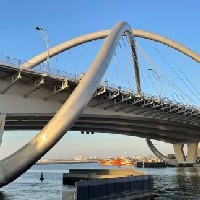
When a beloved landmark bridge over the Mississippi River had to be replaced, one of the main criteria for the replacement structure was to create a similarly impressive crossing. Hennepin County's newly-completed Lowry Avenue Bridge in Minneapolis was built to replace a well-loved bridge with an ageing truss structure because one of the piers had structural problems.
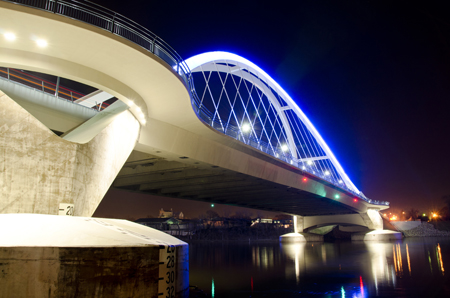
Shore view of the bridge (SRF Consulting)
For the preliminary phase of the project, the engineering team of TY Lin International and SRF Consulting carried out several studies while at the same time conducting a bridge type selection study. The architectural approach for the Lowry Avenue bridge design evolved out of an extensive public outreach programme. A project advisory committee and a technical advisory committee including consultants, transportation officials, and community leaders helped establish a basis for determining the structure type.
Feedback from residents primarily focused on several core issues, including the goal of building a signature bridge that would ‘announce’ the great river’s presence, the need to create community spaces at the road level, water level, and in the park next to the bridge touchdown, and the desire to recreate the experience of driving through the truss.
The proposed preliminary design, which was designed to Minnesota Department of Transportation bridge standards, emerged as the favourite of seven alternatives including two cable-stayed options, two arches, steel girder, steel box, and concrete box bridges.
The community decided on the basket-handle steel tied arch bridge, which has a pedestrian/bicycle path outside of the deck suspenders on the main span, as well as four overhang belvederes, each above one of the river piers on each side of the deck. This design enabled the number of piers in the water to be reduced to two, and these are sculpted to create visual transitions from the main bridge span to the approach spans.
The use of V-shaped piers also helps with the visual balance, softening the thrust of the arch. The slight curvature of the piers also creates subtle plane changes, which absorb and reflect natural light during the day and add dimension to the illuminated structure at night. The final configuration of all the disparate bridge elements was attuned to the scale of the neighbourhood and also to the pedestrian experience of the site.
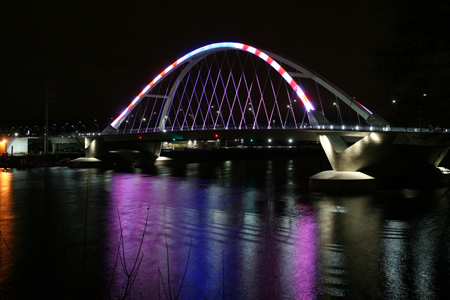
(HCPA/Lisa Fleming)
Arches large enough to be seen from a distance are still scaled to frame the view of the surrounding buildings and punctuate the city skyline. Complementing the design of the basket-handle arches is a colour-changing lighting scheme that has been fully integrated into the design of the arches themselves. Concealed by a valance that serves as a mounting channel, a continuous row of Colorkinetics Colorgraze Powercore luminaires is mounted along the top, outside edge of each approximately 122m-long main span arch.
At the bases of the arches, the same luminaires are mounted between steel fins that help smooth the visual, aesthetic and material transition between the steel arches and the concrete piers. The architectural handrail along the pedestrian path and belvederes incorporates custom-designed LED steplights that create a visual rhythm and illuminate the path without obstructing views of the river.
These luminaires are designed to provide even light on the paths and belvederes, while the roadway luminaires provide illumination for roadway safety and pedestrian and cyclist security. The preliminary lighting design was conceived by Illumination Arts in collaboration with the bridge architect and engineers from TY Lin International and SRF Consulting.
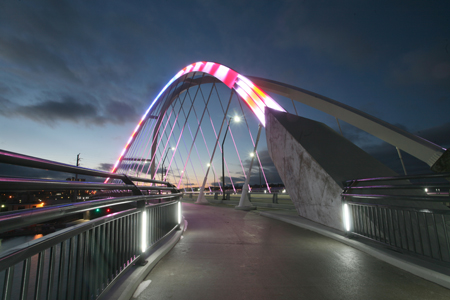
View along the pedestrian path (HCPA)
The electrical design was completed by SRF, who also specified the lighting control system. Finally, the initial programming and scene selections were developed by Hennepin County and its in-house lighting systems professional, who designed more than fifty static and kinetic looks for the bridge. The colour-changing lighting system, manufactured by Philips, was installed and activated just before the bridge was opened last October.
Arch lighting is managed by a Colorkinetics I-Player3 controller that interfaces with its proprietary lighting software. The system has the capability to perform both kinetic and static light shows in millions of colour combinations, and will allow local residents, the city, and the county to have input into the appearance of the bridge at night.
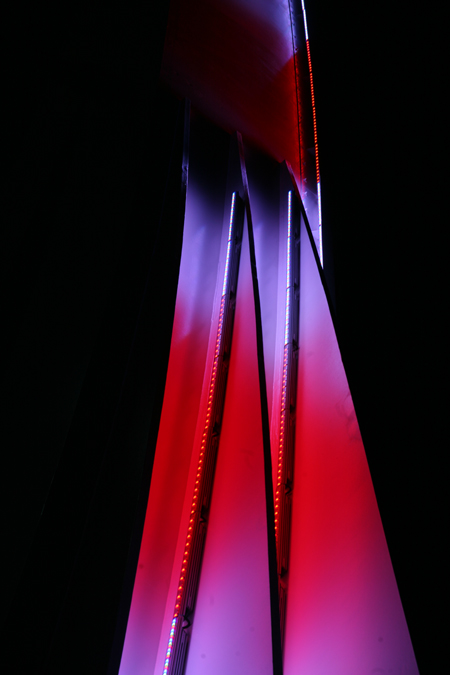
Arch fin detail (HCPA/Lisa Fleming)
Hennepin County Administration is currently evaluating the lighting programming and its relationship to various significant community events, and will be developing a policy to coordinate the two. As a preliminary programming effort, the county introduced a patriotic theme – a kinetic red, white and blue – for election day and Veterans’ Day, a rainbow theme, and several single, static colour themes, including the default blue that matches the colour of the Hennepin County logo.
Most recently, the colours of the American football team Minnesota Vikings were featured in a kinetic lighting event that was broadcast on national television during a game against the Green Bay Packers. For the arch lighting, the luminaire mounting components and wiring have been integrated into the design of the arch ribs.
A 160mm by 108mm valance is bolted to the outside face of each arch rib and painted to match, so that all fixtures are fully concealed within a seamless detail. Behind the valance, 914mm-long luminaires are mounted end to end to create a continuous wash of light on the visible face of the arch. Each luminaire can be controlled separately, and since the fixtures are installed close to the arch rib surface, different colours can be easily distinguished along the full length of each arch.
This configuration provides endless opportunities for using multiple colour combinations, patterns, and rates of motion to celebrate holidays or commemorate special events, transforming solid structure into graceful arcs of light.
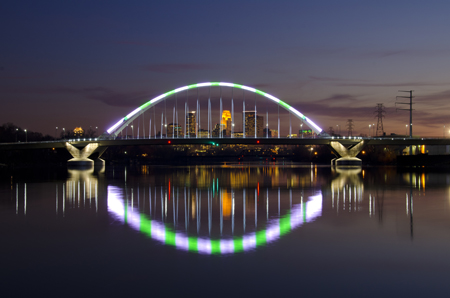
Special occasion lighting on the bridge (SRF Consulting)
The election day theme, for example, featured bold stripes of red, white and blue, accented with flashes of white light representing the stars of the American flag. At the opening day ceremony the crowd cheered each time a speaker described the pride and energy they felt about the design of the new bridge. Minnesota Public Radio described the splendour of the Lowry Avenue Bridge at the centre of riverfront activity.
The beautiful new bridge is a source of civic pride for Hennepin County, with residents of the local community and the Twin Cities alike having already e