
The world’s longest cable-stayed bridge is rapidly taking shape in the Russian city of Vladivostok; one of two major cable-stayed bridges being built in the city ahead of the 2012 APEC summit which will be held on Russky Island.
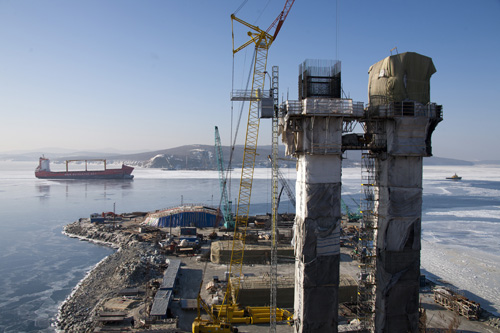
Construction of the 3.1km-long crossing over the Eastern Bosporus Strait began just over two years ago and is scheduled for completion next year. So far, progress has been rapid, and at the end of March the first steel deck element for the main bridge span was lifted into position. Cable installation is expected to begin this month (May).
The main bridge is 1.9km long, with a main cable-stayed span of 1,104m, making it the world’s longest by just 16m. As well as boasting the world’s tallest bridge towers at almost 321m height, the bridge deck has a vertical clearance of 70m above the navigation channel, and features extensive large-diameter bored pile foundations extending up to 77m deep. It will also have the world’s longest bridge cable stays, which will range from 136m to 580m in length.
In total, the crossing is 3.1km long, which includes approach viaducts on both sides of the strait. The 1,104m-long main span is flanked on each side by three spans of 84m length, one of 72m and one of 60m, and the four-lane bridge deck will be 21m wide.
The bridge to the Russky Island over the Eastern Bosphorus Strait is being built under a Federal programme which aims to promote the development of Vladivostok as a centre of international cooperation in the Asia-Pacific region.
The port itself is the largest of Russia’s ports on the Pacific, and its strategic importance means that the bridge must have sufficient navigation clearance for any type of vessel. At this particular location the strait is 1,460m wide and the bridge must be designed to cope with particularly harsh environmental conditions – a wind velocity of up to 36m/s and storm waves of up to 6m high. Winter ice on the straits can be up to 700mm thick and the temperature in Vladivostok ranges from -30ºC in the winter up to +37ºC in the summer.
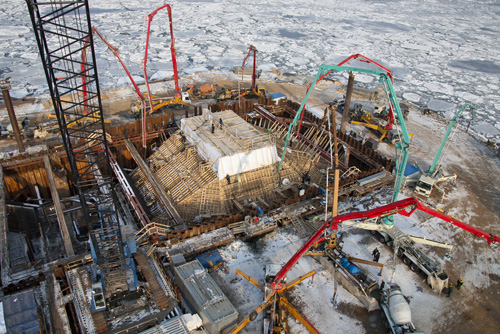
Construction of the bridge is being carried out from independent facilities on each side of the straits, with production yards covering a total area of approximately 16,500m2. Each production facility has a rebar/welding workshop, building inspection laboratories, mechanical, woodworking and equipment repair workshops, office buildings, living quarters, and canteens. These are backed up by a total of four concrete mixing plants, enabling each side of the bridge site to operate independently. This set-up paid dividends last year when a storm warning was announced on the eve of a major operation to carry out the final pour on the pile cap of the Russky Island tower.
The island was almost totally cut off from the mainland; a storm warning was issued on 12 April 2010 and remained in force for three days. Heavy snowfall was accompanied with gusts of wind of up to 25m/s, and wave height in the Eastern Bosphorus Strait of up to 5m. All ferry links to the mainland were disrupted, but main contractor USK Most’s production facility on Russky Island had more than enough capacity to produce the required amount of concrete.It took more than 30 hours to concrete the last pour of the pile cap – a 14m-long by 6m-high bulkhead which forms the connection between the two feet of the main tower.
“The operation was preceded by thorough engineering training; we were prepared for adverse weather conditions and had sufficient resources,” explains Igor Masiuk, foreman of the subsidiary of USK Most in Vladivostok. “The operation involved three concrete pumps, one of which was always in reserve. We used a self-compacting mix which does not require vibration, a process which can take a lot of time.
“However self-compacting mixes must be delivered continuously. The operation involved two plants located on Russky Island. One of them produced concrete and the other was kept ready; in case of unexpected circumstances, it was ready to start producing the mix within 30 minutes.”
Site work began in late 2008 after the Russian government gave the go-ahead for the project, with construction sites being established on the mainland and on Russky Island. The first part of the work involved excavation and concreting of bored piles for the trestle supports on Russky Island, and the construction of a permanent artificial island on which the main tower and three of the four piers for the back span will be built.
Back in May 2009 the first bored pile was excavated to a depth of 25m for the foundations of the first leg of the tower. The process of concreting the pile, which is in the Eastern Bosphorus Strait, was carried out from a boat – the first time in Russia that marine concreting had been carried out in this way. “This was the first super-deep well concreted ‘from the water’, and a lot of work was done to set it up,” said Aleksey Baranov, director of the Vladivostok subsidiary of USK Most.
“Experts of the Far Eastern Marine Research, Design & Technology Institute carried out test bores to determine the seabed geology, and engineers confirmed the drilling depth marks, based on these results.”
About 60m³ of high-quality concrete for installation of the pile offshore was delivered by ferry. Construction of the 120 bored piles required for the foundation of the M7 tower requires excavation of around 5,800m³ of ground, installation of around 11t of reinforcement and pouring of some 10,000m3 of concrete.
Four concrete plants now serve the site – two on the mainland and two on Russky Island – with capacities ranging from 80m3/hour to 160m3/hour.
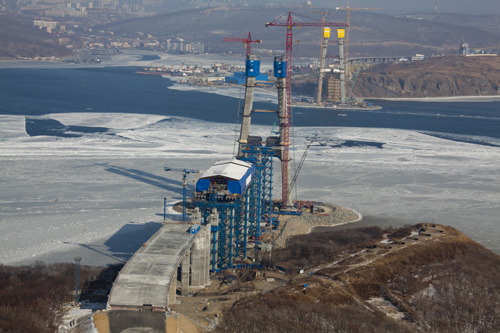
In total, a length of more than 5km of large-diameter piles was installed for the bridge, and these piles are up to 77m long on the mainland tower, where the underlying rock is deeper below the surface. The contractor brought in some hefty drilling machines for the deep foundations, including a Bauer BG36 which arrived on site in 2009.
Machine operator Valery Garbuz explained: “The on-board computer allows detailed monitoring of the whole drilling process: well depth, penetration, torque, bottom hole pressure and so on. The machine is powerful, reliable and intelligent – it’s just what we need here in these very severe geological conditions.”
Experts believe that the bridge construction involves some of the most demanding drilling in severe geological conditions ever carried out in Russia. Moreover, the rocky soil is very mixed and highly heterogeneous – siltstone of 90MPa strength is layered with compressed sandstone which is up to 180MPa.
Man-made peninsulas were rock-filled in the Eastern Bosphorus Strait for tower erection. When construction has been completed, they will protect the towers against erosion and ice and against vessels impacts. The pile cap for the main Russky Island tower was built in the water, using a temporary steel caisson, and rockfilled afterwards to create ship-impact protection.
Space for construction of the found