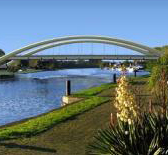
The new bridge is a multi-span prestressed concrete box girder structure 920m long, and it will carry the Dhaka-Sylhet trunk road, providing a direct connection between the riverside towns of Ashuganj and Bhairab. At present road vehicles and pedestrians use ferries; the only other crossing is an existing multi-span steel truss rail bridge 100m upstream of the new road bridge.
"One of the major problems of constructing a bridge of this scale over such a vast flood plain is securing the foundations and protecting them from scour when the river is in flood," says Robert Benaim & Associates technical director David Collings.
In the dry season the river level falls to a depth of 1.5m, but during the monsoon more than 20,000m3/sec may pass through the bridge, and the water level rises by 6m. "Since the railway bridge was built, a deeper channel has formed in the river bed to one side of the river which model testing has indicated could move or deepen further," Collings explains.
The soil of the river bed comprises soft alluvium deposits of silty sand and silty clay which increase in density with depth. The upper layer of loose material shifts with changing flow regimes so it was important to sink foundation piles deep into the very compact sand. "Model testing confirmed the design assumptions that in addition to the general scour to below -30m, local scour of a further 5m to 7m may occur around a couple of the piers. In the design of the substructure we have allowed for scour around each pile group to -39m," says Collings.
With such unstable soil, slip failures are likely and were evident on the river bank next to the bridge site. If a similar slip was to occur under the approach viaducts or link pier it could be catastrophic. The bed of the river was re-profiled with sand bags, while 450m of the Ashuganj bank and 610m of the Bhairab bank were protected with stone pitching, sand bags, a soil covering, and grass and tree planting. All the sand was dredged from the river bed upstream of the bridge. Labourers employed by bridge contractor Edmund Nuttall panned the sand with saucer-shaped wicker baskets from barges on to the shore, before the sand was bagged and stock-piled ready for placing.
The double leaf piers supporting the bridge deck were built off 3m thick reinforced concrete pile caps and a cluster of six 2m diameter bored piles. The pile caps at the piers away from the navigation channel were constructed within circular sheet pile cofferdams, while those on the three piers in the deep water channel were constructed using an innovative jack-down technique developed by Edmund Nuttall.
Using this technique, the pile cap was precast above the water line then lowered by jacking to its final level. The piers were built as it was lowered. The pile cap was then connected into the small cylindrical coffer cells formed around each pile position. "This was the most complex piece of the structure and required significant design time as well as extensive discussions with the checking engineer and the client's engineer," says Collings.
The 2m diameter steel casings for the pile, varying between 40m and 50m in length, were driven into the river bed using a steam hammer. The pile was augered through the steel casing to a depth of up to 75m below water depending on the local scour level. "A polymer slurry was used by the contractor to maintain the pile wall integrity below casing depth during the excavation," Collings explains, "as it is cleaner than bentonite and more of it can be recycled for reuse." The first length of the prefabricated reinforcement cage for the pile was lowered into the tube by crane, as further 14m sections were connected and lowered until the cage had reached the toe. Four 63mm diameter tubes were attached to the rebar cage for sonic logging to establish the pile integrity and for toe grouting.
Concrete was delivered to the work area and formwork using a barge mounted pump and pipelines. Truck mixers brought concrete in 6m3 loads from one of three land-based batching plants and were ferried to the cofferdam on shuttle barges to discharge their load into the concrete pump. Concrete arrived every ten to 15 minutes in order to maintain a steady output of 30m3/hr, sufficient to prevent any cold joints forming during the pour. In the hottest months - from April to June - concreting took place during the night using chilled water and ice to reduce the placed concrete temperature to below 30oC.
The Meghna River was too silty to be suitable for structural grade concrete, so sand was imported from Sylhet. Crushed river boulders were used for the coarse aggregate, removed from the river bed or embankments, loaded onto shallow boats and taken to nearby crushing mills. Nothing else was available locally. Steel was scarce and whilst there was cheap reinforcement available from local stockists, none of it was certified with a grade or kite mark. This was used for chairs, spacers and tie-rods, and only British Standard imported reinforcement was used for the structure. The bridge was financed by British aid through the Department for International Development, hence the use of some UK-sourced material was required.
The bridge deck consists of a single 20m wide prestressed concrete box section that increases in depth towards the supports. Travelling gantry formwork was used to form the 4.76m insitu concrete segments on both sides of the pier, cantilevered out in balanced construction. Each segment was prestressed during erection with two, four or six permanent Dywidag 19-strand tendons. Further permanent prestress was then applied across the completed 110m spans.
The cantilever bridge deck is supported on four massive elastomeric bearings at each pier head, varying in thickness from 250mm at the middle piers to 550mm at the end piers. The size of the bearings at the end piers was governed by the bridge deck movement due to creep, shrinkage, and temperature change. The size of the bearings on the middle piers was governed by the predicted longitudinal seismic movements.
The top of the double leaf piers are designed to resist horizontal seismic loads transferred from the bridge deck via shear keys that lock the box girder deck onto the pier head. The double piers have been sized to resist the impact from an 800dwt cargo vessel, in addition to the seismic forces and gravity loads acting on it. The flared lower half of the piers increase the depth of the section at the point of maximum moment and spread the loads more uniformly into the pile cap.
Benaim and Nuttall considered using precast segmental construction similar to that used on the Jamuna Bridge, for the bridge deck and steel pile foundations on this structure, but had concerns regarding the economics of steel piling and the practicality of precast concrete production. "An in situ box girder bridge deck and insitu bored piles offered the most competitive cost solution and matched the available skills in local labour market," explains Collings.
Construction of the bridge started in early 2000, and all the piles, pile caps and pier heads were completed earlier this year (2002). The final stitch in the superstructure was cast at the end of June. The brid