As part of a new comprehensive sustainability strategy that aims to extend its 100 years anticipated service life to 200, Øresund Bridge is undertaking a wide range of ambitious initiatives. It is investing in solar energy, shifting towards smart maintenance planning, offering discounted chargers for electric vehicles, developing batteries for solar power storing, and also piloting a wind turbine to supplement its energy production.
The road and rail fixed link has a total length of 15.9km and consists of a 7.8m-long bridge, a tunnel and the artificial island Peberholm. Since 2000, it has connected Denmark and Sweden, carrying thousands of vehicles and trains each year. The government-owned Danish-Swedish company Oresundbro-Konsortiet owns the link and creates a new business plan for the asset every five years. During the last such period in 2021, when an analysis of strengths, weaknesses, opportunities, and threats was carried out, the management team noted Denmark and Sweden’s high and growing interest in environmental sustainability. According to Bengt Hergart, property director of Øresund, this motivated the company to adopt a proactive sustainability strategy that would address all aspects of the crossing. “We think that the most sustainable thing we can do is prolong the lifetime of the bridge,” says Hergart. He added that leaving a sustainable bridge for coming generations and postponing the building of a new megastructure are also key motivators.
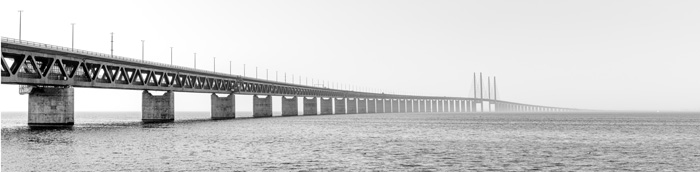
(makasana photo/Shutterstock)
Four major objectives were formulated around the number 100: extending the service life of the structure by 100 years, keeping the bridge open 100% of the time, obtaining a 100% accident-free record and making the bridge 100% CO2 free. Reducing the total cost of ownership was another key goal, explained Hergart, so that the bridge passed on to future generations would be cost-effective and inexpensive to maintain and operate, thus making the case for its continued upkeep.
To ascertain the structure’s service life, the organisation has partnered with Lund University to study all its elements and determine which are critical, on the understanding that any that are replaceable would not constrain service life. The theoretical studies of the design aim to pinpoint any bottlenecks to service life and develop corresponding solutions. Hergart says that possible actions on non-easily repairable elements may include additional monitoring, reinforcement or increased maintenance. The project is in early stages, but initial results conservatively estimate the service life of Øresund at 116 to 130 years for the moment. “We haven’t reached 200. But for 2025 we are convinced we can verify the bridge will have a service life of 200 years or more,” says Hergart, describing the strategy as preventative, proactive, and anticipating risks at the critical areas with increased monitoring. In terms of the other 100-centred targets, Øresund currently closes for 14 hours or less per year on average and has experienced few accidents, putting it in good standing for achieving its availability and security objectives.
A variety of activities and solutions are in place to reduce Øresund’s CO2 emissions. Vegetation on Peberholm Island is estimated to absorb 500t of CO2 a year, while the flora on the Swedish approach to the bridge is calculated to remove 100t of CO2 in the same time period, and the carbonation of the concrete structure is estimated to absorb a further 100t of CO2 annually. The CO2 emissions from Øresund’s operation and maintenance are approximately 350t per year according to calculations carried out with input from the structure’s suppliers, making the operation of the bridge net and climate positive.
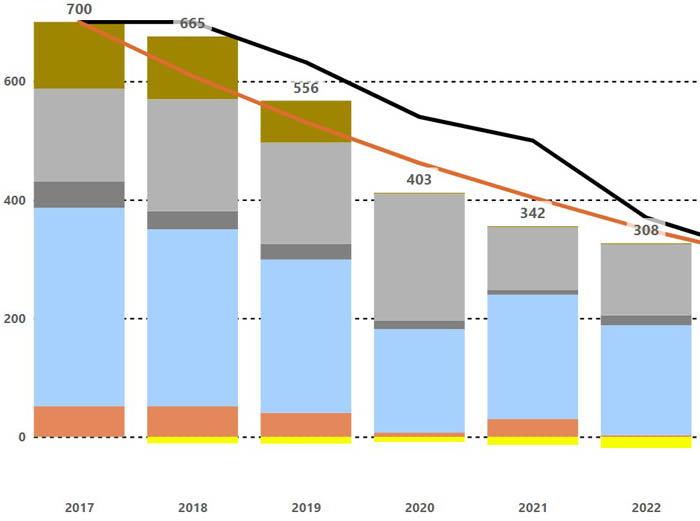
Reduction in carbon emissions on Øresund Bridge
Ongoing efforts have so far reduced the structure’s energy consumption by 57%: it consumed 12.7GWh in its first full year and approximately 5.4GWh in 2022. The sustainability strategy is aiming to go a step further and make Øresund as self-sufficient and independent from the energy grid as possible, by ramping up its production of solar energy, developing a battery pack to store solar energy surpluses, and piloting a wind turbine program to supplement its energy production.
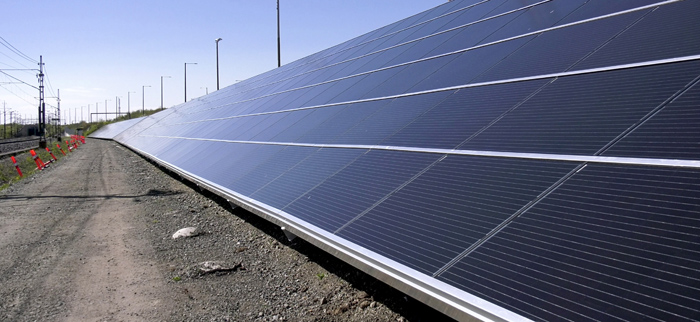
To source 45% of the link’s energy consumption from solar power, 10,000m2 of solar panels are being installed on Peberholm Island in addition to the 3,000m2 already operating at the foot of the bridge. The installation is expected to finish in June, after which data will show whether the panels produce the predicted amounts of energy, “and I would be surprised if they don’t, because the first solar energy park we have is producing more than we thought,” comments Hergart. If the results of the solar power investment are positive, further expansion of the project might be approved. More surface on Peberholm Island has been provisionally reserved for solar panels.
A battery storage system is being developed to solve the issue of solar energy that cannot be immediately used. Wind energy will also be trialled as a supplemental clean energy source during cloudy days. “We are trying to find a place out on the bridge where we can have a small turbine or several small turbines, and we want to have it where we can easily maintain it,” says Hergart. Peberholm Island is not an option due to its protected status, and neither are the piers, due to the rope access that would be required for maintenance. The bridge team is talking with different suppliers and hopes to have a wind energy pilot in place within a year.
Emissions from customers are also being addressed by the sustainability strategy. A trial project is introducing discounted superchargers for electric vehicles in both traffic directions, accessible only to drivers going over the bridge. The pilot will be small scale, with one charging station on the Swedish side and one on the Danish.
A cooperation with fuel companies to sell environmentally friendly alternatives to diesel with a possible discount for Øresund’s commuters is also being explored. The bridge operates a loyalty programme where users register to receive a device that allows them to pass the toll booths via a priority lane, among other benefits. If fuel companies participated in the collaboration, they would get access to Øresund’s 500,000 car-owning loyalty customers.
Another component of the sustainability strategy is the move from a calendar-based maintenance plan to a smart maintenance approach that schedules works based on the needs of the bridge. Measures to monitor all elements on the fixed link range from sensors to machine-learning algorithms, and Øresund has 40,000 different inventories within its property. A target has been set to move 10,000 of these inventories to data-driven maintenance, which means works would only be carried out when necessary, freeing up resources that could be better deployed elsewhere.
Becoming the world’s most sustainable bridge is perhaps Øresund’s most ambitious goal in its 23 years’ history. It is also one that can serve as an example to other bridge owners’ of how sustainability can be incorporated into various aspects of bridge management.