In the summer of 2023, Storm Hans caused severe flooding across Northern Europe, leading to fatalities, transport disruptions, and power outages. In Norway, the worst railway disruption was the collapse of the Randklev Bridge, a 172.5m-long single-track steel truss bridge that crosses the Gudbrandsdalslågen River about 237km north of Oslo.
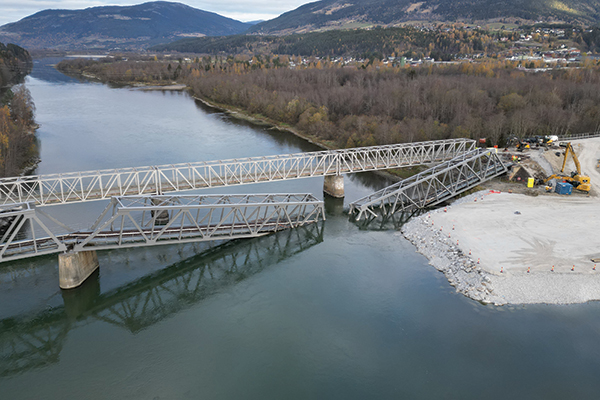 Two out of the three spans of the Randklev Rail Bridge collapsed into the Gudbrandsdalslågen River (Andrew Jørgensen Nordic Unmanned)
Randklev Bridge carries the Dovre Rail Line, which is the main and only electrified railway between the capital and the country’s third most populous municipality – Trondheim. The bridge opened in 1957 to replace an older 1896 crossing that could not handle heavier trains or support electrification, and which was repurposed for highway traffic. The bridge consists of three equal spans supported by two concrete piers resting directly on the riverbed.
In 2023, early August flooding caused movement in one of the bridge’s foundations, bending its tracks. Bane Nor, the agency responsible for the railway, inspected the bridge on 9 August and determined that emergency repairs were needed. This allowed the bridge owner to bypass typical time-consuming procedures and directly hire Øst-Riv as contractor and Ramboll Norway as engineering consultant by 13 August.
Next day, floodwaters peaking at 3,000m3 per second further undermined the compromised foundation, causing two spans to collapse into the river. The third span was damaged but remained standing. With repair plans under way, however, the team quickly adapted and began work without significant delays.
The recovery operation was complicated by the condition of the former railway bridge nearby: because its foundations had also been weakened, it had to be secured before repairs on the collapsed structure could proceed.
Time was of the essence to minimise traffic disruption and reopen the railway quickly, but the river’s flow patterns added further complications. “The main concern for us was the amount of water in the river because there is periodic flooding,” explains Eivind Aslaksen Hamre, Bane Nor’s project manager for the emergency rehabilitation. Even without Storm Hans, the river typically floods from May to October, reaching speeds of 800m3 per second, making in-water work difficult if not impossible. This gave the team a six-month window to finish repairs before summer floods could delay the project until autumn. To meet the tight deadline, work had to continue through the winter, when temperatures can drop to -33°C.
Although a boat equipped with a sonar scanner mapped the riverbed and the damaged bridge sections, divers were also essential for inspecting the area around the collapsed crossing and the damaged road bridge.
Initial site assessments showed that the fallen segments were stable and unlikely to drift away. However, all the foundations – including those of the road bridge – showed signs of significant scour. “Scour has been a big problem in this river,” says Hamre.
Later inspections revealed more details about the collapse: the extreme flooding had worsened the scour, creating a pit in front of the rail bridge’s northern foundation. This caused the bottom plate to slip out from its position, leading the pillar to topple and bring down the two spans it supported.
The ambitious repair plan aimed to conduct engineering and construction in parallel to avoid delays. First, the team would recover the collapsed spans to assess the extent of the damage and determine if they could be reused. Next, the contractor would reinforce the south foundation of the road bridge and the remaining rail bridge foundation, and replace the collapsed foundation, while developing plans to either rebuild or repair the railway bridge. Finally, the superstructure of the rail crossing would be installed.
But first, in order to prevent repeat severe scour and protect the integrity of the remaining foundations during works, the riverbed needed to be stabilised. This was achieved by placing approximately 6,000 rocks, each measuring 0.6-1m in diameter, across a 5,500m3 area on the riverbed using an excavator. “This to make sure that we don’t have any more erosion on the riverbed,” explains Hamre.
As each of the collapsed spans weighed 270t, their recovery required a mega crane the likes of which was not available in Norway. Instead, 81 trucks transported a Liebherr LR 11350 crane from Denmark, typically used for windmill construction. Weighing 1,450t and with a capacity of 1,300t, the crane hoisted the collapsed spans ashore in two day-long operations in October.
Next, Ramboll conducted a three-week assessment of the salvaged elements using visual inspection and 3D scanning. The surveys found that the damage was limited and mainly located at the ends of the recovered spans, where the sides that fell into the river had collided with the riverbed or bridge foundation, while the opposite ends were damaged by the forces during the collapse. Some steel elements had been deformed and twisted.
Several alternatives were considered for the railway bridge, including installing a temporary bridge, a full rebuild, or sourcing replacement spans. However, reusing the existing spans was seen as the most time- and resource-efficient.
Converting the road bridge for rail traffic was deemed impractical since its compromised southern foundation could only be repaired after recovering the collapsed spans, and modifying it to safely support modern trains would take too long. A temporary bridge had been identified in Germany, but its transportation and installation to the relevant level of rail safety was considered too time consuming. And a full rebuild was considered unnecessary, as the collapse was unrelated to the superstructure and its design. “The bridge has been standing since 1957 and has proven reliable,” says Hamre. Additionally, the mega crane could be reused to install the repaired spans, reducing the need for extra equipment.
The salvaged spans were stored in a heated tent near the bridge’s northern embankment, enabling repairs to continue despite the harsh winter weather. Reusing the spans meant adhering to the bridge’s original design, which featured rivet connections. This presented its own issues: “We didn’t have anyone that knew how to build it [the bridge] with rivets, so we used bolt connections instead,” explains Hamre.
About 3,000 rivets were replaced with bolts to repair the steel superstructure, with most damaged sections swapped out for identical parts. Although welding had not been used in the original construction, the steel was of good enough quality to allow it. Consequently, crews were able to cut out some damaged sections and replace them with new, welded steel after checking the area could support the required forces. Only one non-critical damaged area was fully replaced with welded parts.
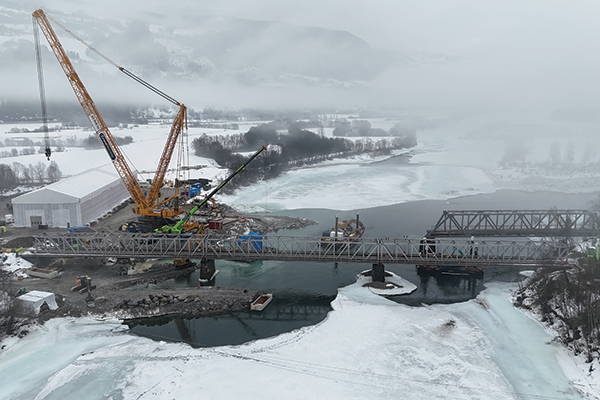 Rebuilding efforts continued throughout winter to meet the tight target timeline (Øst-Riv)
The heated tent made it possible to install bolts, weld, and paint the steel trusses even when temperatures dropped to -20°C. However, ice formation in the river posed a significant problem for reinforcing and constructing the foundations, which needed to be done in parallel to meet the target timeline.
The bridge owner worked with Ramboll to assess the expected behaviour of the ice and its potential impact on the foundations. Excavators were used to break the ice, and the riverbed infill helped prevent ice from drifting downstream into the construction area. Foundation repairs and construction began with the bottom plates, which are essential for preventing the bridge pillars from being carried downstream.
The southern pillars of the rail and road bridges survived Storm Hans but had experienced sufficient levels of scour under their bottom plates to require reinforcement. For the rail foundation, the contractor installed sheet piling around the eroded area and, for the road crossing – concrete blocks were placed around the compromised foundation. In both cases, crews poured concrete under and around the bottom plates for added stability. Due to minor movement in the rail bridge’s south foundation, its bearings were adjusted by several centimetres. Work on the road bridge was completed in November, while the Randklev Bridge’s remaining pier was finished in February.
Although modern standards were not used in restoring the steel spans, as it was deemed unnecessary, the collapsed northern foundation of the Randklev Bridge was rebuilt to meet current technical codes. The new foundation’s bottom plate is 1.5 times larger than the original, improving its capacity and integrity to withstand a 200-year flood. The final concrete pour for the new foundation was completed at the end of February 2024.
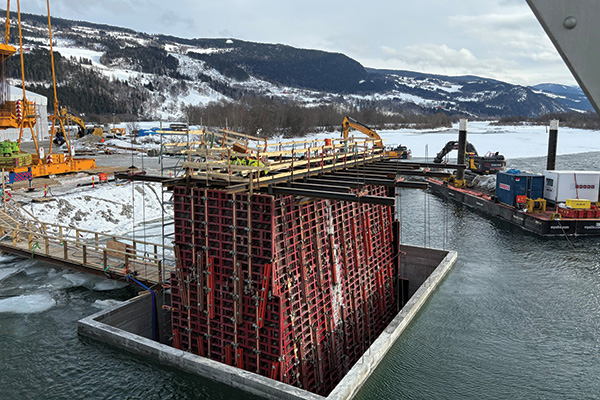 Rebuilding of the collapsed foundation (Jan Ove Degvold, Bane Nor)
The restored truss spans were lifted by the mega crane during a two day-long operation on 29 and 30 April. A key challenge was that the design of the Randklev Bridge did not allow for direct placement of the spans onto their foundations without risking a collision. There were also concerns that the plain concrete southern foundation might not withstand the forces if the middle span was placed directly onto it.
To solve this, the contractor lifted each truss slightly to the right of their final positions, unloading them onto jacks that slid the spans into alignment. Temporary works encased the foundations to help safely transfer the trusses’ loads to the bottom plates. To save time, the railway sleepers were installed before the span. The main repair activities were successfully completed before the summer floods of 2024, allowing railway traffic to resume less than a year after the collapse on 20 May.
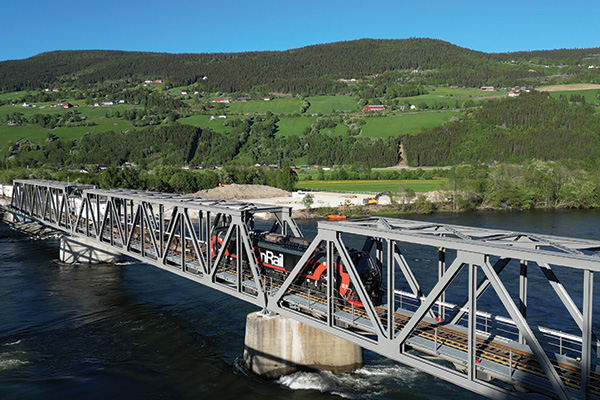 Rail traffic on the Randklev Bridge was restored in less than a year after its collapse (Kjetil Rolseth, Rolseth foto og bildearkiv)
Reflecting on the experience, Hamre offers advice for fellow bridge owners facing the major risks of scour and flooding: “Get some divers and ROVs [remotely operated vehicles] and inspect your foundations regularly. Also have emergency plans in place, especially related to where to find temporary bridge spans, for instance, because it took us some time just to locate these.”