
In recent years in St Petersburg, a lot of work has been going on to repair, rebuild and strengthen the city's historical bridges. Now engineers are just about to start construction on a major project to rehabilitate one of the city's oldest river crossings.
The choice of technical solutions, techniques and methods of reconstruction and repair for historical bridges needs to respect not only the practical requirements of contemporary traffic loads but also aspects of heritage preservation, such as layouts, aesthetic considerations and architectural décor of the original structure. This approach has been used for design development of the Lieutenant Schmidt Bridge reconstruction project, which is about to start construction, and is due to be completed in October 2007. On completion the structure will not only be wider to accommodate more traffic, it will also look more like the original design.
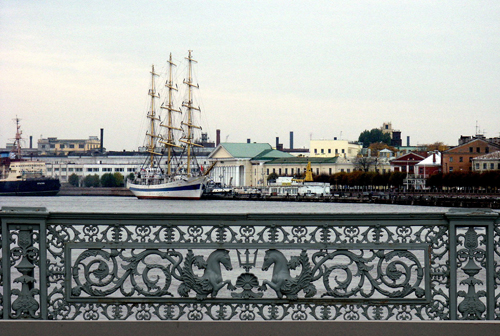
The 331m-long bridge will be closed for ten days at the end of this year. A temporary bridge is being built next to the old structure, onto which traffic will be diverted while the old bridge is rebuilt.
This eight-span bridge was the first permanent bridge over the River Neva, and when it was built in the 1850s, it was also the longest bridge in Europe. It was previously called the Nikolayevsky Bridge and was considered one of the city's most beautiful structures from an architectural point of view.
Stanislav Krbedz, a Russian engineer of Polish descent, developed the design. Originally it was a cast-iron bridge with a bascule section adjacent to the bank of St Basil's Island at the fairway. The bridge is close to Blagoveshchenskaya (Annunciation) Square, which was reflected in its original name. It was renamed Nikolayevsky Bridge in 1885 in honour of Emperor Nicholas I, and in 1918 was renamed again in memory of Lieutenant Schmidt.
It was reconstructed in 1936-1939 because the bascule span could no longer meet the navigation requirements on the Neva. When it was first built, the bascule span was close to the bank, to make it easier for sailing boats to pass through. With the arrival of steam ships, however, bigger draw spans were needed at the middle of the river, where it was deeper. The abutment was also suffering from progressive strain, causing the mechanical lift equipment to become stuck.
The new bridge was built to a totally different configuration and architectural outlook; unfortunately it was no match for the original lightweight façade, with its lace-like arch spans and impressive silhouette. At the time, financial constraints meant that the old piers and beam spans had to be reused; the new bridge was an efficient engineering solution, but from an architectural point of view it was a conspicuous failure, and was completely at odds with the surrounding architecture.
Over the intervening 70 years, the technical condition of the main structure and mechanisms of the bascule span became extremely unsatisfactory and now the bridge no longer meets the bearing capacity and safety requirements.
The main goal of the latest Lieutenant Schmidt Bridge reconstruction is to recover the structure's high-performance properties and its original historical appearance. This work will aim to contribute towards efforts to preserve the historical buildings on both banks of the Neva and keep the adjacent embankments and squares intact for the period of the works.
The project intends to recreate the appearance of the bridge as it was originally designed by Kerbedz, restoring the shape and outlines through use of modern construction techniques