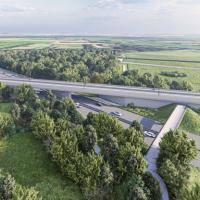
Helsinki had organised an international design competition for the bridge in 2001-2002. WSP Finland’s winning proposal was ‘Merimiekat’ or ‘Sea Swords’, a dual-spanned, asymmetrical cable-stayed bridge with a 92m main span. The bridge connects Ruoholahti and Jätkäsaari office and residential areas on the western shore of the city centre. It features two vehicle lines, two light traffic routes and has provision for a later a tram service.
WSP said that the Crusell Bridge is the country’s most structurally challenging realised using building information modelling (BIM). The designers created a building information model that includes detail right down to all the construction materials and amounts.
”The building information modelling enabled the contractor to see the construction phases in advance and define for example reinforcements much better than by using an ordinary level drawing. Also, they could order all materials just-on-time,” said WSP Finland’s Oulu bridge unit manager Antti Karjalainen.
According to Karjalainen, building information modelling reduces the number of surprises that complicate schedules and create extra costs. The model can be used to simulate any changes to the structure. “Maintenance projects during the life-cycle of the bridge will also benefit from the model,” he said.
WSP Finland’s business area director Pekka Pulkkinen was in charge of the technical design of the bridge.