
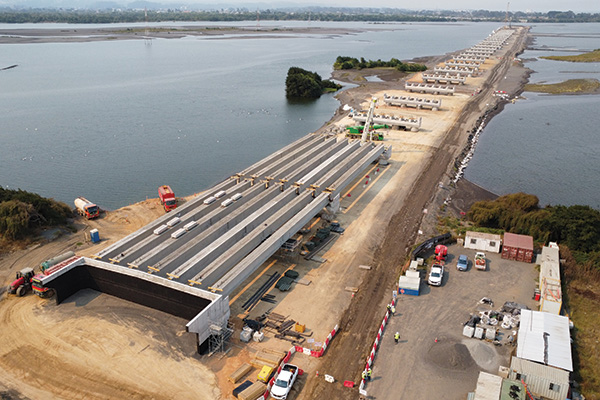
 Installing the first prestressed girders
Industrial Bridge spans the Bio Bio River in the city of Concepción, around 500km south of Santiago in the province of Bio Bio. A highway bridge consisting of pretensioned girders, Industrial Bridge will become the country’s longest of its type when it opens in 2025. The bridge will connect Hualpén to the north and San Pedro de la Paz to the south with a new 6.4km-long urban highway featuring two lanes in each direction. The bridge is part of a project that aims to increase connectivity to adjacent economic zones and reduce travel between the two sides of the river, as well as to improve access to Concepción, Chile’s second major conurbation. As such, the new route includes 17 additional viaducts and footbridges corresponding to a total investment of around US$250 million.
Currently at around 80% completion, the 2,520m structure comprises 56 spans each 45m long and 24.9m wide. Its concept design was mainly characterised by its location on poor ground classified as type III according to Chile’s Highways manual, and which features a liquifiable 5m top layer. The bridge is also sited in the floodplain of River Bio Bio – the widest in the country – and in an area with high potential for scour. Furthermore, the area has one of the highest seismic risks in the world, experiencing an Mw8.8 earthquake on 27 February 2010.
The structural design of Industrial Bridge was carried out by JLS Ingeniería in accordance with the Highways manual of the Ministry of Public Works of Chile as well as AASHTO LRFD 2012, the latter in the context of the vehicular live loading of a truck, as per HL-93.
Taking into account the uniqueness and importance of the crossing for the region, structural seismic demand was determined via a deterministic and probabilistic seismic risk assessment, which was carried out by Ruben Boroschek & Asociados. The study resulted in a much larger seismic demand than that required in the Highways manual.
Following many iterations, the seismic study established a range of accelerations at the bridge location in the context of an earthquake at the plate interface, with a 8.5 moment magnitude. Also taken into account were the results of an analysis for a plate interface earthquake at medium depth, with a moment magnitude of 7.8 and 8. As a result, a peak ground acceleration of 0.4g was proposed with a single spectrum (for horizontal and vertical elements) along the entire bridge site, which describes the seismic response for deep and intermediate seismic actions.
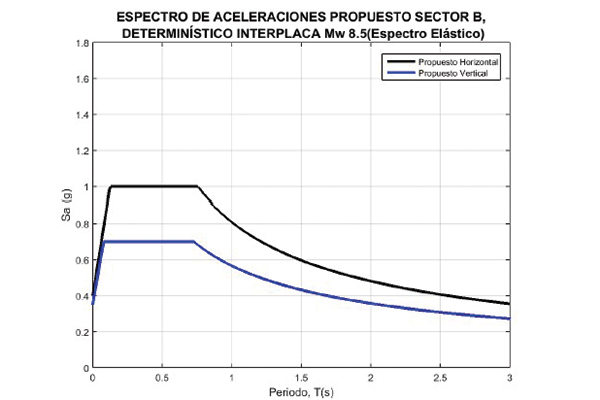
A seismic study determined the range of acceleration at the site in the case of an 8.5 moment magnitude earthquake
To evaluate the flooding risk and establish the design parameters for river works (maximum water levels, flow rate, scour etc) given the significant 2km width of the river, a study was carried out using a bidimensional 2DH hydrodynamic model. For this, a topo-bathymetric database was used covering the numeric domain of the main river channels and the flood-risk areas. This was calibrated to simulate both typical and exceptional water flows, using data from the fluviometric station at the Bio Bio River mouth and the maximum flood levels recorded during the last great flood in 2006.
The Industrial Bridge comprises a pretensioned girder superstructure founded on pile-piers, a typology selected to benefit from elements made of standard sizes (for ease of construction), and one that allows working from platforms when water levels are low. The bridge was planned to be built from one embankment to the other, advancing systematically in a regular cycle of placing piles, pier caps, pretensioned girders and deck, which would achieve efficiency via repeatability.
The structural design checks were carried out using two 3D models created in analysis software SAP2000, with dynamic analysis that considered the aforementioned spectra. The first model was used to estimate forces and design loading of the bridge, and the second displacement. The two models were needed to account for the inclusion of seismic isolation bearings whose energy-dissipating properties could be modified for limit-state analysis, as per the friction coefficient parameters in AASHTO GSID.
For final design, elastomeric bearings with a lead core were selected in order to dissipate seismic forces. The bearings’ shear modulus of 0.77MPa enables a vibrational bridge frequency of 1.72 seconds, but with a damping increase of 25%, which favours a reduction of forces transmitted from deck to piers.
Due to the size and singular characteristics of the project, the resulting principal bridge elements are atypical for a pile-supported concrete girder in Chile. These elements include 45m-long, 2.25m-deep pretensioned girders containing 65 pretensioned cables per girder; piers formed by four 28m-long reinforced concrete piles 2.5m in diameter – the latter unusual in the country; and lead-core elastomeric bearings in two designs, one measuring 648mm in diameter and 367mm high for the bridge piers, and another 800mm in diameter and 459mm high for the abutments.
To ensure the bearings performed as expected, a testing programme and quality assurance process was developed. This included the provision of the details required by the supplier and laboratory as well as testing protocols, acceptance criteria and reporting format - all as outlined in AASHTO GSID and Chilean norm NCh2745:2013 for seismically isolating systems for structures. The testing was carried out in Freyssinet’s laboratory in Milan, Italy. Also tested there were the expansion joints: these have a 400mm transversal and longitudinal movement and are located every four spans, or every 180m.
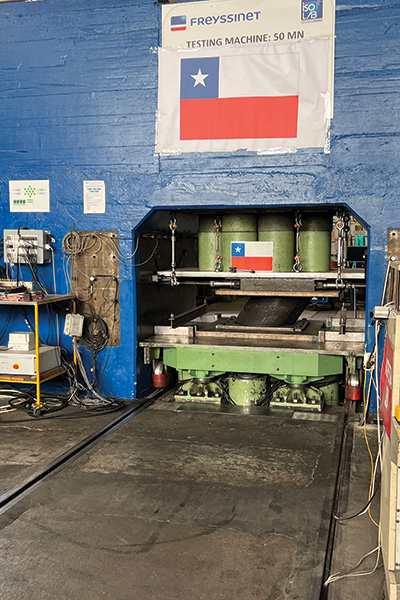
The bearings were tested in Milan, Italy
Other unusual aspects of this project were the installation of 40mm-diameter longitudinal reinforcement in the piles, which is again uncommon in Chile, as well as weldable reinforcing steel bar – a first application in the country. This was prefabricated in Concepcion using automated machinery to guarantee the quality of the joints.
Another first was the use of mechanical connectors for dealing with the splices and bar ends of the 40mm-diameter longitudinal reinforcement at the joints between pile and pier cap. To ensure the methodology would work correctly on site, the technology was verified at Dextra’s laboratory in Bangkok, Thailand, where repetitive cycles were carried out on the selected connections and rebar.
Due to the sizeable horizontal movements of the deck in the longitudinal and transversal directions, traditional seismic-resistant bars were not compatible. As a result, an alternative was proposed: highly resistant 1.5cm-diameter prestressed steel strands with a tensile strength of 270ksi – nearly 19t/cm2 – which enables horizonal deformation of the bridge to be accommodated as well as the vertical forces of the deck to be resisted.
To optimise construction of the deck panels on the pretensioned girders, precast slabs with a cast-in-place concrete slab were installed between the longitudinal girders to support the load of the final deck pour and the loads generated during construction.
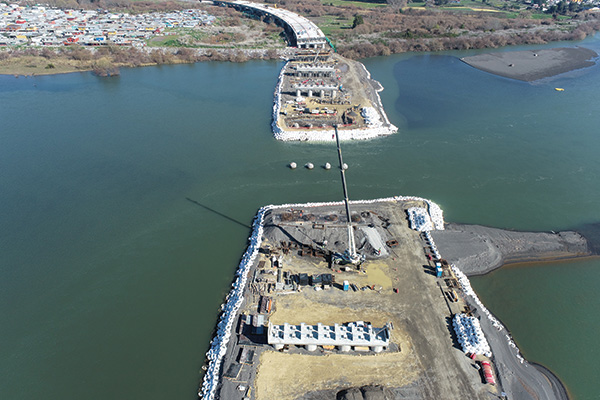 Approaching deck closure over the River Bio Bio
To summarise, the project achieved the final design of a 2,520m-long bridge in a region of high seismicity and one that had been affected by a major earthquake of Mw8.8 less than 15 years ago. The design addressed ground conditions of poor quality for a structure of this size, with a liquefaction potential for the first 5m and scour to 8m. The poor ground conditions required a level of structural design well above that of conventional designs executed in Chile: they called for uncommon solutions that not only led to innovative constructive details but also resulted in the correct execution of a significant piece of infrastructure.
José Luis Seguel is managing director and Claudio Morales Quiroga technical director at JLS Ingeniería, Santiago, Chile.
Client: Ministry of Public Works, Chile
Concessionnaire: Sociedad Concesionaria Puente Industrial (part of Aleatica)
Contractor: FCC Construcción
Engineering consultancy: JLS Ingeniería
Seismic analysis: Ruben Boroschek & Asociados