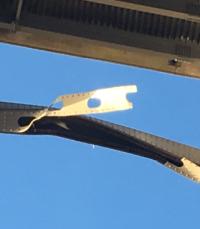
At 11:09am on Friday 18 September 2020, a sudden 127kph wind gust caused a truck carrying an empty shipping container to be blown sideways, tipping over the edge barrier and colliding with a truss diagonal tension member of the Auckland Harbour Bridge in New Zealand. Four lanes of the bridge on the box girder extension bridges remained open but the reduction in peak direction capacity from five lanes to two resulted in gridlock throughout the highway network, with long delays for the drivers of 170,000 vehicles that cross the bridge each day.
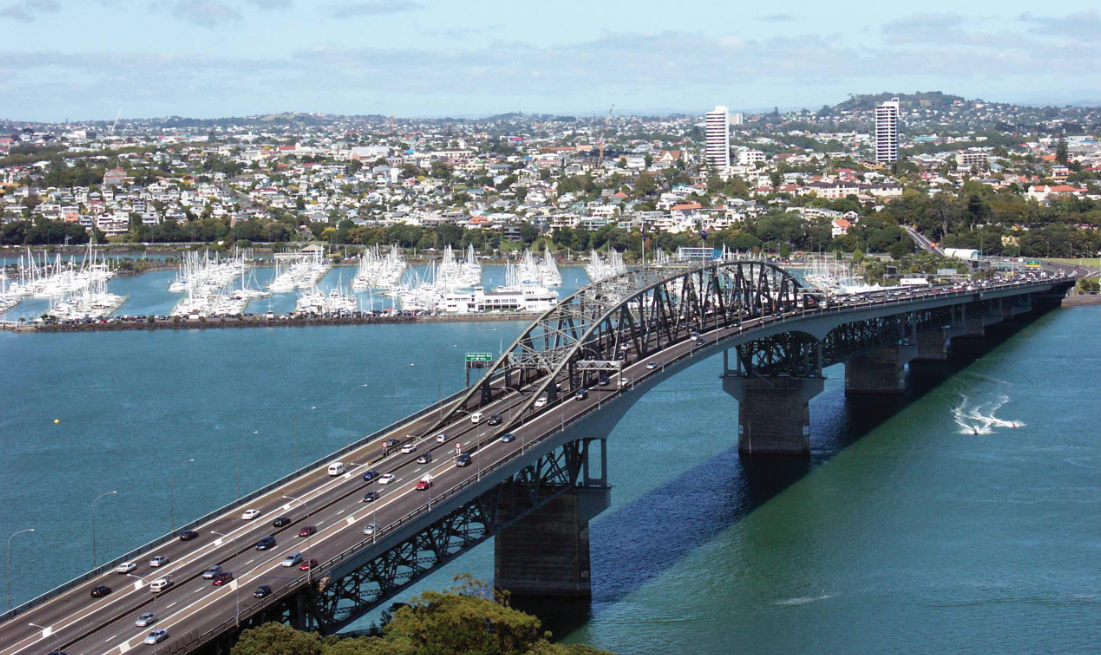 A truck collided with a truss diagonal tension member in September last year
The impact buckled the steel member and severed all bolts connecting it to the lower truss chord. The four truss bridge lanes were closed to all traffic for nearly five days, until temporary repairs enabled two lanes to be reopened to normal traffic. Installation of a permanent replacement member was completed 12 days later, well ahead of initial expectations, to the great relief of the travelling public.
Initial inspections found a badly deformed lower half of the diagonal member and the top half above the mid-splice largely intact, with potential for attaching emergency repair components. However, inspection below deck revealed that all bolts had sheared at the connection to the bottom truss chord, with roughly 65mm of axial displacement between member end and truss node. Being a tension diagonal member at the centre of the 244m-long truss span, this was the most lightly loaded main member and was sized accordingly. This made it more vulnerable to accidental impact loads, but also more amenable to repair than the more robust members at other panel points. Nevertheless, it was clear that immediate closure of the central four-lane structure was necessary until the member was replaced.
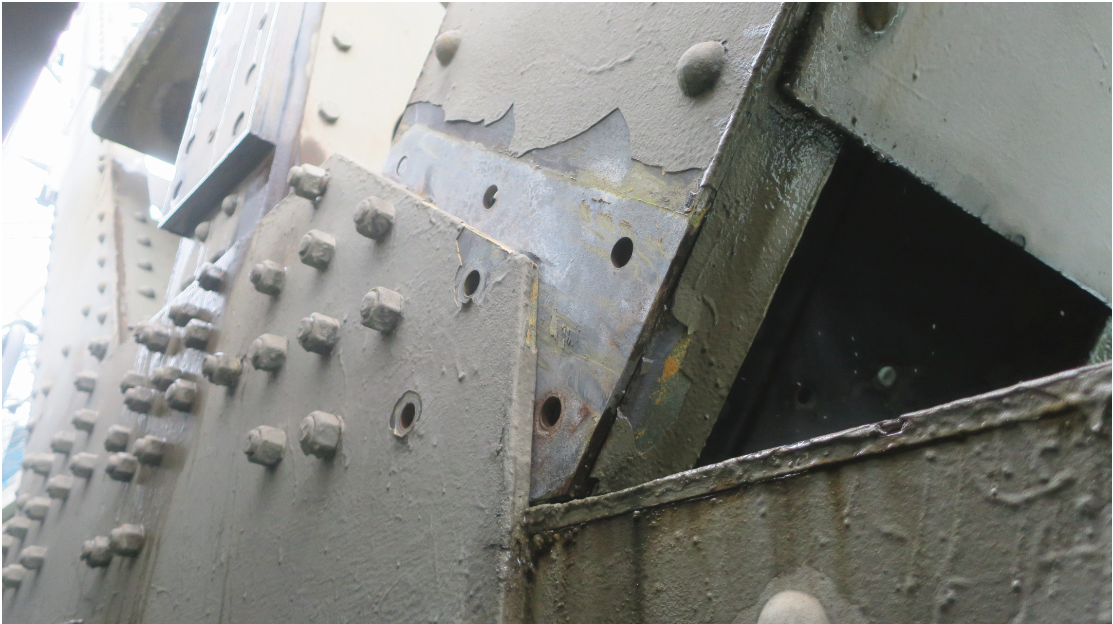 Bottom gusset connection after the incident (ASM Alliance)
To initially secure the damaged member and provide live and wind load capacity during the repair phase, on the day of the accident temporary bolts were installed through existing gusset plate holes to fasten the damaged member.
A response team was mobilised that afternoon by the Auckland System Management Alliance, an alliance between Waka Kotahi NZ Transport Agency, Fulton Hogan and HEB Construction. The team consisted of Auckland Harbour Bridge engineers Beca, bridge maintenance contractor SRG Global, and bridge asset management team WSP. A three-stage emergency response plan was rapidly initiated to include the assessment of load effects from the loss of the damaged member and load-carrying capacity for each stage of repair; the fast implementation of a temporary repair to open as many lanes as feasible; and the design, fabrication and installation of a permanent replacement member to restore full capacity.
In parallel, Waka Kotahi launched a communications campaign to promote alternative routes and the use of public transport while providing regular updates on the repair work.
Despite being a nominally statically determinate truss structure with little redundancy, it was found that after failure of a main truss member the bridge could carry significant wind and live loading. Beca undertook a structural assessment over the weekend with the member removed and found that loads carried by the severed tension diagonal member were redistributed to the diagonal member on the opposite truss via the knee-braced portal frame at midspan.
Additional secondary bending moments in the top and bottom truss chords, which are large riveted box sections, also transferred loads to adjacent panels. This led to significant additional stress in the most critical truss chord members, which restricted the available live load-carrying capacity until a permanent replacement member could be installed and pretensioned to restore balance between east and west trusses. With no preload in a temporary replacement, the truss was found to be able to carry traffic in the two western lanes only.
Four days after the incident closed the truss bridge, an 11.4m-long temporary member was installed to replace the damaged lower half of the tension diagonal. To minimise fabrication time, the design used a 457mm-diameter, 12.7mm-thick steel tube. This was sourced over the weekend, with 12mm-thick adapter plates added at the ends for bolting to existing connections.
During a nine-hour overnight closure of all southbound lanes, SRG removed the lower 11.4m-long diagonal member and replaced it with the temporary member, with support from the ASM team. The bolted connections at either end were match-drilled on site for a close tolerance fit. After installation of the temporary member, a load test using four 21-t trucks at mid span proved the integrity of the repair. The movable median barrier could then be shifted, and traffic controls deployed to open an additional lane in each direction.
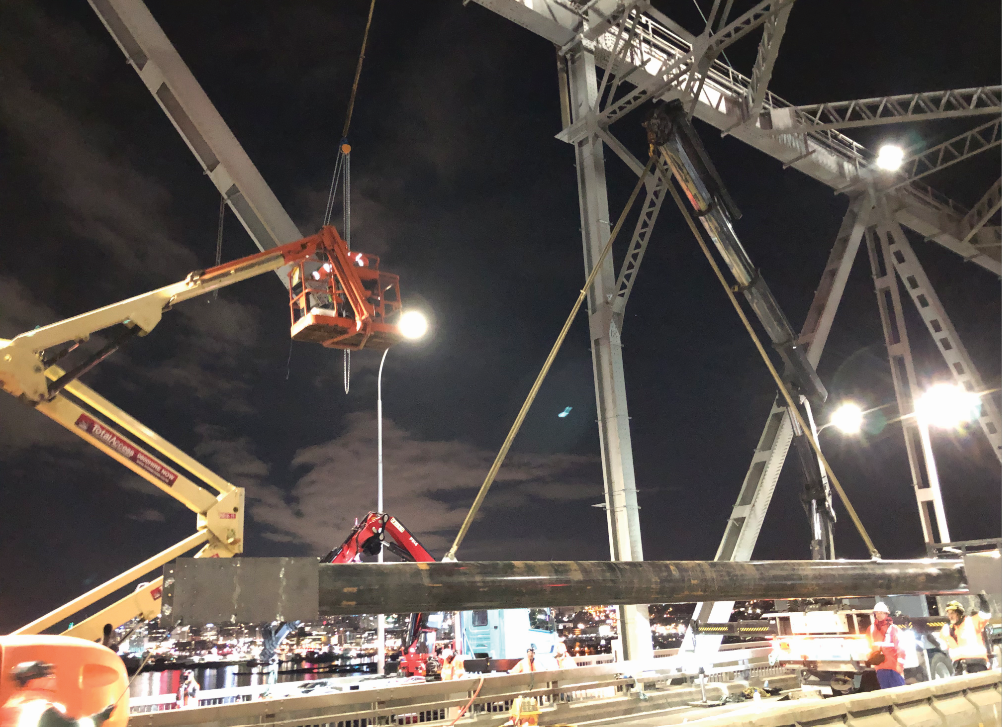 Installation of temporary member four days after the strike (ASM Alliance)
Design of the permanent replacement member proceeded in parallel with the analysis and truss member assessment work. The design largely preserves the appearance of the original battened built-up channels but was welded rather riveted, with thicker plates – increased from 9.5mm to 12mm – and internal diaphragms to improve resilience and avoid damage from a similar incident. A key design feature was inclusion of a jacking frame system for pre-tensioning within the centre splice with allowances for the relative deflections and rotations between the two member segments, so that final tensioning would restore the original alignment.
Staged construction analysis was used to estimate target jacking forces and deflections, allowing for the installation sequence and loads from construction equipment. The target pretension at completion (750kN) aimed to restore the dead load tension prior to member loss and fully reverse the adverse effects of load redistribution arising from the member loss. Fortuitously, an ICE proceedings paper by the original designers (Roberts and Kerensky, 1961) included their member force results for the navigation span truss, providing further confirmation of target loads.
Installation and jacking of the replacement member were completed during a second overnight closure of all southbound lanes. Jacking was carried out in increments with surveys at each step to compare actual displacements with predictions from the structural model.
Strain gauges on the member monitored the force applied to identify any anomalies or uneven stress distribution within the new member. When force/displacement measurements within pre-set acceptance criteria were achieved, the splice joint was then locked, bolt holes were drilled through splice plates and close tolerance bolts installed to prevent slippage after removal of the jack.
A final load test was carried out on 4 October using four 21t trucks at midspan and the remaining two closed lanes were reopened two days later, following a final review by Arcadis, UK. The process consisted of checking for additional locked-in actions that could have occurred during jacking operations to align the member at the splice, as well as potential damage arising from dynamic effects during the incident. Strain gauge measurements were checked, a post-installation inspection was carried out, and confirmation that structural behaviour was consistent with modelling. Final monitoring inspections were completed just 19 days after the incident.
The response involved close collaboration between a large team of designers, constructors, Waka Kotahi, and the ASM Alliance. Daily online coordination meetings with all the key players were held to track progress, confirm decisions and expedite actions collaboratively. The public were kept informed of progress and planned lane closures to lessen the impact on motorway users. The speed of the team’s response exceeded expectations of customers and clients alike.
Describing the project, Brett Gliddon, Waka Kotahi general manager, transport services, says, “It’s been an incredibly complex process with absolutely no room for mistakes, and with our every move under intense public scrutiny. We had a temporary solution installed within days and a permanent fix, and the bridge restored to full capacity within 19 days. This is a phenomenal achievement and one which could not have happened without the amazing people who worked with us at Waka Kotahi to support the effort” n
Will Pank is technical director of structural engineering at Beca and Mike Beamish is senior associate, civil structures, also at Beca. Hannah Barker is Auckland Harbour Bridge asset management team leader at the ASM Alliance