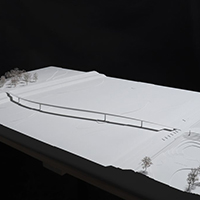
Born in Pamplona in 1936, Manterola graduated in civil engineering at the Polytechnic University of Madrid. His career began at construction company Huarte where he worked alongside renowned architect Francisco Javier Sáenz de Oiza on the design of the 81m-high Torres Blancas building in Madrid, notable for its cylindrical shapes and overhanging rounded balconies. After two years with Huarte, Manterola spent a year and a half conducting research at the Eduardo Torroja Institute of Construction Materials in Madrid.
In 1964, Manterola joined Leonardo Troyano and Troyano’s father Carlos Fernández Casado to co-found engineering consultancy Carlos Fernández Casado, of which he eventually became president and CEO.
While Manterola contributed to a wide range of projects in his prolific career, he gained international renown with his expertise in bridge and viaduct design, leaving his mark on over 200 projects worldwide. Among these are the record-breaking Carlos Fernández Casado Bridge (1983), the Osera Bridge (2001), and La Pepa Bridge (2015).
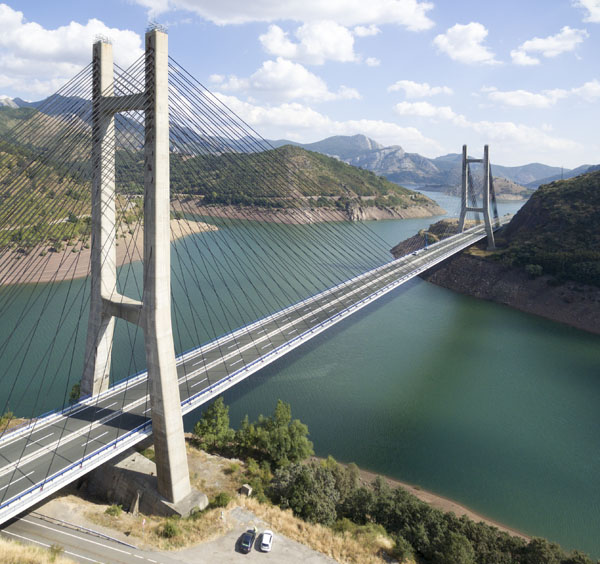
The Carlos Fernández Casado Bridge
Speaking of Manterola’s work, José Romo, CEO of Fhecor, said “Bravery was one of the defining traits of his character that shaped his understanding of engineering. This courage, evident in his first major work – the Carlos Fernández Casado Bridge – was based on profound technical knowledge that allowed him to always explore the limits.” The 440m-long cable-stayed Carlos Fernández Casado Bridge held the record for longest span until 1986 and for concrete cable-stayed bridges until 1995. Spanning the Barrios de Luna reservoir in the province of León, it features two 101.7m-long approach spans and is supported by 220 stay cables anchored to H-shaped pylons.
When Manterola first proposed a tube-concept with circular side-openings for the Osera Rail Bridge over the Ebro River in Zaragoza, sceptics expressed concerns that the bridge would be difficult to construct and would whistle like a flute, scaring the bird population of the surrounding ecological area (Bd&e issue 82). The successful construction of the 546m-long tubular Vierendeel-truss bridge, which today adds whistle-free retro charm to the Madrid-Barcelona high-speed railway line, is a testament to the soundness of Manterola’s design and to his persuasive character.
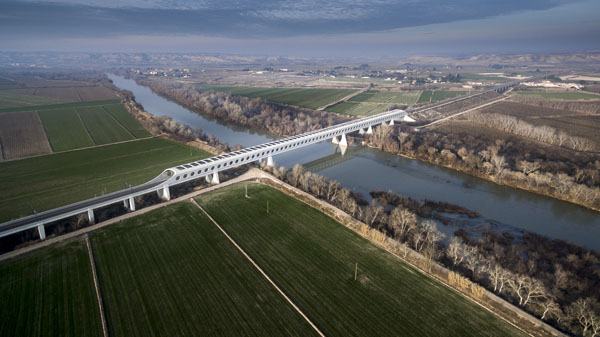
Manterola’s Osera Railway Bridge
The cable-stayed La Pepa Bridge, the world’s second-highest crossing and one of the largest, spans the Bay of Cádiz to connect the city with the municipality of Puerto Real. Also known as the Constitution of 1812 Bridge, it measures 3,082m in length and 33m in width. Its 1,079m-long deck has a complex interior geometry and a trapezoid-shaped exterior. A vertical clearance of 69m accommodates most water traffic, while a 150m-long demountable span section enables the passage of larger ships.
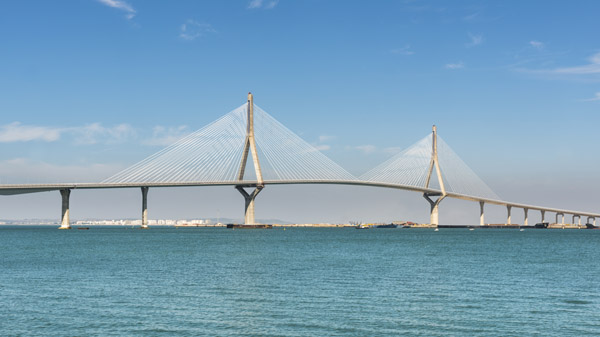
La Pepa, also known as the Constitution 1812 Bridge in Cádiz
Manterola’s work was not confined to Spain: with CFC he undertook projects across the globe, including in the UK, USA, and the Middle East.
As a professor at the School of Civil Engineering at the Polytechnic University of Madrid from 1976 to 2006, Manterola taught over 30 graduating classes. Following his retirement, he was appointed Professor Emeritus in 2007.
Throughout his career, Manterola’s designs demonstrated technical innovation and a keen sensitivity for integrating structures into their surroundings. Committed to sharing his wealth of experience, he published numerous essays, papers and books, including Engineering as a work of art.
“His design and built work is a legacy of unparalleled value that has been recognised nationally and internationally. To join the world of bridges with Javier was to join the world of technology with capital letters; but also, the world of art, architecture, philosophy,” said Antonio Martínez Cutillas, project engineer at CFC.
Manterola received numerous accolades, including IABSE’s International Award of Merit in Structural Engineering, the Prince of Viana Award for Culture, and the Spanish National Civil Engineering Prize.
“Our master, whom we admired and loved so much, is gone, but his personal example and his works will always be with us. That tangible legacy of excellence in structural engineering will continue to influence not only us but also upcoming generations of engineers,” said Romo.
Manterola passed away on 12 May, the Patron Saint’s Day of Spanish civil engineers.
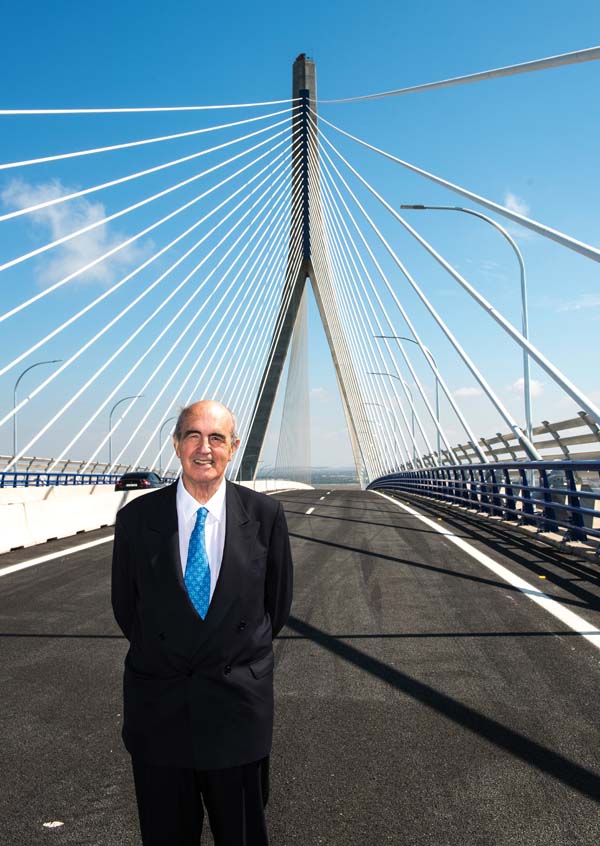
Javier Manterola at the inauguration of La Pepa in Cádiz
A profile of Javier Manterola Armisén was published in Bd&e issue 82 and can be accessed by clicking here.