
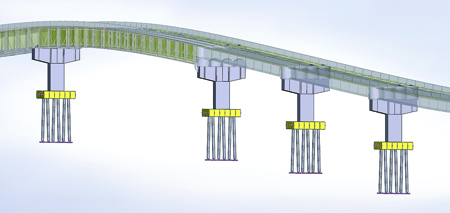
As the benefits of refined modelling for structural analysis continue to gain traction in the bridge engineering industry, Larsa 4D has introdued analytical object modelling methods to simplify the modelling and analysis of large-scale structures by uniting structural objects with the rigorous techniques of finite-element analysis. While analytical object modelling brings new productivity gains to structural analysis and design, there remain many other areas for improvement in the traditional bridge design and analysis practice. One such area for improvement is the inclusion of non-linear effects for soil-structure interaction on multi-span bridges, which requires significant amounts of data to be manually transferred between separate software products, until the behaviour of superstructure and substructure are fully represented.
In Larsa 4D, analytical object modelling starts by selecting structural objects, such as girders and decks, and then setting the unique parameters of those objects. Using this approach Larsa 4D generates an analytical model of each structural object, which are linked together to form a complete finite element model of the bridge system that can be analysed by the analysis engine of the software. To address the lengthy and iterative process of modelling superstructure and substructure elements, new objects for soil, soil profiles, piles, and pile groups are being added to Larsa 4D’s analytical object modelling environment. These foundation objects are modelled using lateral load-transfer curves (p-y curves) based on published recommendations for various types of soil and rock, and are used to build soil profiles that are assigned to the piles at the object level. Once defined, these objects will automatically create FEM-related definitions for piles, such as beams and soil springs. Larsa 4D’s new soil structure interaction tool allows users to integrate non-linear soil behaviour for every stage of construction and load combination, enabling the effects of foundation settlement, sliding, and rocking on the behaviour of the superstructure to be easily determined.
In this version of SSI, piles and the behaviour of the surrounding soil are modelled with automatically generated beam and linear and nonlinear soil springs. Using this feature engineers only need to provide definitions for the properties of soil layers, soil profiles, and the location of piles under a foundation. After these parameters are defined, the rest is handled by Larsa 4D’s automatic generation algorithms. This includes lateral soil resistance represented by two orthogonal lateral non-linear springs whose behaviour is described by p-y curves. Likewise, the skin friction and end bearing of piles are represented by axial non-linear springs whose behaviour is described by T-z and Q-z curves, respectively. Springs for lateral soil resistance and skin friction are generated automatically at discrete points along the length of the pile. Piles are modelled with linear and non-linear beam elements, which further allows the modelling of cracking due to the moment or softening due to the compressive forces on the piles. The behaviour of piles changes if the distance between two piles is smaller than a certain value, which is called the group effect. Larsa 4D handles the group effect of piles by using the P-multipliers approach given in AASHTO specifications. Without any additional information from the engineer, the P-multiplier of each pile in a group is automatically calculated using the location of the pile and direction of loading. With this modelling approach, piles can be incorporated into the whole bridge analysis model in a simplified manner.
Traditional structural analysis only knows about the analytical model. This leaves out crucial information about the bridge’s overall structure which is necessary for bridge information modelling. Analytical object modelling connects structural analysis into the bridge information modelling ecosystem through its structural objects and parameters.
The foundation objects in analytical object modelling can be exported to, imported from, and exchanged with other software in the bridge design process so that data conversions are seamless to and from the many other software packages involved in the bridge design process. And the analytical model can be exchanged with other structural analysis software.
Analytical object modelling is also design-ready. Since analytical object modelling knows how beams and shells form the foundation of a bridge, design processes can take advantage of greater automation. That automation starts with automatic application of the appropriate design code routines and can include automatic selection of critical locations and load conditions for code check and load rating based on AOM’s knowledge of not just the analytical elements but also the overall model structure.
The new soil structure interaction feature in Larsa 4D will save considerable amounts of engineering time by enabling users to model superstructure and substructure in a single finite element model.
Ozgur Kurc is general manager at Larsa Eurasia and John Horner is director of marketing at Larsa