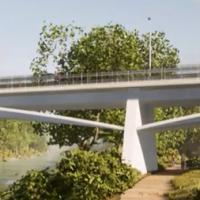
The aesthetic centrepiece for one of the largest highway works currently under construction in Italy is a 600m-long viaduct with distinctive V-shaped piers and an orthotropic deck.
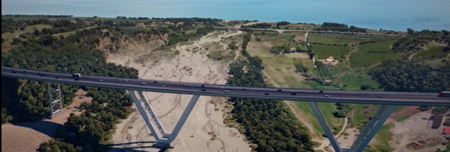
Rendering of the Avena Viaduct (Webuild)
The Mega Lot 3 of the Ionian Highway – known in Italian as ‘la Jonica’ – comprises a new 38km-long section of the SS-106 state highway running between the municipality of Sibari and the town of Roseto Capo Spulico in the province of Cosenza, near the Gulf of Taranto. When completed in 2026, it will form part of the E90 route of the Trans-European Transport Network (TEN-T) and assist in the development of Calabria, a region with one of the lowest GDP per capita figures in Italy.
The US$1.04-billion contract was awarded to Webuild by Azienda Nazionale Autonoma delle Strade (ANAS), an organisation which forms part of the state-owned rail management company Ferrovie dello Stato Italiane. The contract includes the construction of four junctions, 16 viaducts and 13 tunnels, which will be built by Sirjo, an entity created by Webuild specifically for the project.
In order to meet ANAS’s requirements as well as a project deadline of summer 2026, Webuild is taking a standardised approach to both the design and production phases. “Two general bridge deck designs have been developed to align with the two distinctly different geographic characters surrounding the new highway,” explains Massimo Mascia, technical office manager, Webuild.
As the first 18.9km of the new route is relatively flat, the eight viaducts for this area – Section 1 – are composite steel/concrete structures with a maximum deck height of 11m and maximum span of 66m. These spans are typically formed by three main beams and extended diaphragms with external ribs. The diaphragms and ribs support another two secondary longitudinal beams, above which the concrete deck cantilevers with a safety barrier and parapet are located. This design was chosen to optimise the size of the foundations and piers.
The remainder of the new route runs through a landslide-prone hilly area with frequent topography changes from plateau to deep valley floors. Here, seven orthotropic viaducts will be built with a maximum height of 60m and a maximum span of 200m. The standardised design for these structures sees the steel plate deck carried by two main beams and a framework of crosspieces with external ribs. “The orthotropic deck design was chosen in order to meet the requirements of the client, who wanted to reduce the impact of the structures on the environment as well as better integrate them within the landscape,” says Felice Schiavone, head of viaduct design for the project. “In addition, the deck reduces height and weight, with associated benefits in terms of foundations and seismic response.”
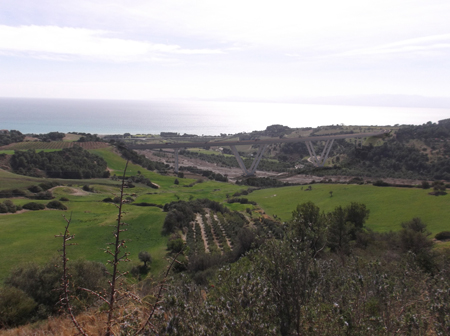
A landmark viaduct has also been included in the project, the Avena Viaduct. This bridge spans the Avena River near the town of Albidona, approximately 1,300m from the sea. The structure is 26.45m-wide and 600m-long with central spans supported 60m above the river by two visually striking steel V-shaped piers. The side spans are supported conventionally by vertical steel pylons. The piers connect to the two longitudinal steel main beams that make up the orthotropic deck, which is formed by steel plate and double-T transversal beams and struts.
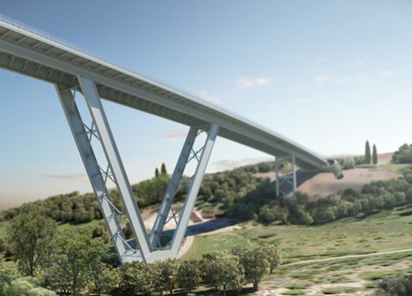
V-shaped piers will support the orthotropic deck (Webuild)
All Avena Viaduct’s piers consist of two double-T girders arranged at a centre distance of 13.5m, in alignment with the deck main beams. The V-shaped pier legs connect longitudinally at ground level, and an arrangement of trusses about 15m apart serve to stabilise each pair of inclined legs.
The steel for the orthotropic viaducts in the project is mainly S460, which was chosen over S355 due to its estimated 30% greater strength, enabling the span of the viaducts to be increased while reducing groundworks for foundations and piers.
According to Webuild, the choice of the orthotropic deck brings a number of benefits to the project, including eliminating the need for a reinforced concrete deck slab and the related pouring/curing activities. Construction by launching means that the work site is largely limited to the area behind the abutments.
In the case of Avena Viaduct, the launching methodology required the initial alignment of the bridge to be redesigned, but this was felt to be worthwhile as launching would eliminate the use of temporary works within the riverbed and the risk of landslides near the north abutment. “The length of Avena Viaduct’s spans was also increased in order to make the viaduct more visually pleasing as well as to reduce water impact and the northern landslide on the piers, and the design optimised to enable prefabrication and off-site work,” says Schiavone.
Groundworks are expected to begin imminently with the driving of 1.5m-diameter piles for the piers and 1.2m-diameter piles for abutment foundations. Almost all steelwork, which includes the beams, orthotropic plates, diaphragms and piers sections have been fabricated and are expected to be delivered shortly at Webuild’s storage areas. Avena Viaduct will be launched from the north abutment using a 95m-long launching nose, equipped with a system for the recovery of the tip. Bracing will be positioned near the top of the vertical side pier to provide temporary support during launching phases.
Completion of the Avena Viaduct is expected in early 2025.