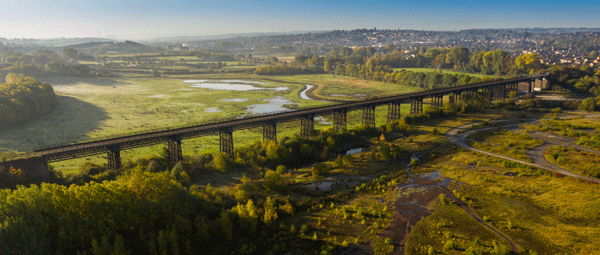
Bennerley Viaduct (Shaun Richards)
Until just a few years ago, Bennerley Viaduct in the English midlands rated as one of the best-kept secrets of its industrial heritage portfolio. The 442m-long ‘iron giant’ strides across the flood plain of the River Erewash not far from the city of Derby, but by dint of the topography and inaccessible nature of the former industrial site, it was little known outside the immediate area.
The structure — which is one of just two of its type remaining in the UK — was opened to trains in 1878. It has a long and chequered past. Having survived being bombed in a Zeppelin attack in 1916, in the 1970s it had to be saved from demolition proposed by former owner British Rail, despite being legally protected as a historic asset (Grade II* listed).
Since 1998, the viaduct has been under the stewardship of Railway Paths, a charity that was set up to own and manage retired railway infrastructure. Project manager Bill Tomson recalls how RPL worked with the local community to establish the Friends of Bennerley Viaduct (FoBV), a charity whose work has been crucial in raising the profile of this forgotten relic and bringing it to the attention of a wider audience.
Tomson was employed in 2014 to project manage some of RPL’s more challenging assets, after the organisation acknowledged that extra resources were needed to take these projects forwards. Not only is Bennerley a substantial structure, but the connections at each end were demolished when the line was closed, leaving it with no obvious purpose.
A grant from Heritage Lottery Fund financed a series of community engagement initiatives. This included the first ‘volunteer work day’, which Tomson says was attended by just two local enthusiasts as well as a representative from the walking and cycling route charity Sustrans, and himself. Happily, interest subsequently mushroomed and led to establishment of the very active FoBV group, which became a charity in 2019 and has played a huge part in raising the profile of the structure.
Getting buy-in from the local community not only created a spirit of ownership, it also leveraged a committed group of volunteers who help out with fundraising, regular work parties to clear vegetation on the site, and hosting visits. FoBV’s community engagement volunteer Kieran Lee notes that the existence of the viaduct can come as a surprise even to those who live in the immediate vicinity. But its inaccessibility — hemmed in by two canals, a river prone to flooding and a live railway line — was what saved the bridge in the 1970s, “It would have been too expensive to demolish it!”.
The Friends’ vision is ‘to create an inspirational green space... where the rich industrial, natural and literary heritage of the Erewash Valley can be enjoyed, understood and celebrated by everyone.’ This involves bringing the viaduct back into public use, in particular providing safe access to the deck so visitors can enjoy the panoramic views. This is being done under a US$2-million project in three phases: an initial contract to restore and repair the viaduct structure, which is under way; construction of a new ramp at the western end (expected to start before the end of the year) and installation of a new deck. Although a substantial contribution towards the latter from Broxtowe Borough Council was confirmed in July, more money is still needed. Completion of all three phases is targeted for spring 2021.
The viaduct gained listed status in 1974 but has been on Historic England’s heritage-at-risk register since 2004. Phase 1 is largely funded by HE, from a pot of money set aside specifically for assets on the register.
Railway Paths asset manager Paul Thomas acknowledges that the scope of the project is not full renovation, rather a case of making the viaduct safe, prolonging its life and providing access. “The main thing at the moment is to restore its connectivity,” he says.
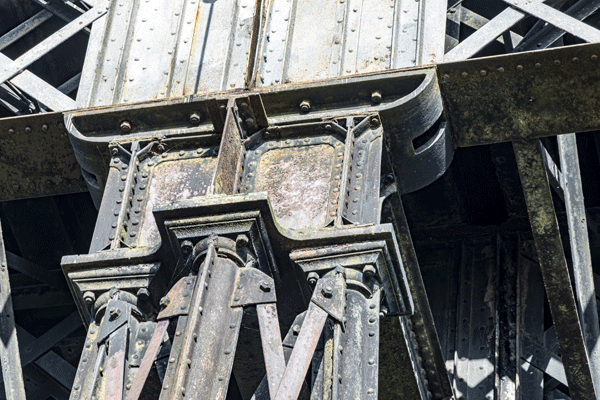
Detail of the pier top (World Monuments Fund Britain/Andy Marshall)
What makes the viaduct notable in heritage terms is not just its rarity, but the fact that it was designed as a bespoke lightweight alternative to a masonry viaduct, intended to reduce the loading on the honeycombed, former mining land that it had to cross. The wrought iron structure has 15 piers and 16 spans supported on brick pier bases; it survives almost unaltered, with none of its structural characteristics modified or obscured by subsequent work. Four large cast iron base plates rest on top of each of the pier bases, and these support 12 wrought iron columns which make up each pier. These hollow columns, which are formed of riveted wrought iron quarter sections, are kept in position by horizontal and diagonal bracing elements tensioned using cotterpins. The lattice girders along each edge of the viaduct deck support 526 transverse iron troughs which contained the ballast. The iron structure is connected to three spans of more standard construction which were added later to carry the track over a railway that is still in use.
Blackett-Ord Conservation Engineering project manager Ian Weir acknowledges the largely unaltered state of the structure, revealing that the drawings published in The Engineer at the time the bridge was built are still used as a reference. His firm was appointed by RPL to initially outline a scope of works for the structure, and subsequently develop this into a schedule of works to fit the available budget. “The initial investigations focussed on a single span and two pier trestles as the most expeditious way of estimating the global condition, and the funding bid had been prepared on this basis,” he says.
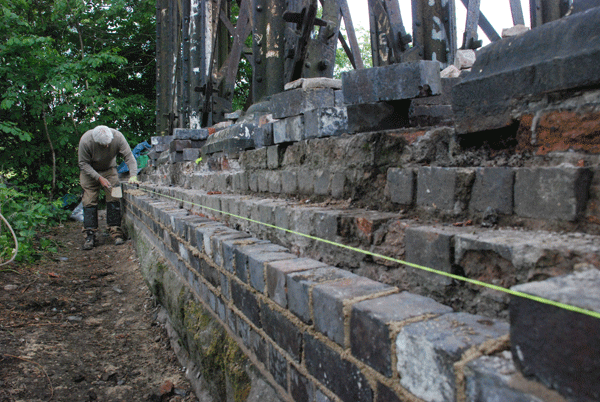
Repairs to masonry (Kieran Lee)
OBE carried out visual inspections and made recommendations, including the removal of vegetation that was hampering access and obscuring the structure. For such an old structure which has had very little maintenance, its condition is very good. The main issues that had the potential to affect the stability of the crossing were the condition of the brick pier bases and brick abutments. Repairs have targeted deterioration of some of the brick courses forming the masonry pier bases; a lack of drainage in the pier bases that was allowing them to retain water; and the deterioration of some of the bolt fixings in the base plates. Elsewhere there was corrosion and delamination of some of the iron elements where leaf debris was causing moisture to be retained; damage to the brick abutment at the east end caused by vegetation; and corrosion to the ends of the iron troughs on the deck which held ballast. The risk of scour is also a constant.
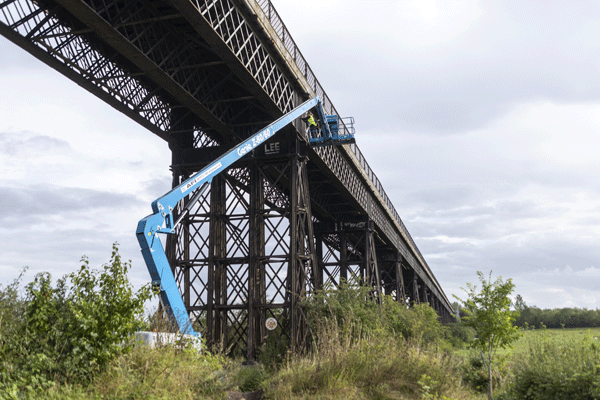
Accessing the viaduct (World Monuments Fund Britain/Andy Marshall)
Many of the missing copings from the abutment walls were uncovered by volunteers clearing ground-level vegetation, and around 1,000 bricks were also gathered from the site for reuse. Deck-level hopper heads, which are part of a drainage system (added after the bridge was built), were loose, and many of the downpipes had also been lost. Entirely removing the system eliminated the risk of them falling off and as Weir explains, had a neutral impact on the structure. “Rainwater shedding will still happen, and the wind will blow it around in any case.” Expansion joints at the abutments will be replaced to allow the viaduct to move again — up to 150mm across the entire structure, Weir says.
Specialist contractor Ackroyds was appointed at the start of the year for the first phase of the work. After setting up on site in early March, the national lockdown immediately imposed a two-month hiatus before work could restart. But Ackroyds contracts manager Geoff Hall has taken the setbacks in his stride, and explains that the logistics of access to both the structure and the site have been the real challenge. The eastern abutment has a narrow access track up a steep slope cut through woodlands and at the west there is currently no vehicular access, only a temporary stair tower for the crew. At ground level, site topography and the presence of the river can even hamper access with cherry pickers, especially when the river is prone to flooding. Luckily this has not been a problem. “The weather has been kind to us!” Hall smiles.
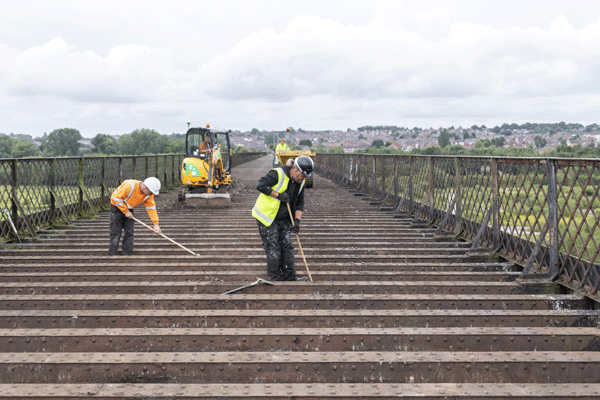
Removing the ballast from the deck troughs by hand (World Monuments Fund Britain/Andy Marshall)
When Bd&e visited the site in August, work was just starting to remove the ballast from the iron deck troughs. The intention is to use the ballast in Phase 2, which will see construction of a new embankment for access at the west end. But this is not as straightforward as it sounds, given the highly contaminated nature of the material, Hall says. “It will have to be capped with new material that will have to be brought in, and meanwhile we have a full material management plan for removing and storing the ballast,” he says. The removal process is onerous: a small excavator loosens and removes some of the compacted ballast, but it still requires operatives with shovels and brooms to get the remainder out. It is heaped into a mini dumper — one load takes the material from about five troughs — and then it is a slow and uncomfortable journey for the driver of the tracked vehicle to the chute at the far end of the viaduct. The only comfort is that the journey will get shorter as work progresses.
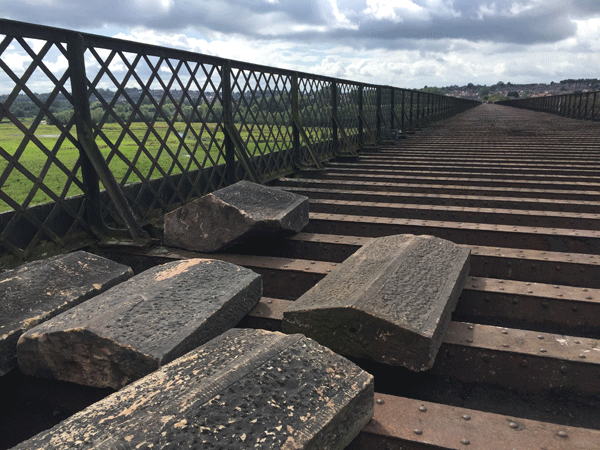
Coping stones (Helena Russell)
In the long term, there are other issues that may need to be addressed, says Weir: “The bridge has a lot of redundancy, given that it no longer carries trains. But there will come a time when its condition will become critical and we have carried out some trials and investigations that the owners can use to assist future decisions.” This includes test patches of protective coatings and an assessment of rust residue present in water from inside the hollow pier columns, for example.
Owner: Railway Paths
Engineer: Blackett-Ord Conservation
Main contractor: (Phase 1): Ackroyds Construction
Funders: Historic England, Railway Heritage Trust, World Monuments Fund, Broxtowe Borough Council, National Lottery Heritage Fund, Railway Paths, HB Allen Charitable Trust, Charles Hayward Foundation, Pilgrim Trust, Sylvia Waddilove Foundation UK, Railway Ramblers
Infrastructure time capsule
The backdrop to the construction of the bridge — known at the time as Ilkeston Viaduct — gives a fascinating snapshot of the political and economic forces that drove expansion of the railway network. The Midland Railway dominated the region; those who owned coalfields in the Erewash Valley wanted to break the monopoly as transport costs made it difficult for them to compete in lucrative southern markets.
One such owner was the 10th Duke of St Albans, who had millions of tonnes of coal reserves to the east of the Erewash Valley but no access to the rail network. What he did have was political power, and he was influential in securing approval for a new line.
Local businesses and councillors in Derby also considered that the Midland monopoly was holding back the development of the city; they lobbied Parliament for the city to be served by an additional railway company. In 1872, when the Act of Parliament was passed, the Great Northern Railway Company instructed its chief civil engineer Richard Johnson and resident engineer Samuel Abbott to design the line and its structures including the viaduct.
The viaduct was built and assembled by Benton & Woodiwiss, a railway construction company based in Derby. All of its wrought and cast iron component parts were fabricated in the city and some of the bricks which form the pier bases have a Derby stamp on them.
The large cast iron base plates and the wrought iron piers and trusses were all fabricated by ironwork contractor Eastwood & Swingler, also based in Derby.
Friends of Bennerley Viaduct: https://www.bennerleyviaduct.org.uk/