
Making a special journey to visit a tourist attraction, only to find it encased in scaffolding and protective sheeting can be a disappointing and frustrating experience. But English Heritage has turned this on its head at Iron Bridge, by taking the opportunity to give visitors a different view of the bridge, along with a special insight into the structure of the historic monument, and the restoration process that is under way.
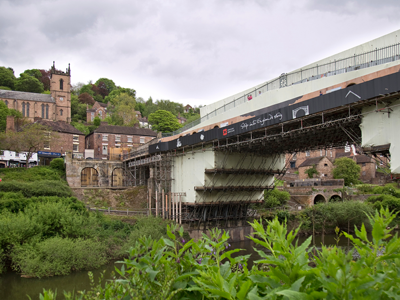
The Iron Bridge surrounded by protective scaffolding (English Heritage)
The Iron Bridge is notable as the first major bridge in the world to be built wholly of cast iron; its construction started in November 1777 and it was completed in December 1780, being officially opened on 1 January 1781. It spans the River Severn near Coalbrookdale and gives its name to the town that sprang up around it. It is Britain’s best-known industrial monument and remains in use by pedestrians.
The main bridge span is a semi-circular arch which is 30.6m long and made up of 10 half ribs, each cast in one piece. It consists of 385t of ironwork and almost 1,700 components, the heaviest of which weighs 5.5t.
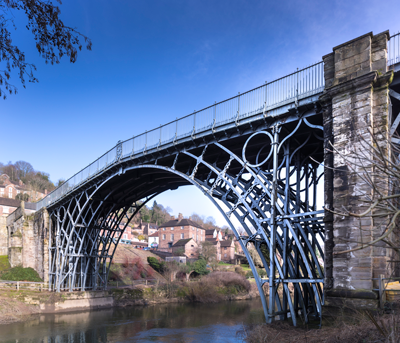
The Iron Bridge before works started (English Heritage)
Although being an arch bridge, the structural members have connection details that owe more to woodworking techniques than anything else. Drawings for the detailed design of bridge members were made by Thomas Gregory, a pattern maker who usually worked with wood, and this is thought to be why the bridge uses carpentry jointing details such as mortises and tenons, and dovetails and wedges, despite the fact that it is built of iron.
The structure has been in a state of flux almost from the day it opened; ground movements in the gorge, which have caused movements of the abutment, resulted in the first repairs to the structure being recorded just three years after the bridge was opened. Repairs and adaptations have continued since that time, with a range of interventions intended to stabilise and strengthen the structure (see box, page 36).
Despite having been subjected to a great deal of attention over its lifetime, the detailed condition of the bridge still had to be estalished in full at the start of the contract.
One of the difficulties that structural engineer Ed Morton Partnership faced at the outset of the project was knowing the condition of the structure in any great detail. Although a full laser survey had been carried out just a few years ago to map the physical dimensions of the structure, this did not provide them with any indication of the condition of the iron members or the presence of any new cracks or fractures. As Ed Morton explains, it was very much a case of drawing up a schedule of works on which to base the initial estimate, with the understanding that this might all change in the course of the contract.
The scope of works was to provide full access to all the spans of the bridge — the main one and the two more recent side-spans; to carry out whatever repairs to the iron structure were deemed necessary; to grit-blast the existing coating back to bare metal, and replace it with a new coating; to carry out repairs to the masonry on the abutments; and to remove the existing deck and provide a new one, including a new waterproofing system. Part of this, says Morton, included the opportunity to review the services currently incorporated into the deck, to see if any needed renewal or could usefully be eliminated.
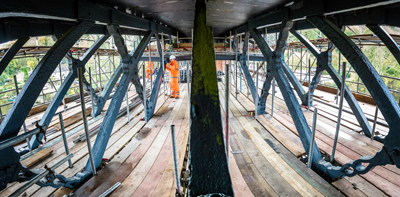
The general public was offered the opportunity to get inside the structure on hard-hat tours (English Heritage)
The first stage in the process, once the contract had been let, was to get the access scaffolding up and carry out a full inspection of the structure. This was no mean feat, as Morton recalls; erection of the scaffolding took several months to complete — in fact the system was fully designed before it went out to tender, as the team considered it too great a risk to leave this until after the contract was let. The access system envelops the structure entirely, and is supported not by the bridge itself, but rather by the concrete apron which was cast on the river bed between the two abutments in the 1970s. This was added in an attempt to halt the slow shifting of the abutments, one of the main problems for the structure over its long life.
The access system incorporates not only a full enclosure system for catching blast media from the paint removal process, but also a separate walkway along the side of the structure, which is accessible to the public on a daily basis and gives them the opportunity to see into the work area and observe what is happening on the bridge.
English Heritage corporate affairs manager Tom Jones explains that during the early development of the scheme, they spent quite a lot of time talking to the local community to try and establish the impact the work would have on the visitor economy in the gorge, which many businesses rely heavily on.
Visitors do not have to buy tickets to visit the bridge even under normal circumstances; it is open all hours and is free to access. There was concern that visitor numbers would drop during the works, when the bridge would be fully enclosed in scaffolding and not visible.
As Jones explains, the idea of a publicly-accessible scaffolding walkway was considered, and questions were asked about the impact this would have on cost and the construction programme. Although the work could have been done quicker without the public access, and at a lower cost, the newly-established charity recognised that it had greater benefits in terms of public outreach and education, and also keeping the local businesses on side.
This unprecedented and free opportunity to get ‘up close and personal’ with the bridge was supplemented by a series of ticketed hard-hat tours, which sold out within days of the announcement. It had been billed as a once-in-a-lifetime opportunity, says Jones, and although it was not possible to measure any change in visitor numbers, since the bridge is open to the public and unstaffed under normal circumstances, the anecdotal evidence suggests that the public has a healthy appetite for this kind of outreach. Jones adds that recruiting and training volunteers to assist on the walkway has also enabled EH to develop its relationship with the local community.
While the public walkway has specified opening hours, the contractor is also required to keep the bridleway over the bridge deck open throughout the project, as well as providing access to the tollhouse on the south side of the bridge.
The need to keep the bridleway open has meant that the deck has had to be refurbished in two phases, with the downstream side just being finished off when Bd&e visited, and the focus due to move to the upstream side in the next phase. A temporary protective cover was erected over the deck within which the existing pavement could be lifted, repairs made to the iron deck plates as required, the waterproofing membrane installed and the new pavement put into place without the weather causing delays.
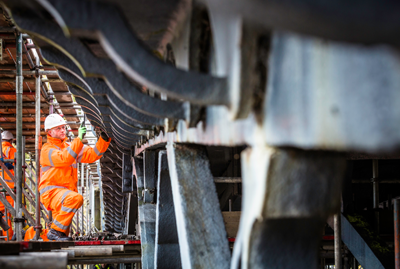
The Iron Bridge Conservation Project (English Heritage)
The last time that the bridge was scaffolded was in 1999, says Morton, and things have changed a great deal since then, especially the legislation relating to temporary works and access requirements. The fact that the old lead paint had been removed in the 1980s, when the coating was last fully renewed, was something of a blessing as it at least removed one of the potential hazards for the workers and the environment. But even so, the limited capacity of the temporary works meant that the grit blasting media had to be swept up and removed from the scaffolding on a carefully managed basis, so as not to overload the structure.
Another recommendation in the early phases of the work was to carry out a diver survey of the concrete apron which acts as a strut between the two abutments, to check its condition. Morton says it was important to ensure that all elements of the structure had been assessed as much as possible before the work started, so that any necessary repairs could be incorporated into the programme.
However, the inspection revealed that no work was required to this part of the structure, and as Morton explains, the predominant action working on the structure today is corrosion. The brittle nature of the material makes it prone to fracture, and jacking forces created by corrosion between structural elements and the faces of fractures are the main actions that need to be addressed.
One of the particular difficulties on the Iron Bridge is the fact that it can’t be dismantled. On other cast iron structures, Morton would recommend that they be fully dismantled to enable all the joints and faces of fractured elements to be treated for corrosion.
While the fractures and cracks are not ideal, the refurbishment work does not seek to repair them, only to fix in place any that might otherwise be at risk of falling off. Likewise the past repairs — of which there are many — are not being replaced unless absolutely necessary. The repairs are part of the history of the structure, says Morton - after all, the first repairs are almost as old as the bridge itself. Almost all of the original fabric of the bridge survives, and when considering what materials should be used for any repairs on this contract, heritage considerations supported the proposal to make repairs ‘readable’ for future understanding of the bridge. Rather than trying to replicate the original material, it is considered appropriate to use something different to allow additions to be identified.
A major survey and finite element analysis of the bridge was commissioned by English Heritage in 2012 — the first ever full-strength assessment of the structure — and this work was carried out by consultant Ramboll. It used the geometry produced by a comprehensive laser scan to produce a solid model which could be used for finite element analysis. All defects and cracks in the structure were also incorporated in the model — about one hundred in total. The analysis found that the main span has good capacity, able to take a pedestrian load of 3kN/m2 or a 7.5t double-axle inspection access vehicle. The cast iron deck plates, which are on all spans, are also able to take this level of loading, but the report recommended that outrigger loads should always be spread across the deck, as some of the plates are cracked. The deck plates also have ‘lobes’ on them which are necessary for transferring forces between the different elements of the superstructure, but they have proved challenging to repair and paint. They are integral to the deck plates but tend to suffer from a build-up of corrosion behind them, which not only threatens the longevity of the lobes themselves but can introduce additional forces into the structure.
The old paint has been removed back to bare metal, and a new coating from supplier Sherwin Williams has been applied. The atmosphere is not particularly corrosive, says Morton, but humidity can be a problem. More difficult is the fact that there are so many connections, junctions, fractures and repairs to consider. Whether mastic sealant should be applied, or the joint left open to ‘breathe’, has generally been decided on a case-by-case basis. Larger gaps are mostly left open to allow air to circulate through them, with smaller cracks and fractures filled.
The paint system is Sherwin Williams M24 which consists of three layers; a primer of Macropoxy M902 (100µm); an intermediate coat of Macropoxy M905 (100µm) and a top coat of Acrolon C237 Sheen (50µm). A stripe coat of Macropoxy M905 (75µm) is applied to edges, joints and junctions as necessary between the primer and intermediate paint coats.
Once contractor Taziker had put the access scaffolding in place, the team could inspect the bridge at close quarters to establish a more accurate schedule of repairs, and start the process of making templates for any pieces that needed to be replaced. Any new fractures or damage were noted, and trial repairs were carried out at certain locations. All procedures had to be approved before they could rolled out across the bridge; just one of the requirements of working on a structure that is protected as a listed building as well as a scheduled ancient monument.
The scope of the work included the full removal and replacement of the deck pavement, which has been done in two phases to allow it to be kept open for public access throughout. The deck had been paved with bitumen in the past, but this was not successful in keeping the water out of the structure and a damp-proof membrane is now being applied.
The masonry of the bridge was not in bad condition, says Morton, except for damage caused by the ingress of water from the deck. Repairs here will be simply removing vegetation, repointing the mortar, and pinning any stones that need holding in place.
Having the public at such close quarters is also a challenge — the contractor’s site induction video not only covers health and safety issues, but also reminds staff that they should adapt their behaviour and language appropriately.
The walkway provides access along the side of the bridge, just below deck level, and the plywood hoardings have windows cut at intervals along the bridge span, letting the public see into the work zone between the bridge superstructure. The walkway is accessible every day of the week, and visitors can also book guided tours into the work zone.
The project team has been on site since September last year, with completion currently scheduled for November 2018.
This article was published in issue 92 of Bd&e, third quarter 2018