

Latvia’s biggest construction project, the Southern Bridge, is now open to traffic and is due to be fully completed in 2011 when the second phase is finished. The bridge in Riga was designed by Latvian architect Ingurds Lazdins and provides a new link over the Daugava River.
The existing crossings no longer offer sufficent capacity for the continuously growing urban traffic flow of the area. The Southern Bridge is an essential part of Riga’s infrastructure which is intended to contribute to improving the city transport system and reducing traffic jams.
The bridge is 5km from the city centre and will provide a connection from Riga to the country’s Eastern Motorway as well as taking the main transit flows, bypassing the city centre and taking them to the port as well as offering a direct route to the Via Baltica highway.
The task of the bridge is to carry traffic between the south-western part of Pardaugava and the areas of Riga’s right bank without traversing the city – hence reducing congestion in the downtown area. The bridge also allows through traffic to bypass the city centre as well as reducing the traffic on nearby streets and that crossing Salu Tilts (the Island Bridge).
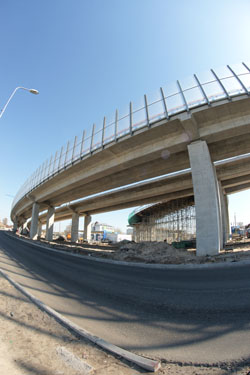
The second stage of the bridge construction which is currently under way, concerns the construction of a new connection on the right bank of the river. This part of the work involves reconstruction of the Slavu railway overbridge; one of the most complex and busiest junctions in Riga. In comparison with the construction of the main river bridge, this stage is more labour-intensive and complex in terms of traffic management and work planning. In order to avoid interrupting traffic on the existing junction, a new traffic overbridge must first be built, onto which traffic can be diverted while reconstruction of the existing overbridge can be carried out. The second stage of the Southern Bridge project is planned to be finished before 2011.
A new bridge over the River Daugava has been needed for quite a while, to improve links between the left and the right banks of the city and serve the rapidly-expanding boroughs in the east. The construction project was tendered in 2001 – it encompasses the bridge over Daugava river itself, elevated intersections, and junctions at each end.
Work on the Southern Bridge project started in 2002, when the development department of Riga City Council established the route of the Southern Bridge.
The chief designer of the bridge concept design was Tiltprojekts but the concept for the main bridge was designed by the St Petersburg Design Institute (Institut Giprostroimost Sankt-Peterburg) which won the tender contest. The development of the bridge architecture and design was entrusted to the design group Arhitektonika after an international meeting organised by Riga City Council concerning the architectural and construction solutions for the Southern Bridge. The cable-supported bridge system that was chosen allowed the main spans to be considerably increased, making the bridge much more attractive.
Transport Systems joint venture, which consists of six Latvian construction companies, won the bid to build the bridge. The consortium members are Skonto Buve, BMGS, Latvijas Tilti, Rigas Tilti, Tilts and Viadukts - all of them are experts in their field with many years of experience both in Latvia and other European countries.
This new crossing is the first to be built in Riga over the Daugava River for almost 30 years – the previous crossing was Vansu Tilts (the Cable-Stayed Bridge), which was built in 1981. All the same, the idea of building a bridge at the site of the Southern Bridge was not original – a link at that site had first been included in the Riga City development plans in 1937. The total length of the bridge is 803m – it has five main spans of 110m, along with side spans of 77m and 49.5m at each end. It has a total area of 27,527m2 and carries six lanes, three in each direction, as well as footways and cycle paths.
In order to accommodate the local geological conditions, the foundations consist of bored piles in steel pipes 1.4m in diameter, in a dense grid founded on the Dolomitic rock.The foundations were built in cofferdams, with an underwater concrete layer deposited once the piled foundations had been installed and subsequent concrete casting of the grillage and support bodies.
The superstructure was designed in the form of continuous steel stiffening girders with a prestressed reinforced concrete deck and column combination at the six river piers, and cable stays which are used to prestress the reinforced concrete superstructure to create what is known as an extradosed bridge.
These type of bridges fall between conventional girder bridges in which stiffening is provided by the girder itself and the cable-stayed method where stiffness is provided mainly by the cable-stayed truss while the girder stiffness is reduced.
 |
|
Construction of interchange structures on phase 2 |
The main design concept of the Southern Bridge superstructure is that the pre-stressing elements, the cable stays, are taken out of the deck girder, allowing the bending factor in the girder to be reduced and transfers the stress to the girder in the tensile areas above the supports, through pre-tensioning. The cables reduce the horizontal compression in the pier-top areas, while in conventional cable-stayed bridges, the cable stays provide elastic absorption of vertical loads.
One of the advantages of extradosed bridges is that the cable stays are not exposed to fatigue loads; the axial stress in the cable stays remains low under service loads. For the superstructure of the Southern Bridge, the estimated cyclical change in tension is around 36MPa for the most characteristic cable, compared with a value of some 200-250MPa for cable-stayed bridges. This is because no more than 30% of the service load is absorbed by the cable-stayed truss in extradosed bridges. The lower cyclical stress allows the permissible tensions in the cables to be increased up to 60 – 65% of the breaking tension, which boosts the efficiency of the cable stays.
The bridge piers are reinforced concrete structures, with steel towers on top, on which the cables are supported by saddles. The saddles were specially designed to prevent the cables from slipping under unsymmetrical service loads. Each tower is equipped with a set of eight saddles, one saddle for each cable pair. Each saddle consists of a steel tube with complex geometry adapted to the architectural requirements and the arrangement of the cables, which are in a fan pattern and in different planes. The tube is supported by a ribbed foundation plate.
Each saddle bundles 37 individual strands, each of which consists of seven galvanised wires and has its own sheath. All strands are installed in a sheath of high density polyethylene and they are anchored with special cable collars designed and manufactured by Freyssinet. The collars are anchored in the module and connected to an adjustable nut. The section between the anchor and the cable is protected by an impermeable enclosure.
One advantage of the cable system adopted is that it offers