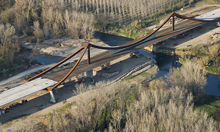

After dark, architectural lighting can add a sense of magic to bridge structures, inviting the viewer to return in order to have a different, fascinating, encounter with the same bridge. The play of light and shadows allows a bridge to be expressed as simple line geometry and brings life to the landmark by night, and this approach is just as relevant to huge record-breaking spans as it is to pedestrian structures.
Earlier this year the world's first curved double-helix bridge opened in Marina Bay, Singapore – not only is the structure designed to be a dramatic landmark during daylight hours, its lighting is intended to make it stand out at night time.
The 280m-long bridge is part of a 3.5km-long waterfront promenade that loops around the Marina Bay. It was designed by an international consortium of Arup, Cox Group and Architects 61 which won the competition to design two bridges on behalf of Singapore’s Urban Redevelopment Authority
The design inspiration behind the ‘Helix’ pedestrian bridge was DNA, which was chosen as a symbol of continuity and renewal, reflecting Singapore’s aspirations for Marina Bay. Next to the Helix, the new six-lane vehicular has a simple, elegant design that forms a backdrop to the pedestrian bridge.
The Helix is created from two separate spiralling steel members held together by a series of delicate connecting rods to form a rigid tubular structure – like two springs wrapped around each other in the opposite direction, one inside the other.
The bridge uses five times less steel than a conventional box girder bridge, and the frame supports the pedestrian deck, shade canopies and light fixtures without the need for a secondary structure. The end result is a visually appealing structure that is highly functional while using minimal resources.
The lighting design is intended to illuminate the iconic structure by night in a way that will appeal to a wide audience. The LED lighting enhances the intriguing double-helix structure, making it a visual spectacle from any view around the bay.
A series of multi-coloured lights was installed in the helical strands to reflect the unique design of the structure. Arup’s lighting designers selected the latest LED technology for longevity, recyclability and for the flexibility of being able to offer more than 16 million dynamic colours. The outward-facing luminaires accentuate the sweeping structural curves, with another discreet array of lights illuminating the internal canopy sections of laminated glass and stainless steel mesh to create a dynamic membrane of light.
When triggered via an intelligent control system, the dynamic lighting sequences accentuate the members, revealing the long sweeping strands as they intertwine along the bridges length. The lighting is programmed so that a variety of colours and dynamic sequence effects can be implemented for different events and festivals.
Careful placement of luminaires ensured that energy requirements were kept to a minimum – and there is not a single luminaire on the entire bridge that consumes more than 12 watts of power.
Meanwhile at the other end of the scale, Arup was responsible for designing the lighting on one of the world’s longest cable-stayed bridges, and in one of the most high-profile locations in the world, in the centre of Hong Kong harbour.
The simple yet elegant lines of the new Stonecutters Bridge are picked out with cool white light to reinforce their beauty and underline the simplicity of the bridge structure against the backdrop of the golden night sky.
The lighting scheme is based around three key architectural elements; the towers beacons and light strips; the tower pylons and the cross-girders.
A wash light with colour temperature of 4,000K+ is projected on to the face of each tower, with arrays of metal halide projectors equipped with narrow to medium beam optics, starting at the deck and tapering off towards the top and base of the tower. The cross girders are also lit to create a continuous, subtle glow of light. These form a neutral clarity theme as a backdrop for the occasional festive colour light shows
The beacons and tower light strips are the two key architectural elements of the bridge which will be lit with LED luminaires to allow the creation of a dynamic colour palette of light, intended to add a narrative dimension to the bridge at night. Narrow beam graze optics ensure a uniform wash across the strip reflector from the sides; diffuser ‘direct view’ optics provide a distinct delineation to the strip and broaden the viewing angle for the light strip. The beacons are back-illuminated with LED projectors fitted with vertical wall washing optics. These projectors are located behind the translucent glazed screen near the top and bottom. Under the standard daytime clarity theme, these are preset to cool white colour.
It was important for the design of the architectural lighting to reflect the prevailing night-time conditions of the bridge’s surroundings, in particular the intensely-lit cargo terminals nearby. Sophisticated lighting visualisation software Radiance was used to model the lighting to ensure that when seen from a distance, the structure would stand out from its surroundings, achieving a minimum design luminance of 20cd/m2 for white light and 6.5cd/m2 for coloured light.
A key element used to convey different messages in lighting schemes is colour; red is associated with happiness, prosperity (in Chinese culture), excitement, energy and power; while gold and silver are associated with wealth and prosperity.
Various display sequences of light patterns were explored as a narrative to express the characteristics of Hong Kong. It is a place which offers a diversity of experiences; a place where east meets west, blending Chinese heritage and British colonial influences.
When two colours on opposite sides of the colour wheel are placed next to each other, each makes the other appear brighter. The complementary colours are the three primary colours; red, blue and yellow, and their secondaries are the colours obtained by mixing the primaries in pairs of all combinations; green, orange and violet
The complementary pairs of red-green, blue-orange and yellow-violet provide great contrast and high visibility. They were selected for the colour light show and represent three different lighting themes.
For the first theme, the dynamic orange light from LED fixtures is set against a predominantly blue backdrop. An orange colour light strip 12m long, formed by a group of ten, 1,200mm LED modules will propagate or ‘stroll’ from the base of the light strip towards the beacon. Once it reaches the beacon, the colour of the tower light strips and the beacons instantly change to orange.
This is followed by further sequence; in this cycle, the dynamic blue light is to be set against a predominantly orange backdrop. Each cycle is played over a preset time interval to coincide with the time taken by a vehicle driving at a certain speed (nominally 60km/h) to reach the midpoint of the 1.6km-long bridge. The intention is to allow road users to experience, to a certain degree, the colour transformation of the bridge. The time it takes the dynamic colour strip to reach the beacon will be approximately 48 seconds and the change of colour for all light strips and beacons is synchronised.
Gold and silver were chosen to express the second, financial city theme in a metaphorical way. The LED luminaires are programmed to illuminate all light strips and the bea