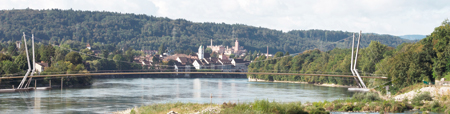
A competition to design a new crossing of the Rhine River between Germany and Switzerland was won in April by a proposal for a long-span suspension bridge with a timber and stone deck. The footbridge concept, by Miebach Ingenieurbüro, has cranked steel towers supporting a 214m-long block-laminated timber deck structure topped with granite paving.
The winning design was selected from entries submitted by eight shortlisted teams participating in the competition for a new link between the cities of Rheinfelden in the Swiss canton of Aargau and Rheinfelden in the German state of Baden.
The two regions jointly launched a design competition last year calling for the construction of a 4.5m-wide and up to 250m-long bridge as a new link across the Rhine River for pedestrians and cyclists. The aim of the competition was to achieve a closer relationship between Rheinfelden Aargau and Rheinfelden Baden and to upgrade the eastern urban area.
Initially some 50 international teams had expressed an interest in participating in the competition, but the client chose to shortlist only eight and invited them to submit their concepts to the jury panel.
The scope of the brief was fairly wide-ranging — a single pier was permitted to be placed in the river at a specified location, and the bridge deck had to be 4.5m wide across its length. A budget of no more than US$5.4 million was proposed for the bridge construction. Other than that, teams were given free range to come up with solutions.
The bridge will restore a link for pedestrians and cyclists that was formerly carried along the top of a hydropower dam upstream of the site. The dam and power station were demolished some years ago and the new bridge will reconnect the two sides — a factor which is particularly important for cyclists as it links major cycle routes. The upstream area is a particularly important natural habitat and the bridge is not permitted to impact it.
As Frank Miebach explains, the location that was offered for the pier would have resulted in an asymmetrical structure, and some of the teams did choose to submit designs of this nature.
“We had a lot of discussion about whether to create an asymmetric design, but decided fairly early on that a symmetrical structure would be more appropriate,” Miebach recalls. “We thought it would be more attractive, and possibly also cheaper, to put the foundations of the towers on the banks of the river rather than in it.” The fact that there is already some degree of imbalance between the environments on the two banks of the river — the Swiss side being quiet and rural with a lot of private housing and the German side being largely industrial — gave the designers the feeling that they did not want to emphasise the differences or ‘favour’ one side. There are also quite obvious topographical contrasts between the land on the two sides of the river.
The winning solution features striking cranked towers on each bank of the river; the shape of the towers was deliberately chosen to reduce the impact that the bridge will have on the river bank, particularly on the Swiss side where some of the houses are very close to the abutment.
The possibility of these houses conflicting with the cable anchorages and their foundations was the main reason for the shape of the structure, Miebach says.
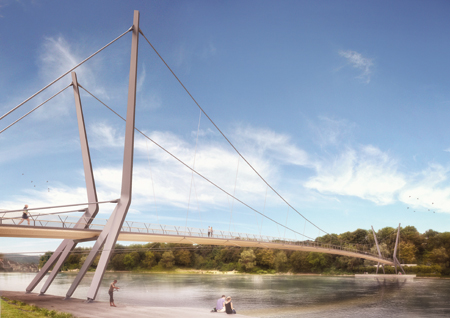
The 30m-high steel towers are cranked just above deck level and they are a single element above the crank and split into two legs below it, each of which terminates in a pinned connection at ground level. This arrangement — combined with the length of the deck — requires supplementary cables in order to allow the slenderness of the towers, and for stability of the deck against vibrations. As well as the main cables which suspend the deck, each tower leg is tied back by a cable which connects between the crank point and the main cable anchors. Additional cables along each side of the deck provide stability and eliminate the need for transverse beams; they tie in to the hangers, which are at 10m centres, and to the deck at the same point.
Miebach’s work generally incorporates timber as a structural material, and in this case he has designed the main structural element of the deck as two block-laminated timber girders topped by granite slabs. “Our goal is always to make timber structures,” says Miebach, “but of course you have to protect the timber. We were very convinced by the natural appearance and quality of the stone, and it enables us to create a fully-waterproof deck.” The weight of the stone slabs also has benefits for the static behaviour of the bridge, in particular as regards vibrations.
“We did also think about making the towers out of timber,” he adds, “but as well as the challenging geometry of these towers, they are too exposed. It would have been very difficult to protect them. They also have to accommodate huge forces on the top from the main cables.” Where it is used, the ratio of dead weight and load capacity makes the material very economical, and Miebach calculates that construction of the timber structure will permanently bind approximately 550t CO2. Miebach Ingenierbüro worked with landscape architect HHVH and Swillus Architekten on the concept.
Construction will be a challenge, Miebach accepts, in particular the erection of the deck elements which he proposes to build in 30m-long sections. They will be installed without the granite decking, which will be fixed on above a waterproofing layer.
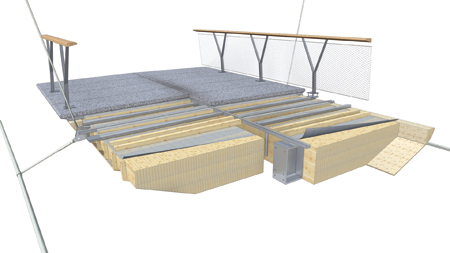
Cutaway detail of the deck, showing the timber block laminated structure, the waterproofing layer and the granite paving.
In selecting the winning design, the judges highlighted the use of timber as the main construction material, since there is a long tradition of timber bridges in the area and timber is sustainable as well as innovative.
Most of the funding for the new crossing has been ringfenced, but the final hurdle for the promoter of the bridge, which will be a joint venture between the two local authorities, is to persuade all stakeholders of the benefits of the winning design.