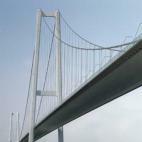
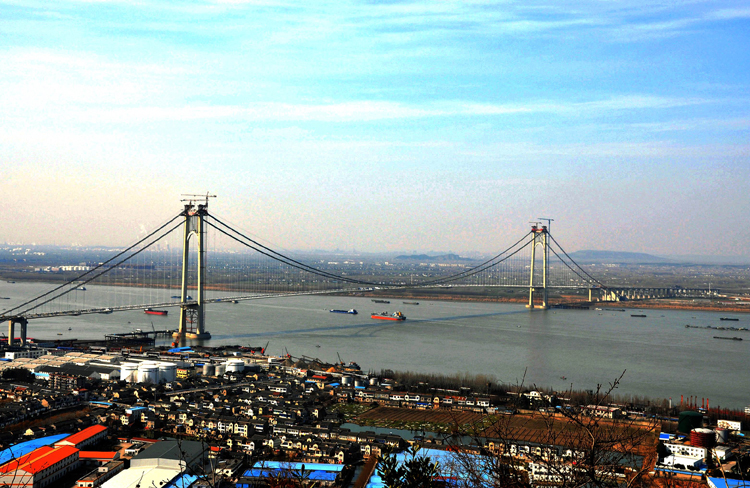
Nanjing’s latest bridge is 10km downstream from the Nanjing Second Yangtze River Bridge and more than 300km inland from the river estuary in the province of Jiangsu. The new crossing will be an important part of Nanjing’s second ring road, as well as linking into the Chinese state highway and expressway network. The main structure is a three-span continuous suspension bridge which has a main span of 1,418m and side spans of 410m and 363m, and a rise to span ratio of 1/9. The construction cost of the main bridge, which will be open to traffic at the end of this year, is approximately US$308 million.
The three-span suspension bridge has been designed as a continuous structure which offers a number of advantages including reduced transverse displacement of stiffening girders under wind loading and a reduction in the number of expansion joints. However this type of structural system creates some difficulties in the construction process.
The biggest issue created by a three-span continuous system is that where the main girder passes through the tower, the rotation of the main cable will create live load moments on the main girder. The rise-to-span ratio, arrangement and design of suspenders, rigidity of the girder and vertical supporting conditions all have an impact on this situation, but not all of them can be optimised and adjusted solely on the basis of it. In an entirely floating supporting system, girders are flexibly supported by suspenders which can reduce the number of vertical bearings.
However this increases the load on those suspenders close to the towers and as a result, these suspenders need greater rigidity, which is not good for reducing the main girder moment. In a half-floating supporting system, the girders are supported rigidly near the tower, increasing the moment greatly. This bridge was designed with a flexible half-floating system in which the rigidity of support is adjusted by flexible bearings to ensure all structural elements experience an appropriate force.
Compared with the traditional system, the continuous system reduces the longitudinal displacement of girders under live loads; however in the scale of this bridge, a displacement of around ±70cm still remains, which will increase the size of the expansion joints. In general, longitudinal displacement caused by live load can be partly reduced by setting a central buckle or level displacement-retaining flexible cable.
This bridge uses vertical displacement-retaining devices which allow two-way displacements caused by temperature, while limiting displacement caused by longitudinal movements; this reduces the longitudinal displacement of the bridge girder and in turn reduces the size of expansion joints.
Meanwhile, the longitudinal force acting on the lower transverse beams of the tower, which is produced by resisting longitudinal displacement, makes good use of the longitudinal rigidity of the tower to reduce the moment on the tower based effectively. This displacement-retaining device is relatively simple to install and uses a concrete baffle plate set on the lower beam of the tower.
At the south anchorage of the bridge, the bedrock is between 33m and 42m deep; it has high strength and good adhesion performance, but its uneven surface and distribution of strata led to a diaphragm-wall foundation being adopted as the best choice. The ∞-shaped cross-section of the foundation is 82m long and 59m wide, and composed of two non-integral circles with outer diameter of 59m and one diaphragm, of wall thickness 1.5m.
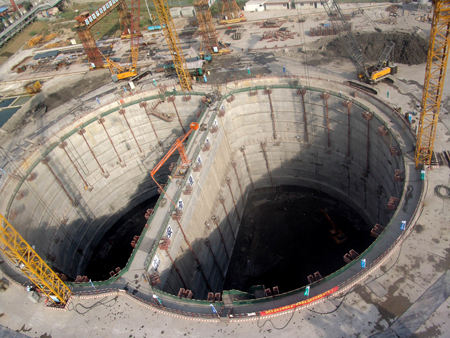
The total depth of the foundation wall is 40-50m. Once the wall construction was completed, excavation began in August 2009 and casting of the concrete base was completed in December 2009. Geological conditions at the north anchorage location are quite different to those at the south anchorage; the site is in the flood plain, and it has flat and even bedrock at a depth of 64m. Hence the foundation for the north anchorage used an open caisson; construction was more difficult and risky because of the sinking procedure, and its location quite near to the Yangtze River embankment.
As a traditional foundation type, the key technology of design of open caisson foundation is to making the sinking procedure more straightforward. The north anchorage open caisson foundation is 52.8m deep, and 69m by 58m in cross-section. Normally open caissons are sunk under gravity, which overcomes buoyancy and the skin friction. Nanjing’s Fourth Bridge adopted a new procedure at the north anchorage to assist the sinking procedure; an airscreen system composed of compressed air and pipelines which were embedded in the caisson wall.
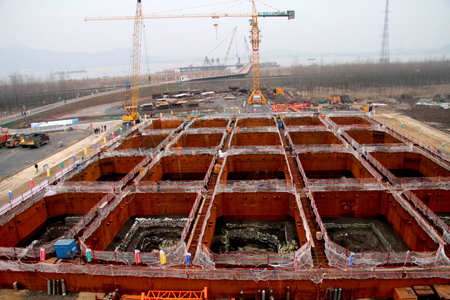
Ultimately the foundation installation team were able to achieve a daily sinkage rate of 1.01m at the north anchorage. The main cable is the major load-carrying system for a suspension bridge, hence enormous tension loads are transferred to the anchorage through the anchoring system. In general two different types of systems are seen in existing suspension bridges: steel framed back-anchoring system and prestressed anchor system.
Steel-framed back-anchoring system is common in completed suspension bridges both in China and overseas because of its reliability and durability. The force transfer method is concentrated rigid compression transfer, hence enormous stress concentration in the steel frame and anchorage concrete is inevitable, also this system has a dispersed arrangement of anchoring bars, leading to high steel consumption and large location brackets being necessary during construction.
Prestressed anchors have also been widely used in long-span suspension bridges in China over recent years and a new type of replaceable anchoring system has been developed recently to improve its durability, but it needs regular monitoring which increases the maintenance demand and also the replacement cost during the operation period. This bridge adopted a new kind of system for force transfer to the anchor, composed of several steel anchoring plates, each made of one or more distributing force transfer anchoring elements depending on the number of anchoring strands. The unit element consists of three parts; the steel anchoring box, steel bars and anchoring area.
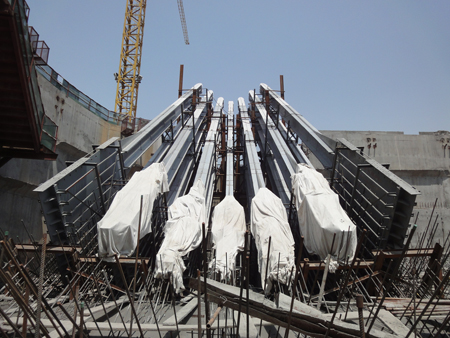
This system has the same reliability and durability as the steel framed back anchoring system, but is smaller, because the anchoring area composed of PC tenon shear key and bottom compression plate decreases the stress concentration in the anchoring system. The anchoring plate and its multiple elements has good integral rigidity and is easy to install, so only simple support brackets are needed during construction making it easier to install and reducing the amount of steel required.
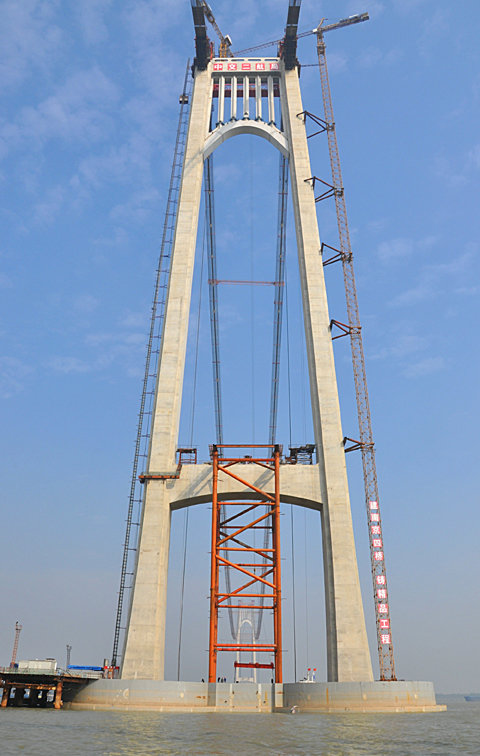
Because of the rise-to-span ratio of 1/9, the tower is tall and straight and it has been deliberately designed to complement the landscape. Both the tower legs and the transverse beams are made of concrete, while the arch beams and tie bars are steel. In order to decrease wind resistance and the possible occurrence of vortex vibration in the tie bars, the number and shape of section of tie bars were optimise