The Bjørnafjord project is part of the E39 Coastal Highway project which was launched in 2009 to provide an improved and continuous highway along the coast of Western Norway. The route is 1,100km long and passes through terrain that is deeply indented by fjords, creating the dramatic scenery that one is accustomed to seeing in images Norway, as well as numerous bodies of water between coastal communities, from Kristiansand in the south to Trondheim in the north.
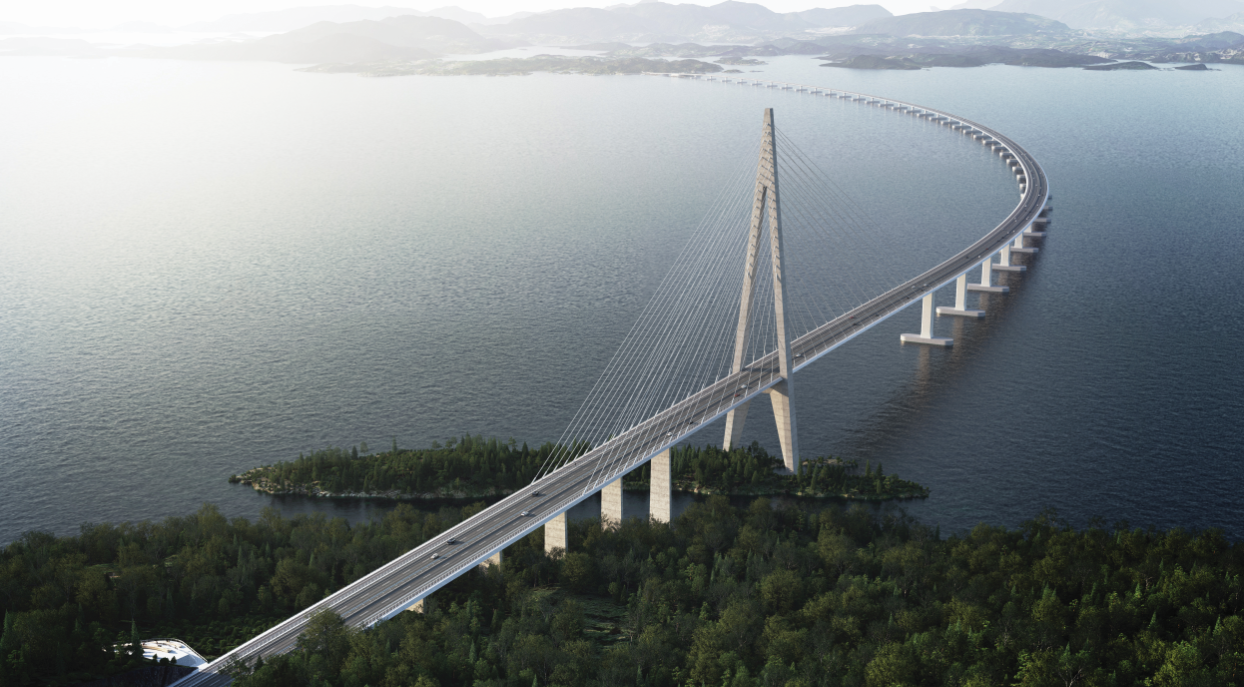
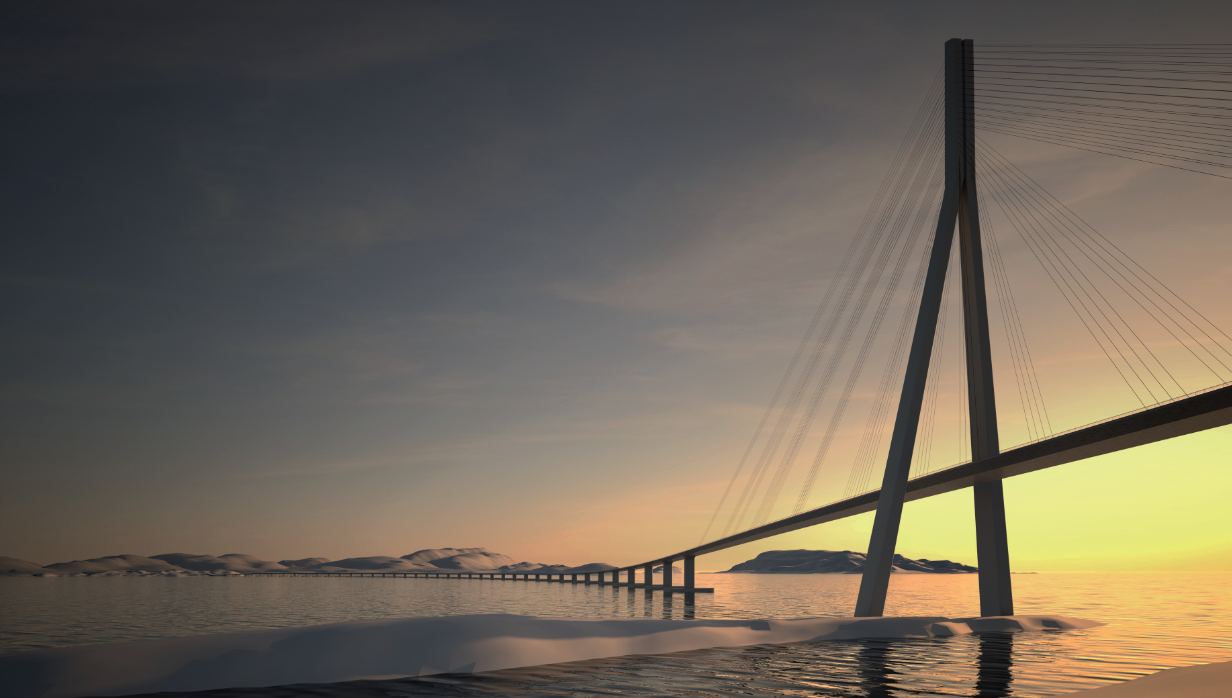 Concepts for the cable-stayed section put forward by the two consortia commissioned to study design alternatives (above and below: OON & NPRA and AMC & NPRA)
A proposal to create a ferry-free route along the west coast through the creation of subsea rock tunnels, floating bridges, submerged floating tunnels and suspension bridges was originally put forward in 1985, and a report was completed in 1991 that studied the feasibility of replacing 11 ferry crossings with fixed links. At that time, it was not deemed possible to cross the 5km-wide Bjørnafjord in the foreseeable future, largely due to its depth, which is up to 550m. Nonetheless, some fixed links along other parts of western coast were conceived as a result of the report, including the longest end-anchored floating bridge in the world, Nordhordlands Bridge, in 1994.
By 2009, there were eight remaining ferry crossings along the E39, and the possibility of a fixed connection across Bjørnafjord was re-examined to avoid a lengthy detour to the east of it and the continuation of lengthy travel times between key communities. “The purpose of crossing the Bjørnafjord is to connect the housing and labour markets between the cities of Bergen and Stavanger, which have roughly 400,000 people in each urban area, by removing the two ferry services between them,” says Mathias Egeland Eidem, head of complex structures at the Norwegian Public Roads Administration (NPRA).
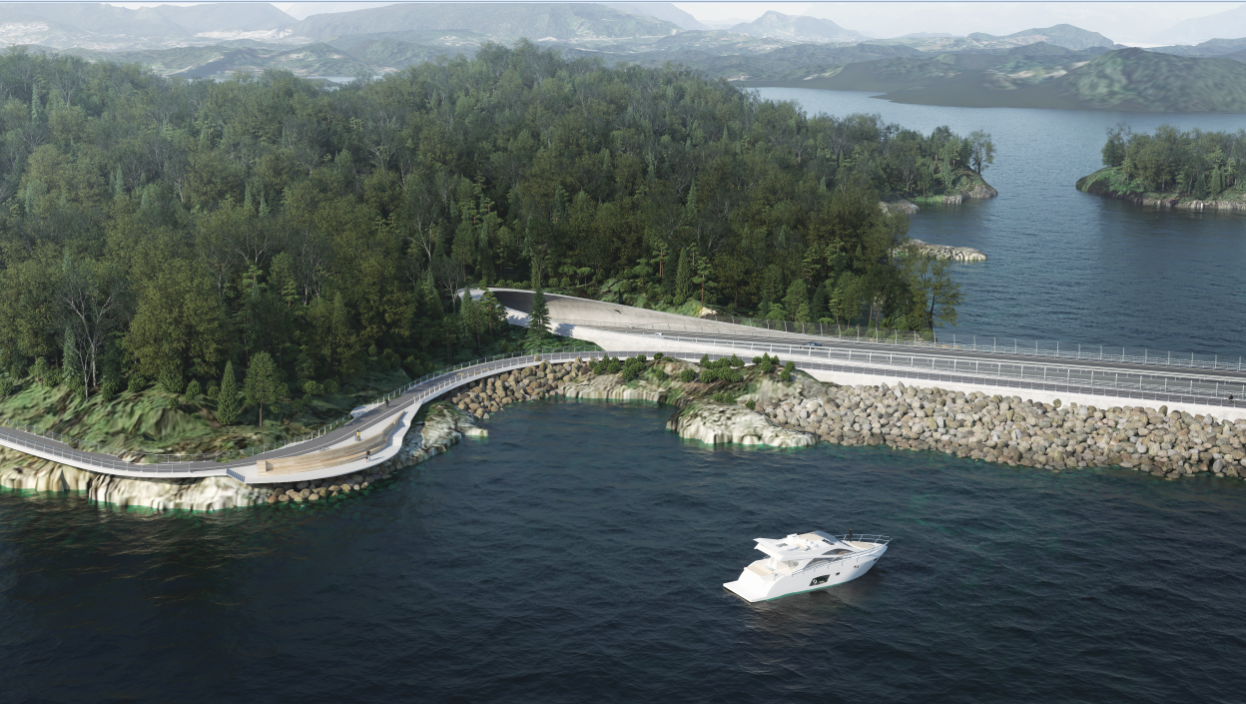 A view of the north landing point under the AMC concept (AMC and NPRA)
Numerous options for the bridge have been considered: an end-anchored floating bridge, much like the Nordhordlands Bridge but on a much larger scale, a side anchored floating bridge, a submerged floating tunnel, a multi-span suspension bridge, and a 3km-long single-span suspension bridge with the tower founded 150m below the water level. “We ran cost assessments on the different structures and quickly found the single-span suspension bridge would be too costly. So that concept was scrapped and we continued planning.”
Further assessments looked into the risk of ship impact and environmental damage posed by the options, including any changes to the islands in the northern part of the fjord, which have been designated as valuable recreational areas for the people of the city of Bergen.
Another challenge has been to collect sufficiently detailed measurements of wind, wave and currents in the fjord: “Although, Bjørnafjord is somewhat sheltered from the North Sea by a set of islands to the west, we need to have detailed information of the waves in the fjord compared to offshore because our structures are more sensitive: it’s not just a single point in the sea, it’s a long stream of interconnected structures with a lot more eigenmodes that can be set into motion by different wave loads.”
Geotechnical conditions on the seabed have also been analysed using extensive geophysical mapping, which highlighted that submarine landslides pose a high risk for any foundations on the project, limiting the scope for anchorages in much of the fjord. With this challenge in mind, the multi-span suspension bridge option using tension leg platforms to support the towers was ruled out partly due to the need to anchor one of the platforms below a steep-sided valley on the north side of the fjord, where there is a high risk of movement. The submerged floating tunnel proposal was also eliminated due to cost, as well as the risk inherent pursuing an idea with several novel aspects.
“To avoid the north end of the fjord, we looked at moving the ship channel to the middle of the fjord, but that would have been far too expensive. After further consideration, we moved the ship channel to the far south of the fjord and ended up with two concepts: an end-anchored floating bridge and a side-anchored floating bridge,” explains Eidem.
Two alternatives for these options were tabled: a curved, end-anchored floating bridge only fixed at the ends (K11), a curved, end-anchored floating bridge with supplementary moorings (K12), a straight side-anchored floating bridge (K13) and a side-anchored floating bridge with an S-shape (K14).
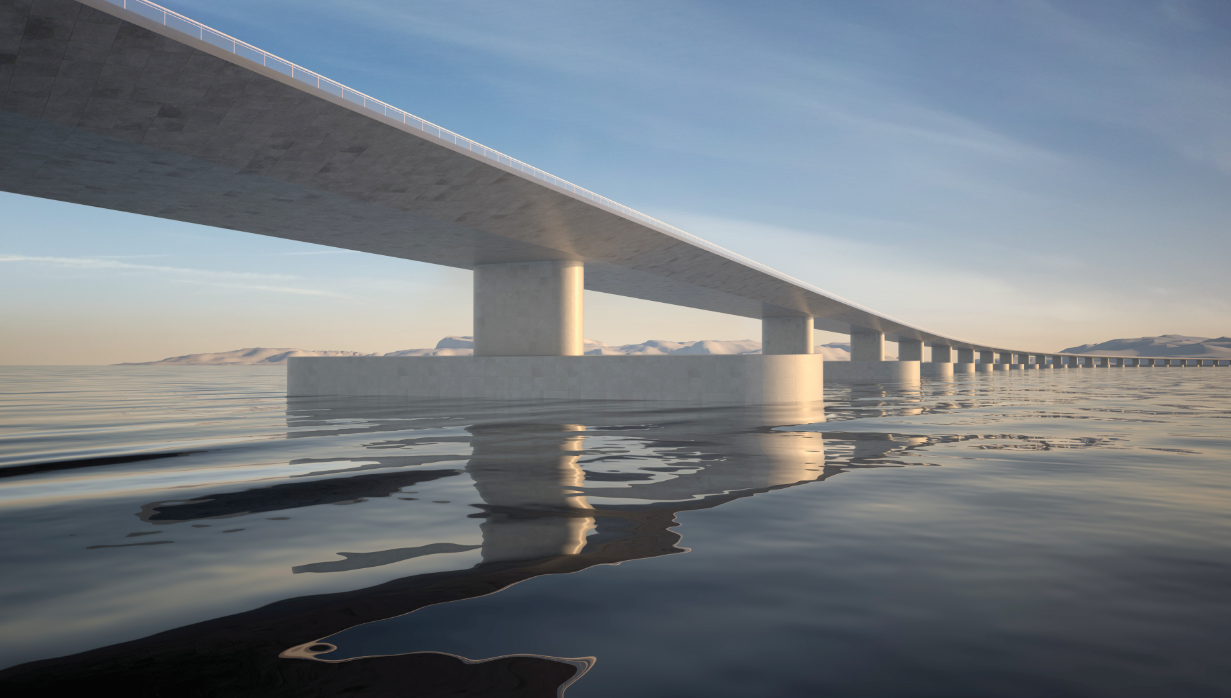 38 steel pontoons distanced 125m apart support a steel deck (OON and NPRA)
In November 2018, two competing consortia, AMC, which consist of Aas Jakobsen, Multiconsult and Cowi, with partners, and OON, which comprises Olav Olsen and Norconsult, with partners, were commissioned to study the alternatives to identify the best crossing when considering both cost and risk. Both deemed K12 as being the best solution, and DNV GL, which conducted document reviews and independent analyses of the proposals, agreed.
Furthermore, DNV GL’s review of the AMC and OON K12 bridge documentation did not reveal any major deficiencies that may impact the feasibility of the project. However, it did flag uncertainties to both concepts for certain items that may affect the cost and schedule, stating, “Fabrication and installation of the bridge are at this stage described on a high level. Consequently, DNV GL consider the basis for cost and schedule estimates as very uncertain for the construction phase.”
The main advantages of the K12 solution are that it is the most aesthetically pleasing alternative, requires the lowest investment cost and the lowest total cost (including the investment and operational costs), and has the lowest overall risk and the highest level of redundancy when considering accidents such as ship impact. Also, an arch shape in plan, will allow the lateral forces acting on the structure via waves, currents and wind to be handled in compression, even with the majority of the bridge untethered.
The preferred preliminary design comprises a 4,770m-long floating bridge section with a radius of 5,000m, 38 steel pontoons and three clusters of supplementary moorings. The design avoids the possibility of unacceptable resonance from parametric excitation while also reducing the effective buckling, the span length and (therefore) the cost.
Since the components proposed for the mooring system are ubiquitous in floating offshore installations across the world, the main challenge is to find safe spots for the anchors to be placed on the seabed. The three moored pontoons will be relatively close to the centre of the floating bridge section where there is relatively flat area of seabed available below with sufficient seabed soil for installation of suction anchors and stability.
There will be four mooring lines on each pontoon, with R4 chain and 124mm coated steel wire ropes as well as fibre ropes to be studied as alternatives. Pontoons without mooring lines have been designed with a draft of 5m, while those with lines will have a 7.5m draft to support the vertical loads imposed by the moorings. The length and width of both sets of pontoons are 53m and 14.9m, respectively, and they lie 125m apart with their lengths perpendicular to traffic. A ‘circtangle’ shape for the pontoons has been selected over a kayak form to reduce the cost of fabrication.
 Three of the steel pontoons are moored to the fjord floor in the preferred design
The southern end of the Bjørnafjord crossing will consist of a single-tower cable-stayed section with a main span of 380m, providing a 250m-wide and 45m-high navigation channel for water traffic. The 220m-tall A-shaped tower will be founded on the islet of Svarvahelleholmen, with the lower legs tapering from the cross beams towards the ground where the bending moments are smaller. The A-shape was selected for its high transverse stiffness and strength, its ability to accommodate large transverse forces in the instance of a ship collision, as well as for its architectural appeal. Further investigations of the tower shape will be undertaken to clarify feasibility and costs. The stays are parallel multi-strand cables arranged in four fans, each with 18 cables. In the main span, the outermost cable is anchored 20m from the first pontoon in the current design, but this could be fine-tuned as design work continues. From the south abutment (on land) to the tower, the first span is 40m, followed by four 55m spans and a 140m span, for a total length of 400m. The outermost cable on the land side is anchored 250m from the tower.
In principle, the deck will be divided into a steel portion above water, and concrete above land, with concrete viaduct spans and five concrete piers up to a height of 56m supporting them. Steel and concrete box alternatives for the 140m back span are also to be studied further, with steel currently the preferred choice due to high bending moments expected in the event of ship impact in the tower region.
The entire floating bridge section, including orthotropic box girder and pontoons, is expected to be fabricated from steel plate. The floating steel orthotropic girders are 4m in height, 27m wide and with span lengths of 125m.
In terms of constructability, several options have been studied to date, including the most common approach to building large steel bridges, ie production in Asia with transport to Europe, but also robotised production with laser welding closer to site. “The idea is to have a purpose-built factory and assembly site on the west coast of Norway. We would basically build a section, feed it out of the factory, and then lift it on top of four pontoons, so you would have a 400m long string, which is then floated to the site. In the vicinity of the site, the elements would be joined up as they’re completed, and then they would be towed out into the fjord,” Eidem explains. The main floating section would then be welded to the two end points of the bridge before being bolted.
The bridge will be designed for a 100-year service life, and preliminary design will continue this year, with both consortia still under contract for further work. According to Eidem, with the right political decisions, competitive bidding will start in 2025, marking the next stage in possibly the most technically challenging project the Norwegian transport sector has embarked upon, and a pivotal moment in the development of bridges for large bodies of open water.