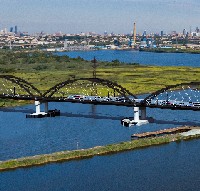
In Freeport, Texas, the Velasco-Freeport Railroad Bridge was feeling the impact of increasing modern load requirements. The bridge, which was originally built in 1916, was one of the first bridges constructed in Freeport, just four years after the city was founded.
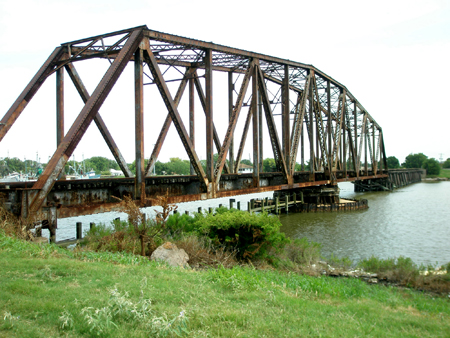
The original swing span at Freeport
The swing span railroad bridge, owned by Union Pacific Railroad, was carrying limited rail traffic but needed to be replaced in order to effectively serve the Port of Freeport at Brazos Harbor.
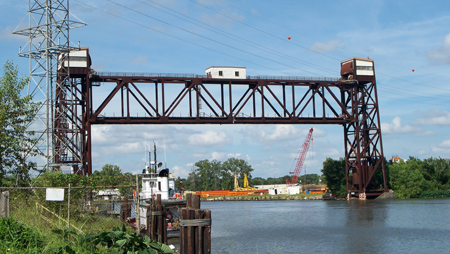
The original Houma lift bridge
Meanwhile nearly 540km upstream in Houma, Louisiana, a bridge across the Gulf Intracoastal Waterway, which was originally designed by Modjeski & Masters, had been unused for nearly 20 years. The bridge was built in 1982, but was abandoned less than ten years later due to a slump in the oil industry, and sold to its current owner, also Union Pacific Railroad. Once the tracks were removed from the bridge approach, the US Coast Guard, which mandates that unused bridges be removed for safety and obstruction reasons, directed that proceedings for the bridge’s removal should begin.
The solution was to repurpose the more modern Houma lift bridge for use in Freeport. The structure had been considered for other relocation projects before the Freeport site, but had been unsuitable for various reasons. To confirm that Freeport was the right site for the bridge, and before the deconstruction and relocation process could begin, a number of questions needed answering.
What was the condition of the Houma bridge? Was it a good candidate for being dismantled, shipped and rebuilt? Was it more cost-effective to relocate the bridge, or build a new one? Could the Intracoastal Waterway and its bridges and locks provide adequate clearance for barges carrying the Houma bridge? And could the replacement be executed without impacting rail or marine traffic? A team of technical experts from Modjeski & Masters worked with Union Pacific to determine the feasibility of the project.
After a series of site visits, field surveys and inspections of existing structural, mechanical and electrical conditions, they agreed that the relocation was viable. A number of key factors were evaluated in drawing this conclusion. Rail traffic load capacity of the Houma bridge could safely meet capacity requirements at the new bridge site, while vertical and horizontal clearance for marine traffic was deemed more than adequate.
The Intracoastal Waterway from Houma to Freeport had suitable clearances to allow the structure to be transported, and the Houma bridge was able to be broken apart and shipped in major sections. Also impacting the decision to move forward was the availability of heavy marine equipment at both sites making dismantling and rebuilding possible. The final obstacle to overcome before the relocation could begin was acquiring the remaining permits, a process that originally began in 2006. Because the Velasco-Freeport swing bridge qualified for inclusion in the National Register of Historic Places, the US Coast Guard permit was the most challenging to acquire due to Section 106 adherence. This requires federal agencies take into account the effects of their undertakings on historic properties that are included in, or eligible for inclusion in the National Register of Historic Places. To obtain this permit, a model of the original Houma bridge, along with a few mechanical components of the actual swing span bridge, were put on display in a local museum.
By 2009, all permits were acquired, including a Texas air quality permit, Velasco Drainage District permit, and a US Coast Guard permit, among others. Once all necessary permits were in place, preparation for dismantling could begin. Because the Houma bridge had been idle for nearly two decades, the design team needed to ensure that the bridge could be fully rehabilitated before its relocation.
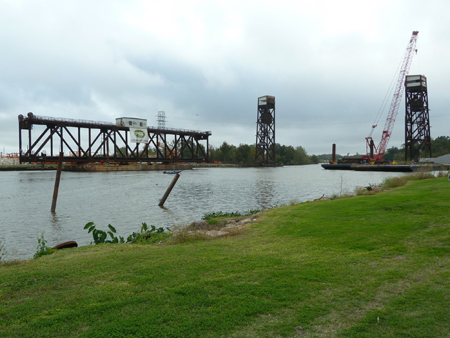
Lift span after removal
A team of electrical, mechanical and structural engineers worked together to determine which components could be salvaged and rehabilitated and which would need to be replaced entirely. Careful evaluation indicated that a large majority of the structural and mechanical components were in good condition and could be cost-effectively rehabilitated, including the lift span, towers, counterweights and counterweight sheave and bearing assemblies.
Not only did reusing existing materials have an impact on the project’s overall budget, but it also prevented the potential for substantial delays caused by custom ordering and fabrication of certain structural and mechanical components. While reusing structural and mechanical parts had a time- and cost-savings impact on the overall project, the entire electrical system was previously stripped by vandals looking to salvage copper and would require total replacement.
A team of electrical engineers, including the Modjeski & Masters engineer who outfitted the Houma bridge with its original electrical system, retrofitted the bridge with a new, more modern system, which would make future repairs and maintenance more seamless. Replacement parts in a new system are typically easier to locate, and electrical engineers familiar with the updated system can be more efficient in making repairs.
With old parts rehabilitated and new parts installed, contractor PCL Civil Constructors carried out several test openings before the bridge was deemed to be in proper working condition to proceed with the relocation. The bridge was dismantled into large pieces including the lift span, towers and counterweights and loaded onto seven barges that would carry it down the Intracoastal Waterway to Freeport.
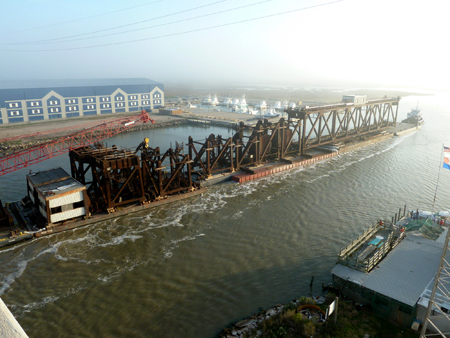
The bridge on the barge
The barge convoy navigated a series of bridges and locks along the waterway, and heavy fog provided the only major shipping setback, prolonging what should have been a three-day trip to nearly six days. After successful navigation of the Intracoastal Waterway, the bridge and its team of engineers arrived in Freeport ready to address a series of challenges involved with the reconstruction.
Throughout the rebuilding process, scheduled to take nearly twelve months, the bridge needed to remain operational for rail and marine traffic. To do so required an acute level of coordination between design and construction teams with both rail and marine traffic schedules. With the Freeport swing span at 88m and the Houma lift span at 78m, a 10m variance in bridge sizes demanded an unusual solution.
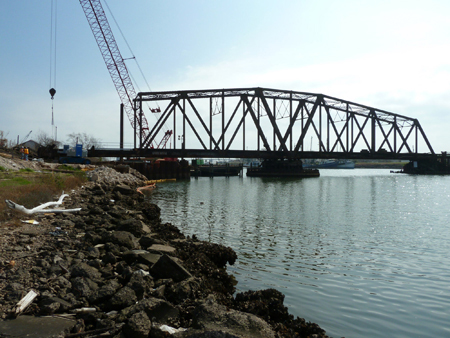
The swing span with the bobtail
The procedure involved a temporary modification to the swing span, bobtailing the north end and requiring precise execution by the contractor. Two truss panels were removed from the north end of the swing span, which provided necessary clearance for the erection of the north lift span tower. With truss panels removed on only one end of the bridge, weights and steel from removed truss panels were leveraged to rebalance the swing sp