The tale of how the first iron bridge designed by Isambard Kingdom Brunel was discovered and saved from demolition in the nick of time is the stuff of storybooks. At the centre of it is English Heritage inspector of ancient monuments for London, Steven Brindle, whose painstaking work and determination made this hugely important discovery possible.
The story goes back more than ten years, beginning with Brindle's decision to research and write a book about the construction of Paddington Station, the terminus of Brunel's Great Western Railway.
But Brindle's book project was put on hold for some time, until recently, when he picked it up again and went back to his research. It was only at a late stage in his studies that Brindle came across a batch of some 50 volumes of Brunel's records that his family had given to the Great Western Railway company after his death, so he set aside a day in which to study these records for anything important.
Among these volumes, he says, were about 12 really important books - half were letter books, the other half were titled 'Facts' which were in effect the private record books relating to Brunel's work. "On the private record books there was no list of contents, no index or anything," recalls Brindle, "which meant that I had to look at every page of the six volumes. There was a lot in the books about iron - Brunel was just getting interested in this material - and in one volume were the results of tests on 150 samples from different foundries. He also includes a list of 'reliable sources of sand' and gives details of lime mixes for concrete."
The two entries relating directly to Paddington Station were the results of load-testing timber trusses for the engine shed, and details of load-testing of cast iron beams for a bridge over the canal near the station. "Brunel had never built an iron bridge before, and was being very thorough with his research," says Brindle.
He began to wonder if the bridge, built in 1838, was still there; first impressions of the existing bridge currently in use over the canal suggested that it had been largely rebuilt and what could be seen of the structure looked Edwardian in style. Brindle was unable to access the towpath of the canal to have a closer look at the structure, and it was not until about two months later - in late April 2003 - that he got round to contacting the local authority to ask about this. Had he known about the contract that was being negotiated at the time, he might have acted with a little more haste. "I had no idea that there was a project being planned for the reconstruction of the bridge, with a US$112 million contract due to be signed in a week's time," explains Brindle. The modest canal bridge is one of a series of structures carrying road traffic over various transport links at the western end of Paddington Station, including the rail tracks entering the station. Owner Westminster City Council had been working with a number of other organisations to try and negotiate a reconstruction and widening of the link, which had turned into something of a bottleneck for traffic. The logistical complexity and potential cost of the project had meant that progress to this point had taken four or five years; if all had gone smoothly, Brindle would have been too late to save the bridge, which was earmarked for demolition.
It emerged that a structural survey of the canal bridge in 1999 had identified that the main structure was made of cast iron, and a weight limit of 8t had been imposed because the capacity of the bridge was unknown. Without the documentary evidence, of course, the engineers would have been unaware of the historical significance of this bridge.
Brindle went to inspect the structure, and his initial findings suggested that this was indeed the bridge for which Brunel had been testing cast iron beams. At this stage, he realised that if he was going to disrupt such a major project, he need to be as sure as he could be that this really was Brunel's bridge. "I had to go back to the National Archive to see if I could confirm it," Brindle recalls, "and very often, historical material doesn't give you exactly what you want. On this occasion, however, it came out perfectly."
He found two letters from Brunel to the canal company, explaining his plans and designs for the bridge very explicitly, as well as documents detailing prices from contractors. "It's certainly his personal design," says Brindle. Further confirmation came from the library of the Institution of Civil Engineers, which owns engineering drawings of works for the Great Western Railway, including detailed drawings of the canal bridge. "The documentary record is as good as it can be," says Brindle, "there's absolutely no doubt it's Brunel's bridge."
This conclusion came as something of a shock for Westminster City Council, now facing the possibility that English Heritage may wish to list the structure, creating a serious delay for the reconstruction project. The lack of knowledge about the detailed fabric of the bridge did not help - without knowing how it was put together, it was difficult for engineers to know whether it could be taken apart and then reconstructed elsewhere, or whether this would destroy the bridge for good.
In the end, a compromise was reached - English Heritage agreed that it would not press for the structure to be listed, if the council would agree to engage in discussions on how best it could be salvaged.
Test pits in the road revealed that the bridge seemed to be constructed without any positive fixings, reducing the chances it would be seriously damaged during dismantling. "We were sure that it could be taken apart," says Brindle, "but we weren't sure how much damage and corrosion there would be."
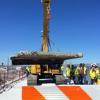
A number of options were investigated, including keeping the structure in one piece, sliding it out and then transporting it somewhere, but this would have cost about US$3.6 million and also involved planning risks. A permanent site would have had to be identified, with all the associated paperwork in place and planning agreements settled, in time for the move. By comparison, dismantling the bridge and taking it offsite in pieces came in at just under US$1 million. Funding for the work was finally confirmed in October 2003. As Bd&e went to press, dismantling of the structure was more or less complete. Main contractor Hochtief, which is responsible for the entire reconstruction project, had carefully uncovered the structure, breaking out the concrete and removing the soffit plates between every other pair of main girders to enable them to be secured into specially-designed steel cradles and lifted out in pairs by crane. The condition of the cast iron structure was found to be in remarkably good shape considering its age.
The dismantled bridge will be stored on an English Heritage site in Portsmouth while a final resting place is sought. The favoured site is just a hundred metres up the canal where a new footbridge is needed, but it is not clear yet whether there will be the opportunity to rebuild the bridge to its full width.
Bridging history
One of the main reasons that Brunel was driven to use a material he was unfamiliar with was the physical constraints of the site. The gradient of the road which the bridge would carry had to be kept to a minimum, while a certain amount of headroom had to be retained for barges on the canal. Even with the use of cast iron, Brunel was unable to design a bridge with a clear span across the canal, and had