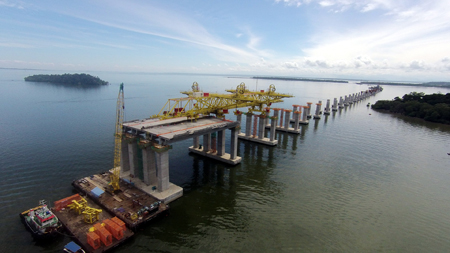
Contractors building the 13km-long marine viaducts for the new Temburong Bridge in Brunei have put into use a new self-launching lifting gantry which can erect two full-span decks at a time. This is believed to be the first time this erection procedure - dubbed the balanced heavy lifting method – has been used on a bridge project.
Contractor Daelim Industrial Corporation commissioned the design and manufacture of the innovative self-launching lifting gantry, which will be used to erect a total of 578 precast full-span girders on the 13.4km-long marine viaducts of the new crossing. The gantry, which was supplied by Dorman Long Technology, is capable of simultaneously lifting and erecting 50m-long twin-box bridge decks by balancing the weight on each side of the lifting gantry.
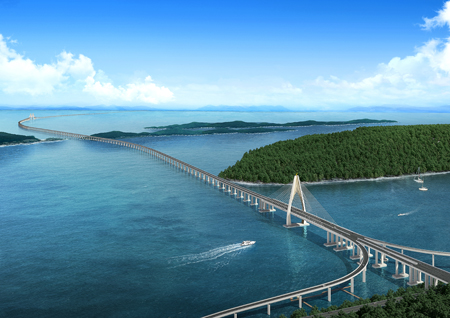
The Cadangan Projek Jambatan Temburong (Proposed Temburong Bridge Project) is one of the largest and most important infrastructure projects in Brunei, a sovereign state located on the north coast of the island of Borneo in southeast Asia. Apart from its coastline with the South China Sea, the country is completely surrounded by the Malaysian state of Sarawak. The new bridge project is designed to provide a connection between two districts which are separated by the Malay border and Brunei Bay. It will reduce travel distances for goods, labour forces, and services and is expected to encourage further business activities and development in the Temburong District.
The overall scope of the new bridge, which will cross Brunei Bay, is divided into six packages. Daelim and its local partner SWEE were selected as the contractor for the marine viaducts and the two navigation bridges, which began construction in February and October 2015, respectively, and which are due to be completed by the middle of 2019. The initial detailed design of all packages was developed by Arup and the final revision was carried out by Daelim for the specific site conditions and constructability.
Work package CC2 involves the construction of the 13.35km-long marine viaducts – two viaducts of 8.25km and 5.1km long, with a cable-stayed bridge over the navigation channel in between. The deck structure was designed in the form of twin prestressed concrete single-cell box girders with a span length of 50m and uniform height of 3m. The original design of the bridge deck was based on proposed use of the precast segmental span-by-span construction technique with post-tensioning and short-line match-casting. The typical five or six-span continuous deck structures had a traditional combined prestressing system with several internal and external tendons.
Daelim proposed an alternative design of full-span precast deck with a pretensioned system with only internal tendons. Daelim also developed the innovative launching gantry with Dorman Long Technology for the installation of these full span girders and applied balanced heavy lifting concept. The marine viaducts contract, which includes the ramp bridge sections, has 267 spans composed of a total of 578 precast girders. Two types of typical box girder sections are used for the deck system of this project; the larger of the two, which is 11m wide and 3m deep, is used for the main viaducts and the smaller, which is 7.5m wide and 3m deep, for transition and ramp sections.
The box girder spans weigh between 610t and 870t and they are manufactured by use of the pre-tensioning method in a factory equipped with steam-curing facilities. The girders are all produced in just two casting lines and each line produces a single girder every two days. Two system moulds were made for casting these full-span girders and in one of the casting lines, adjustable bottom and outer moulds are introduced to allow the line to produce both girder types.
Generally, in order to improve the efficiency of pre-tensioned girders, the common practice has been to ’drape’ a portion of the strands, beginning at or near third points in the beam. However, draping has some disadvantages that can increase the complexity of the production process and create a lot of interference with possible post-tensioning ducts. In consideration of this, Daelim applied straight tendons while limiting the level of force transferred to the concrete by debonded tendons. The use of debonded strands in precast girders has several benefits, including reduction of pre-tensioning stresses at girder ends, reduction of girder end zone web cracking and increased fabrication economy and safety.
Strand debonding is accomplished by sheathing the prestressed strands in plastic tubing for a given length from the ends of a girder; this tubing prevents the strand from bonding to the concrete. With this, the transferred level of stresses from the steel strands to the concrete can be controlled within an allowable level at the end of pre-tensioned beams; it is also possible to eliminate or minimise cracking at the girder ends. Daelim has also been developing bridge information modelling technology for several years and has applied it to many bridge projects in Korea.
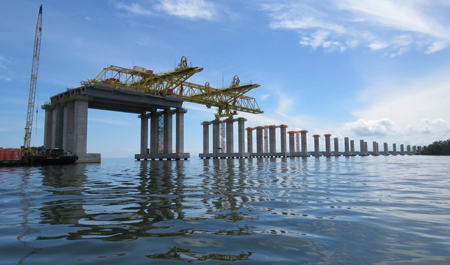
For the Temburong Bridge project, bridge information modelling technology was used to check any possible interference between tendons and rebars near the anchorage and to optimise the girder sections. The company estimates that this has saved about US$8 million through optimisation of both material quantities and work processes, while greatly simplifying the casting and construction work of the viaduct. The original design concept for the marine viaducts proposed use of the precast segmental construction method – a process which is widely used in long bridge construction.
Hundreds of bridges have been built using this method even though the need to avoid joint decompression increases the cost of prestressing and a huge casting yard with efficient logistics is needed to cast and deliver the segments. The precast segmental construction method requires a great deal of in situ work in a marine environment and can have a negative impact on work zone safety and the environment.
Meanwhile, the casting yard is situated quite a distance from the site in Brunei Bay; at its closest, still approximately 15km. At the tender stage, Daelim’s proposal was to minimise superstructure work because of the marine environment, keep the investment cost in machinery for production and erection of the girder as low as possible, and maintain a fast speed of construction to meet the tight construction schedule. As a result, the contractor opted for the full-span girder casting method and chose to develop a pre-tensioned full-span girder design.
Using a full-span girder can significantly reduce construction time and decrease the environmental impact. In fact, full-span precasting can also reduce the size of casting yard required, minimise in situ work in the marine environment and address concerns about the joint between the segments. A bridge alignment with tightly-controlled geometry can also be achieved through full-span precasting.
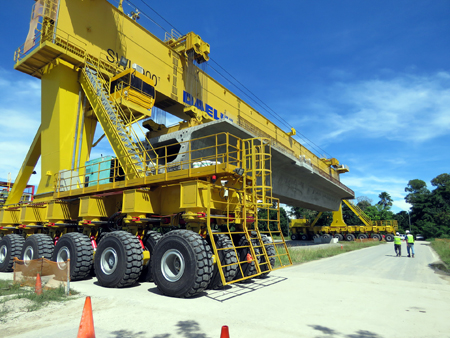
The shallow depth of water in Brunei Bay means that the girders have to be transported by barge and this is done at high tide using a pair of tug boats. The girders are loaded on to a barge by a 900t straddle carrier which can be employed in the casting yard at other times, for example to transport the precast girders from the factory to the stock yard. These barges have been specially designed and built to enable them to accommodate the unbalanced weight of the girder and to be fixed to the pilecaps at the erection locations.
The remaining problem was how to install the delivered girders on the marine structure without the use of any independent machinery such as a heavy floating crane. The seabed in the bay is generally flat and it has a water depth of about 2m except at the navigation channels for the cable-stayed bridges. A further problem to solve was the need to minimise the amount of dredging along the bridge alignment to reduce the construction cost.
After careful investigation of tidal and bathymetric survey data, the dredging depth and width were set as 3.5m and 80m, respectively, along the bridge alignment. However this low limit of dredging depth would still not enable large vessels with heavy machinery to access the site. Hence Daelim decided to develop a self-launching erection gantry capable of lifting and installing two 870t bridge decks simultaneously at the erection location.
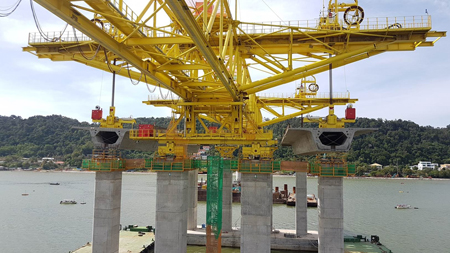
Specialist manufacturer Dorman Long Technology was appointed to supply the erection gantry. Full-span girder erection has been used for many high speed railway bridges and has even recently been used for construction of highway bridges. In these highway projects, new girders were installed by heavy lifting machinery or launching gantries; the girders were delivered by trolley from a pre-installed rear end superstructure.
However for the Temburong project this type of heavy lifting machinery and trolleys could not be used because of the shallow water depth across the entire bridge alignment. A great deal of effort was put into reducing the size and weight of the gantry by Daelim and Dorman Long Technology. After some research and development, this was achieved by balancing the weight of the girders themselves at both sides during girder lifting.
This new type of gantry provides a fast and economical solution for the erection of twin-box marine viaducts, and eliminates the need for delivery of spans over the deck using a transfer gantry or from a casting yard at the end of the bridge. Hence the casting yard can be located anywhere in the region as long as the yard has waterfront access, and the viaduct can be constructed in separate sections without the need to create a continuous line for over-deck delivery.
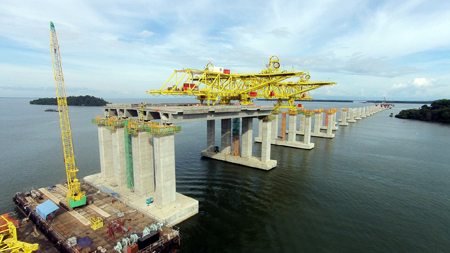
The gantry uses four main strand jacks DL-S588 for lifting, and a number of hydraulic systems for self-launching and gantry operation. The strand jacks incorporate a stroke synchronised slow-bleed lowering system, allowing the two bridge girders to be carefully lowered onto the bearings for a smooth and balance load transfer. The gantry has three legs and uses an innovative launch sequence to avoid placing heavy loads on the deck beams away from the piers when the gantry moves forward to the next span.
This innovative launching gantry has a central system that controls and monitors the lifting strand jacks, the strand-jack transverse and longitudinal movement jacks, the gantry launch jacks and the leg movement winch. The central control system incorporates safety interlocks to prevent unsafe operation of the gantry during precast girder lifting and movement, and during gantry launching.
The first pair of bridge girders was erected at the start of this year, and the gantry is expected to be in operation on the project for the next two years. It is capable of erecting viaduct sections that are up to four decks wide in some places, at an erection rate of one bridge span every two shifts.
Lee Kyoungjae is general manager of Daelim Industrial Company